 Follow Us on Google News
 Follow Us on Google Discover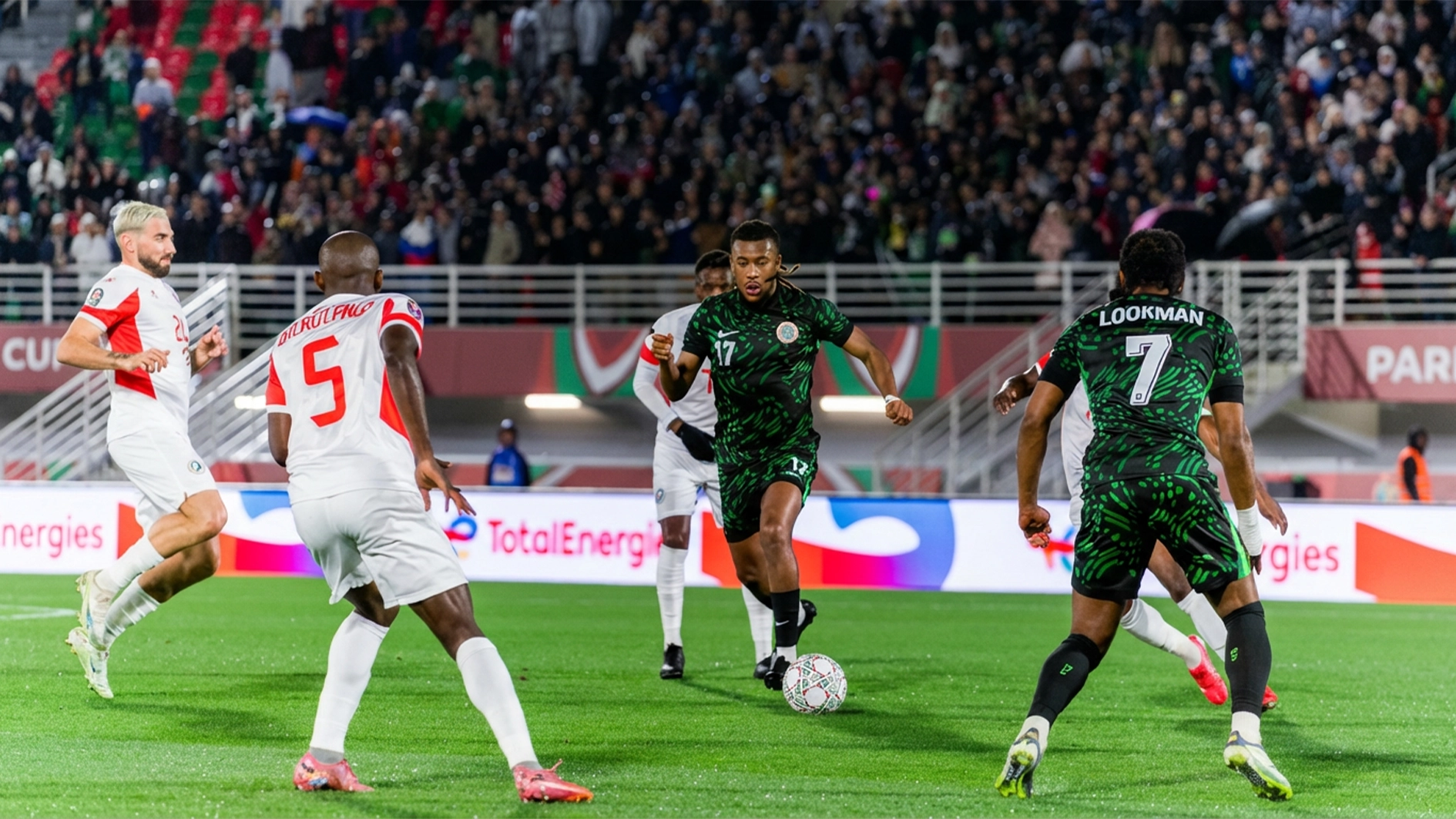
Although the just-concluded African Nations Cup in Morocco was almost marred by ugly scenes on the final day, the championship brought to the fore the continent’s wealth of talent and the many pleasant possibilities that can be realised with the right environment, GOWON AKPODONOR, who was in Morocco, reports.
Football is acknowledged for its power to bring people from diverse backgrounds together, offering joy, peace, hope, love and passion to many who follow their favourite players or teams as they battle for personal and shared glory.
Apart from its entertainment value, football also helps forge friendships, encourages cultural discovery, brings joy to communities, and unites the entire world.
In Africa, football has become one of the biggest tools in the attempt to bring the diverse peoples of the continent together, with the biennial African Cup of Nations, the Confederation of African Football’s (CAF) main tool in bridging the gap between the biggest and richest nations and the poor and less developed nations of the continent.
Every two years, the best of Africa’s youths gather together to showcase their talents in the bid to win the trophy and rank their countries as first among equals in the round leather game. But this quest for greatness sometimes turns ugly, with the win-at-all-costs syndrome threatening to mar what would have ordinarily been the celebration of the continent’s greatness.
On Sunday, January 18, in Rabat, Morocco, the world was treated to a farcical drama that almost ruined what had been one of the best football spectacles in recent times.

World football leaders and lovers of the game from across the globe were scandalised when Senegal walked off the pitch and threatened to abandon the final game of the 2025 AFCON against the hosts, Morocco, claiming that the match arbiters were doing everything possible to ensure that the Atlas Lions won the championship.
The Senegalese were irked that the centre referee Jean-Jacques Ngambo Ndala, from DR Congo, disallowed what they saw as a clean goal in the dying minutes of the game and awarded “an undeserved penalty” shortly after to the hosts.
It took the intervention of Senegalese icon Sadio Mane and some other stakeholders to get the Teranga Lions back on the pitch after over 17 minutes.
Officiating was one of the issues that dogged an otherwise fantastic championship played on world-class facilities provided by Morocco, which is one of the countries hosting the 2030 FIFA World Cup alongside Spain and Portugal.
Perhaps what worked against the championship was the ineffectiveness of the Video Assistant Referee (VAR), which, in other climes, helps referees reach acceptable decisions in times of dispute.
At the 2024 Africa Cup of Nations in Côte d’Ivoire, officiating was at its finest, with CAF’s VAR operation setting standards that many applauded.
But the same technology went to sleep in Morocco, forcing (some say allowing) the referees to misjudge calls, and referees ignoring clear penalties and other infringements- a development that led to conflicts in many of the games.
Some stakeholders dealt several hard knocks to CAF for assigning knockout games to centre referees whose poor performances in the group stage should have led to their being sent home.
The chaos in the final game was the climax of a complaint that trailed games involving Morocco from the quarterfinal against Cameroon, which resulted in the Cameroon Football Federation (FECAFOOT) President, Samuel Eto’o, being banned for four games after criticising referees’ decisions in their 0-2 loss.
Nigeria was also at the receiving end of the alleged bias in favour of Morocco in the semifinal, which the Super Eagles lost on penalties.
Apart from complaints about poor officiating, policing the games is also an aspect of the competition that CAF has not mastered after several years of organising the championship.
These manifested in most of the knockout games involving Morocco, as their fans had unfettered access to their opponents’ goalkeepers’ box.
Many times during the game against Nigeria, Moroccan fans ran onto the pitch to steal goalkeeper Stanley Nwabali’s towel, believing it had the power to stop their team from scoring.
They repeated the same thing in the final against Senegal, with the match warders looking on. The stadium staff even assaulted the assistant Senegalese goalkeeper, who tried to prevent them from stealing the towel. The Moroccan fan regularly pointed a laser light at the eyes of the opponents’ goalkeeper to impair their vision.
Irked by the Moroccan’s attitude to other teams, a Senegalese fan, Elhadj Diop, accused CAF of being handicapped because it has sold the game to the North Africans.
He said that all the teams “that played against Morocco complained about unfair treatment before and during the games, and CAF did not do anything other than fine those who complained.
“If CAF wanted Morocco to win, they should have given them the title directly instead of bringing in 23 other teams just to mark their appearance. What Morocco did to their opponents is not fair, and that’s not how a good host is supposed to do.”
He said that CAF is handicapped by the agreement it has with Morocco to provide facilities and funding to host its women’s and youth championships.
Events on the final day of the championship slowly eclipsed the overall fun and brought a sad end to what had been an otherwise highly entertaining championship. English football analyst, Darren Lewis, one of those who saw things from this prism, particularly condemned Senegal’s coach, Pape Thiam, for ordering his players off the field in the game and also slamming Morocco’s captain, Achraf Hakimi, and fans of the Atlas Lions for “stealing” Senegalese goalkeeper’s towels while play was still on.
Lewis, however, insisted that events of the final day should not be used to tar the whole of African football, which has shown that it has come of age.
He said: “Judging by the clips that went viral on social media and the reactions to them, Senegal doesn’t come out of it with that much credit either for walking off in response to that late penalty award, nor do the referee and his assistants.
“But again, that’s no more a reflection of all of African football than, say, England fans smashing up their own stadium at the final of Euro 2020.
“Are they a reflection of all of European international football? Was the Calciopoli scandal that rocked Italy and left Juventus in Serie B a reflection of all of European club football?
“When Steve Bruce famously marched his Sheffield United players off the pitch during an FA Cup fifth round tie against Arsenal in 1999 at Highbury, was that a reflection of domestic English football?
“You know, sometimes we get hardwired to make sweeping statements in sport. But when we do that, particularly in this case, we are bringing in leagues, clubs, players, officials, and even supporters who had nothing whatsoever to do with what happened in the AFCON final.
“Let’s stop with the idea that the whole thing is a bad look for all of African football. It was a shame for the AFCON final, no doubt. And for Morocco, judging by the clips that went viral on social media and the reaction to them, Senegal doesn’t come out of it with that much credit either for walking off.”
However, the championship was much more than claims of poor officiating and fans’ misconduct. Morocco showed with its pristine pitches and stadiums that an African country can provide the environment for world-standard football.
The stadiums in Rabat, Fez, Marrakech, Casablanca, Tangier, and Agadir host some of the finest football pitches in the world.
It was a great advertisement for the African game and a big example for other countries to emulate in the quest to raise the standard of the continent’s game.
Also, in terms of followership, the championship recorded some milestones in the number of fans that followed it up till the final day.
According to insideworldfootball.com, in France, it was reported that M6’s broadcast of Senegal’s win recorded 3.4 million viewers tuning in. It was the most viewed for the tournament in that country for 18 years. BeIN Sports sub-licensed the match to M6.
More viewers watched than the last tournament in 2023, which only had 793,000 viewers on W9. BeIN also had good numbers, with about 595,000 viewers on average and 756,000 at the peak.
Outside of France, the tournament also garnered viewers. In the UK, Channel 4 showed the whole tournament for free and drew 1.7 million viewers. In Italy, Sportitalia had more than 900,000 viewers on average, especially when things got crazy near the end.
Online, BeIN had more than 800 million video views on social media – 150 per cent more than the last edition of AFCON.
The numbers show that people can’t get enough live football, no matter when or where it’s played.
The 2025 Africa Cup of Nations also showed the possibilities within the Nigerian team, Super Eagles.
To measure the success of a national football team at a major competition like the AFCON and World Cup involves a combination of result-based metrics. These include how far the team went in such competition, its performance, and how well they played, which are often contextualised by pre-tournament expectations.
At the 2023 edition of the AFCON tournament held in Cote d’Ivoire, the Super Eagles made it to the final and lost the trophy to the host country 2-1.
Not many ardent fans gave them a chance of success because the team failed to qualify for the 2026 World Cup in a qualifying group that comprised Rwanda, Lesotho, Zimbabwe, Benin Republic and South Africa. They reasoned that a team that could not pick one of the nine tickets allocated to Africa for the FIFA World Cup, despite being in a “weak group”, did not deserve their support.
But the outcome in Morocco, where the Super Eagles put up a strong performance, forced many Nigerians to fall in love with the team once again.
To many stakeholders, the Super Eagles that campaigned at the AFCON in Morocco were refreshing, going by the emergence of young talent and their increased confidence at the tournament.
Though the Super Eagles lost in the semifinal to the host, Morocco, the majority of the fans are now of the opinion that with more support, the team will return to its pride of place in African football.
Looking at ways to build on the performance in Morocco, 1984 AFCON silver medal winner, Paul Okoku, preached continuity, which entails retaining the present technical crew and building on the present Super Eagles’ squad.
“One of the biggest problems that Nigerian football has faced over the years is the tendency to rebuild from scratch after every tournament, regardless of performance,” the U.S.-based Okoku said.
“The team in Morocco showed balance, resilience, tactical awareness and most importantly, belief. These qualities do not develop overnight. They come from time spent together, clarity of roles, and trust between players and the technical crew. The core of this squad should be preserved, refined, and allowed to mature together rather than disrupted by frequent overhauls,” he stated.
Okoku described the Super Eagles’ performance in Morocco as a foundation rather than a final destination.
He said that, to build on the team’s success, there is a need to have technical stability. “This is non-negotiable. Whether it is the current coaching crew or a future one, Nigeria must commit to a clear football philosophy and give the technical team the authority and time to implement it.”
Edema Fuludu, who was part of the Super Eagles’ squad that won the AFCON title at Tunisia ’94, also harped on the need to build on the team’s performance in Morocco.
“The Super Eagles were a very solid side, particularly in the game against Algeria, as they physically and technically dominated the game. They wanted to win and played to win, with every single player working so hard that the Algerian team was subdued.
“This is the Super Eagles all Nigerians should be proud of, and it amazes me that with so much talent and abilities we took qualification for the football’s biggest event (the World Cup) for granted. This is one team from this present disposition that should be at the World Cup. Unfortunately, the dynamics of the game are such that if you fail to take your chances, you become a game for opponents.”
Like Okoku, Fuludu also wants the authorities to build on the successes recorded in Morocco, saying that the current squad looks similar to the 1994 squad that won the AFCON and proceeded to the World Cup with so much verve and determination as the best team from Africa.

