 Follow Us on Google News
 Follow Us on Google Discover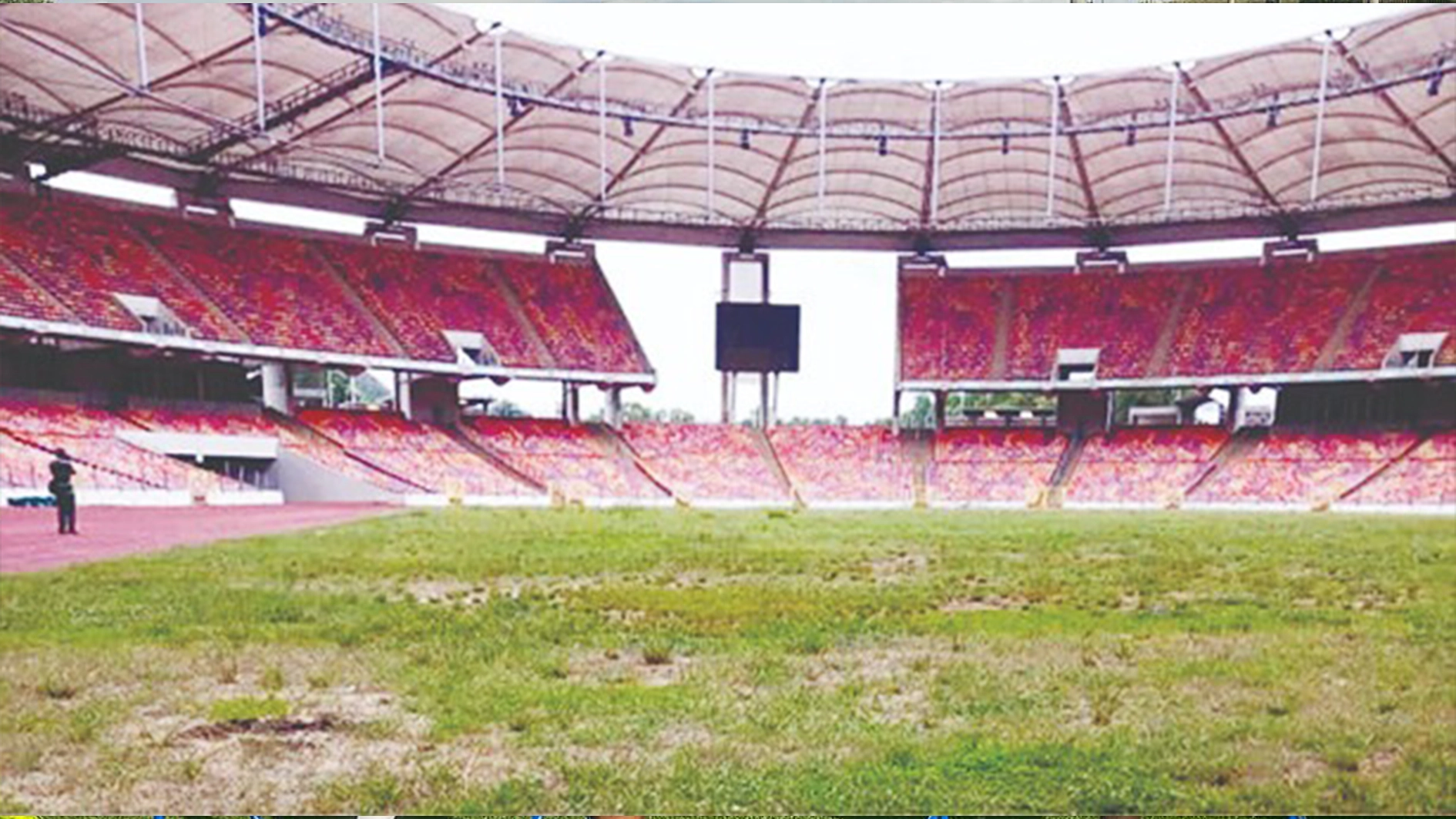
With over 50 stadia in Nigeria, only two have ‘manageable’ playing pitches that can host FIFA/CAF matches. This ugly development has, in many ways, contributed to the poor state of the country’s game. GOWON AKPODONOR reports that several factors that bequeath the country with horrible playing surfaces must be urgently addressed to turn things around.
Countries with a strong football culture place a high value on good playing pitches because they offer significant advantages for players’ safety, performance, and the overall quality of their craft.
They also see quality facilities as a prerequisite for sports development, as they offer practical benefits to the owners. These range from reduced injury rates to increased usage and financial return on investment.
Apart from improving players’ health and safety, having good stadiums, particularly modern 3G and 4G surfaces with shock absorption, reduces the risk of injuries associated with uneven surfaces, mud, or frozen ground. It provides better cushioning, which is gentler on players’ joints and muscles, and also helps prevent problems like slipping on mud or tripping on uneven terrain.
More importantly, a flat, consistent surface allows for smoother ball roll, more accurate, predictable bounces, a quicker, more fluid, high-tempo game, and allows players to showcase their technique.
Quality pitches are essential for young players to develop their techniques, as they provide several opportunities to practice accurate skills without adapting to irregular pitches.

In most cases, having quality pitches, such as hybrid systems with excellent drainage, allows play even after heavy downpours and, in the process, minimises match cancellations.
In Nigeria, many football stakeholders believe that the lack of quality playing turf has diminished the beauty of the game nationwide.
To them, the various national teams are not enjoying the benefit of playing on a specific high-quality pitch, which they say, gives “home field advantage,” as they are accustomed to the surface’s particular speed and bounce.
The stakeholders say teams operating in quality pitches can tailor the pitch size to suit their style of play (e.g., using a larger pitch for a fast-paced game or a smaller pitch to limit opponent space).
In recognition of the important role top quality facilities play in sports development, the Chairman of the National Sports Commision (NSC), Shehu Dikko, while on a tour of the National Stadium, Lagos in January last year, affirmed that the Federal Government was on the verge of revamping all the facilities nationwide to give the national teams, clubs and players different choices in their campaigns.
Dikko frowned at the anomaly that the country has only one CAF-certified stadium in Uyo, which has made it difficult for the country to host international games.
He said: “The NSC is very committed and confident that within the framework of the Renewed Hope for Nigeria’s Sports Economy (RHINSE) programme and indeed the overall Renewed Hope Agenda of President Bola Tinubu, this iconic edifice and several of our national stadiums and other sporting infrastructures across the country will be brought to life through a sustainable PPP and concession programme.”
Other stadiums earmarked for rehabilitation, he said, include the MKO Abiola Stadium, Abuja; Ahmadu Bello Stadium, Kaduna; Tafawa Balewa Stadium, Bauchi; Obafemi Awolowo Stadium, Ibadan; and Nnamdi Azikiwe Stadium, Enugu.
He said that the NSC has been empowered by President Tinubu’s significant increase in the budget allocation for the sports sector from N29 billion in 2024 to over N94 billion in 2025, representing a 227 per cent increase.
But one year down the line, nothing seems to have changed. Worse still, the Godswill Akpabio Stadium, Uyo, which has been the only FIFA-recognised facility serving the entire country, is losing its shine due to overuse. Stakeholders fear that it may go the way of the other facilities if urgent steps are not taken to halt the decline.
Delta State has the most stadiums in Nigeria. In 2006, when CAF increased the number of host venues for the Africa Women Championship (AWC) from two to four, the then Delta State Governor, James Ibori, delivered four stadiums in Oghara, Warri, Ughelli and Oleh to host the event.
He later constructed more facilities at Ozoro, Kwale, Agbor, and Ogwashi-Uku, while the administration of Dr Emmanuel Uduaghan and Dr Ifeanyi Okowa added the Sapele and Asaba stadiums, respectively.
Sadly, the playing turf of all the stadiums is completely dead today, forcing the state’s football team, Warri Wolves FC, to play their Nigeria Professional League matches at the university stadium in Oleh.
The country’s dilemma is compounded by the penchant of some states to build artificial pitches that are not recognised by FIFA or the African football governing body, CAF, due to the threat these hard surfaces pose to players.
The appeal of these artificial turfs is that they are more durable and easier to maintain, as they do not require constant nurturing, unlike a FIFA-approved grass pitch, which requires special care.
The major problem is that some of those taking to the artificial pitch do not know FIFA’s stance on it.
For instance, shortly before he vacated office in 2023, former Governor Okezie Ikpeazu of Abia State renovated the Enyimba stadium with over N800 million to enable the team to use the venue for their continental games. But the arena was promptly rejected by CAF’s inspection team, which said the pitch fell short of the required standard for continental games.
Sometime last year, Remo Stars also fell into that hybrid pitch trap, and CAF advised them to look for an alternative pitch for their Champions League games.
The MKO Abiola Stadium in Abeokuta was recently granted limited approval to host international matches of certain categories.
Last month, the Nigeria Football Federation (NFF) was forced to change the venue of the 2026 FIFA U-20 Women’s World Cup third-round, first-leg qualifier between Nigeria and Senegal from Ibadan to Abeokuta.
While announcing the sudden change, the NFF’s Director of Competitions, Ruth David, said it was due to the deteriorating state of the playing pitch at the Lekan Salami Stadium, Ibadan, which the Oyo State government not long ago spent over N5.5bn to fix.
The Lekan Salami Stadium, popularly known as Adamasingba Stadium, was earlier approved for the Nigeria versus Senegal tie. The complex actually hosted the Falconets’ second-round, second-leg clash with the Rwanda U20 girls in September last year.
This indictment of the Ibadan stadium drew wide criticism from many football-loving Nigerians, who believe that the country’s football has been floundering because talented players have no space to hone their skills.
Former Super Eagles midfielder, Edema Fuludu, said having good pitches is key to quality football.
“For competitive football, the pitch has to meet standard requirements, which vary from clime to clime,” Fuludu said. He added: “Good pitches play key roles, including giving optimal control of the ball, receiving a pass, retaining a pass and releasing a pass.
“It also improves coordination of players’ technical abilities, improves execution of agility, speed, balance and coordination. Good pitches also reduce the risk of injuries such as sprained ankles, knees and other joints,” he stated.
“While Europe, for example, has advanced technologically in planning and preparing football pitches for optimal benefit of the game and overall performance of players, Africa is struggling, save for countries like Morocco, South Africa, Tunisia and Egypt.
The vast majority of the 54 CAF members are far behind in providing standard facilities.
“I was in Kigali, Rwanda, recently as a FIFA Coach Educator for my Assessment practice with four other Nigerian colleagues, and I noticed that even as organised and likeable as the country is, investment in good football fields is also lacking, just like the majority of the African countries in the West, East and Central Africa.
“Our assessment practice, which was initiated and supported by the Nigeria Football Federation (NFF), is a big window for coaching development in Nigeria. FIFA is indeed looking up to Nigeria to lead the way in Africa, and it is up to us,” he stated.
Fuludu, a member of Tunisia ’94 AFCON-winning squad, said that bad pitches have a history that is as long as Nigerian football.
Nigerian-born FIFA facility expert and Chief Executive Officer of Monimichelle Sports, Ebi Egbe, said that Nigeria’s football ecosystem, especially the Nigerian Premier Football League and the Nigerian National League, cannot rise on failing pitches.
“This has been Nigeria’s weak point for many decades,” he said, adding: “Across the country, football surfaces continue to fail players, clubs, broadcasters, and regulators due to weak substructures, poor drainage, outdated turf technology, and maintenance gaps.
These are not minor defects, but performance barriers holding Nigerian football back.”
Egbe blamed the Super Eagles’ failure to secure one of Africa’s nine automatic tickets to the 2026 World Cup on the poor state of the turf in Nigeria.
“It would be wrong for anybody to expect the players, most of whom are coming from Europe, to be at their best when they play on a pitch that belongs to the 19th century.
“Unfortunately, virtually all the pitches that we have in this country today, except for just a few, are bad.”
Super Eagles defender, Ola Aina, recently told OwnGoalNigeria.com that the lack of a proper playing surface is a bigger hindrance to Nigeria’s quest to dominate African football.
“One big problem we face in Nigeria is the lack of proper playing surfaces. If we can get at least ten good pitches where we can play, train and play our games at home, we will be unbeatable. If you remember, we won all our away games during the World Cup qualifiers but struggled at home. It is the playing surface. Alex Iwobi complained about it, and he is very correct.
“We will beat almost any team in Africa and probably the world if we get good pitches in Nigeria because the team is loaded with talent. All we need is a better surface to express ourselves,” Aina said.
NSC Chairman, Dikko, while speaking to The Guardian recently, said that the Abuja National Stadium would be the starting point of the ambitious project, with Ibadan, Kaduna, Lagos and Uyo also slated for upgrades.
“Abuja Stadium will receive a pitch of the same quality and technology used in Morocco for the Africa Cup of Nations,” Dikko said.
He noted that Nigeria could have been the first African country to install such advanced pitch technology, but procedural requirements delayed the process.
Outlining the phased approach to the renovation, the NSC chairman said Abuja will lead the way before attention shifts to other key venues.
“Abuja will start, and Kaduna, Ibadan and Lagos will follow. We will work with state governments to put life into their stadium pitches. Even Uyo might change,” he said.
However, April is approaching, and there is no sign of any company working to bring playing pitches back to life.

