 Follow Us on Google News
 Follow Us on Google Discover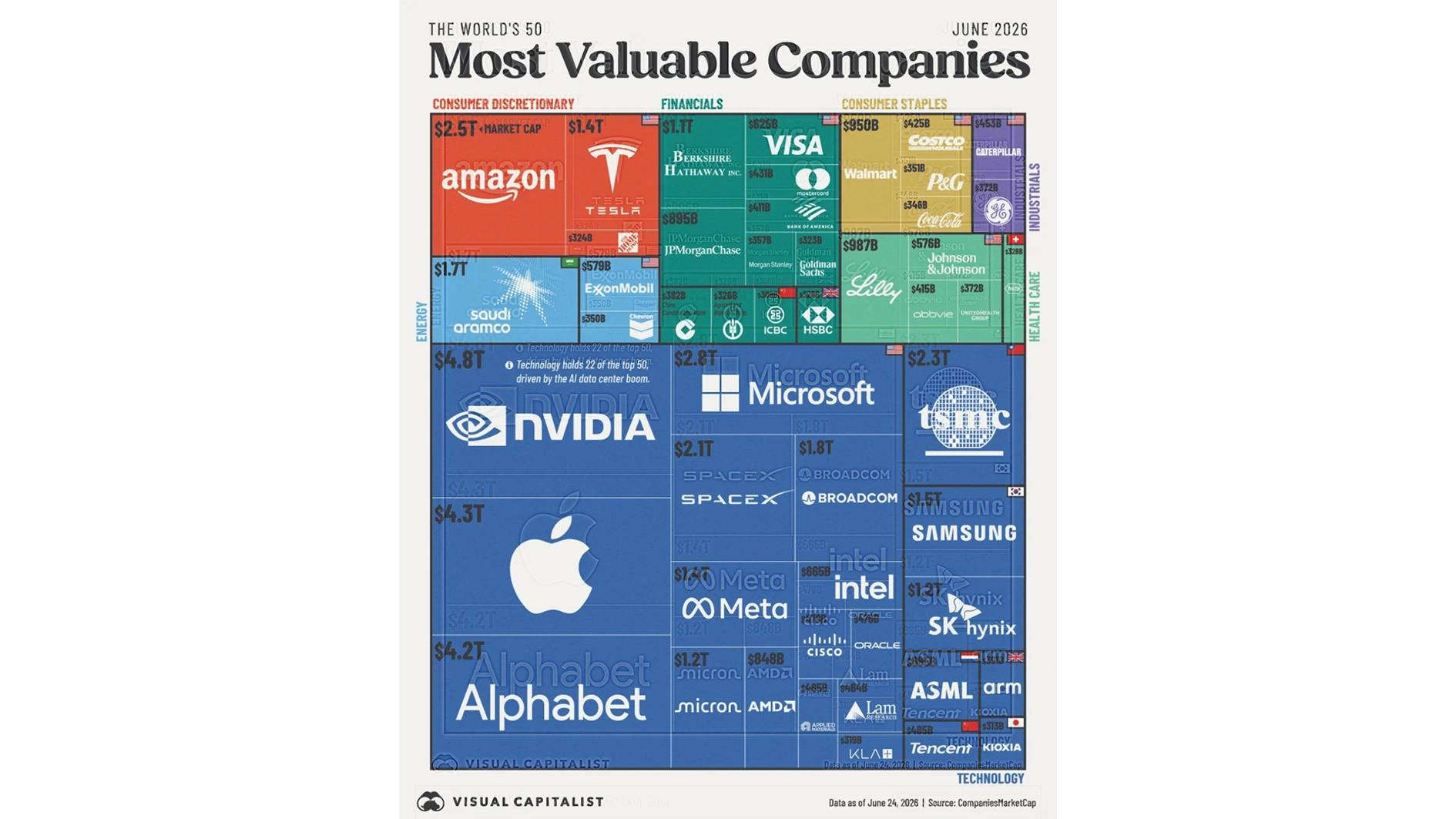
Technology firms have revalidated their dominance in the global economy, sweeping the latest ranking of the world’s 50 most valuable companies as of June 2026.
The list, compiled by CompaniesMarketCap and visualised by Visual Capitalist, showed that tech giants now account for nearly half of the world’s corporate heavyweights, underscoring the sector’s unrivalled influence in shaping markets and innovation.
At the top of the chart sits NVIDIA, whose meteoric rise on the back of the artificial intelligence boom has propelled its market capitalisation to an astonishing $4.8 trillion. Close behind are Apple ($4.3 trillion) and Alphabet ($4.2 trillion), both continuing to thrive on consumer ecosystems and digital advertising dominance. Microsoft, long a cornerstone of enterprise software, holds a commanding $2.8 trillion valuation, while TSMC ($2.3 trillion) and SpaceX ($2.1 trillion) highlight the growing importance of semiconductor manufacturing and space technology.
The rankings revealed that 22 of the top 50 companies belong to the technology sector, dwarfing representation from traditional industries such as energy, finance, and consumer staples. This surge is largely attributed to the AI data centre boom, which has fuelled demand for chips, cloud infrastructure, and advanced computing power. Firms like Broadcom ($1.8 trillion), Micron ($1.2 trillion), SK Hynix ($1.2 trillion), and AMD ($848 billion) have ridden this wave, transforming once niche semiconductor players into trillion-dollar titans.
By contrast, sectors that historically dominated global markets now play a supporting role. Saudi Aramco ($1.7 trillion) remains the largest energy company, but its valuation trails several tech firms. Financial giants such as JPMorgan Chase ($895 billion) and Berkshire Hathaway ($1.1 trillion) continue to wield influence, yet they are overshadowed by the sheer scale of technology valuations. Consumer staples leaders like Procter & Gamble ($987 billion) and Walmart ($950 billion) remain resilient but are far from the trillion-dollar club that tech companies increasingly define.
The data paints a clear picture: technology is not just a sector, it is the engine of global corporate value. From AI and semiconductors to cloud computing and digital platforms, tech firms are rewriting the rules of economic power. As industries from healthcare to finance lean ever more heavily on digital infrastructure, the dominance of these companies is likely to deepen, raising questions about regulation, competition, and the future balance of global markets.

In 2026, the world’s corporate hierarchy is unmistakably tilted toward Silicon Valley and its global counterparts. The age of oil and banks has given way to the age of algorithms, chips and data.

