 Follow Us on Google News
 Follow Us on Google Discover
The Muslim Public Affairs Centre (MPAC) has strongly criticised the recent visit of a United States congressional delegation to Nigeria, accusing it of engaging in what it described as “sectarian, unbalanced, and troubling” consultations during its stay in the country.
In a statement released on Tuesday, December 9, 2025, MPAC said the delegation, which was in Nigeria for a series of security-focused meetings with government officials, failed to conduct itself with the neutrality expected of foreign partners. According to the organisation, while the group held several high-level security discussions, at least one member of the delegation went out of his way to prioritise meetings with Christian and traditional leaders, completely excluding major Muslim institutions and communities.
MPAC highlighted comments made by U.S. lawmaker Riley Moore, who wrote on X (formerly Twitter) that he came to Nigeria “in the name of the Lord.” Moore also described his meetings with Catholic bishops Wilfred Anagbe and Isaac Dugu, as well as His Royal Highness James Ioruza, the Tiv traditional ruler, as “deeply moving”. He further referenced ongoing violence in Benue State, repeating allegations of a “genocidal campaign” by Fulani groups.
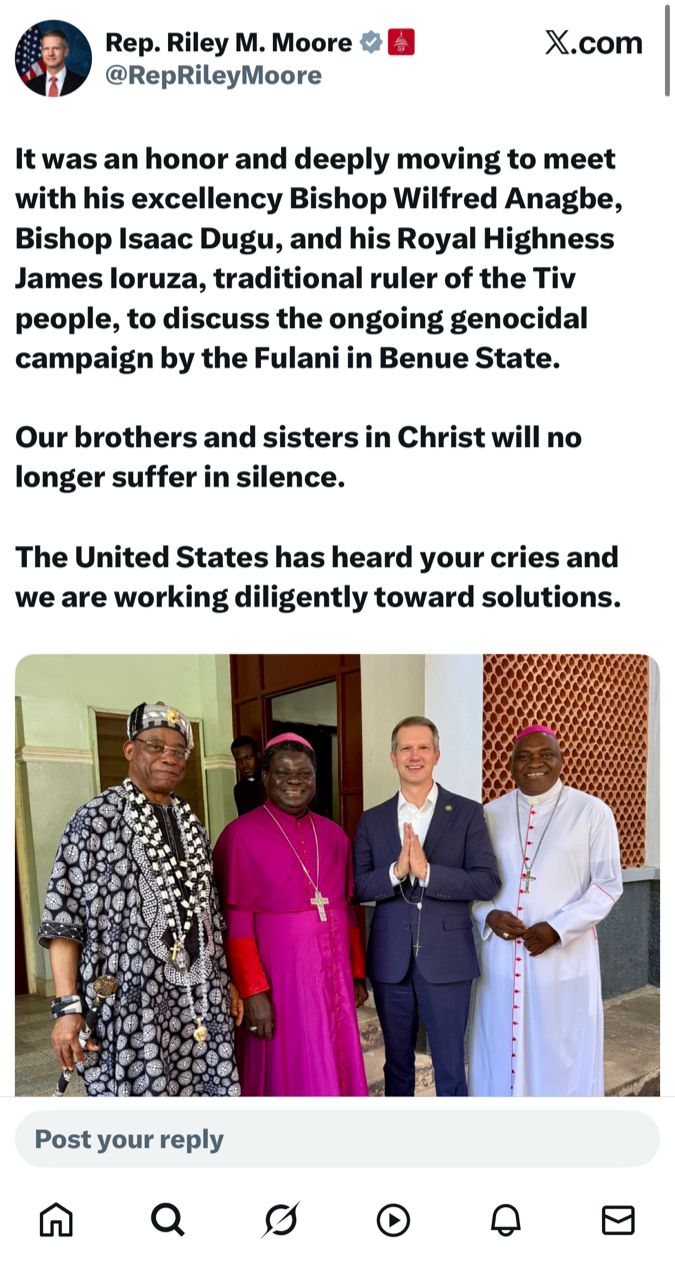
The organisation said Moore’s actions and public statements were not accidental, but a calculated attempt to amplify a particular religious narrative. It noted that the lawmaker “found time” to meet Christian leaders and the representative of the Pope in Benue. At the same time, the entire delegation avoided the Nigerian Supreme Council for Islamic Affairs (NSCIA), the umbrella body for the country’s Muslim population.
According to the statement, the delegation also failed to visit Muslim communities affected by violence or speak with Muslim victims, whose stories form a crucial part of the country’s security and humanitarian challenges. MPAC argued that such omissions cast doubt on the delegation’s neutrality and the credibility of any assessments it hopes to make about Nigeria’s complex security landscape.
The organisation questioned how any delegation seeking an objective understanding of Nigeria’s religiously mixed society could “intentionally cut off communication” with one of its largest religious communities. It said the avoidance of Muslim voices while embracing Christian leadership suggests “partisanship, an agenda, and influence from extreme religious lobbies in the United States”.

MPAC warned that Nigeria must guard against becoming “a playground for imported prejudice or religiously skewed foreign policy”. It expressed concern that selective engagement by powerful international actors could inflame suspicion between Muslims and Christians, undermine peaceful coexistence, and embolden actors who promote division.
The organisation pointed to what it described as a dangerous emerging pattern: selective listening, selective engagement, and selective outrage from some foreign observers. MPAC said such behaviour could further damage trust in international partnerships, especially those involving security and humanitarian support.
It also raised critical questions: why the NSCIA was excluded, why Muslim victims of violence were ignored, and what safeguards exist to ensure U.S. policy on Nigeria is not shaped by extremist religious lobbies abroad.
MPAC concluded by calling for fairness, respect, and balanced engagement from all international partners. It said Nigerian Muslims deserve to be heard and represented, and that any credible assessment of the country’s challenges must include all communities.
The organisation reaffirmed its commitment to speaking out against injustice and promoting peace, urging global actors to approach Nigeria with the neutrality and moral responsibility its context requires.

