 Follow Us on Google News
 Follow Us on Google Discover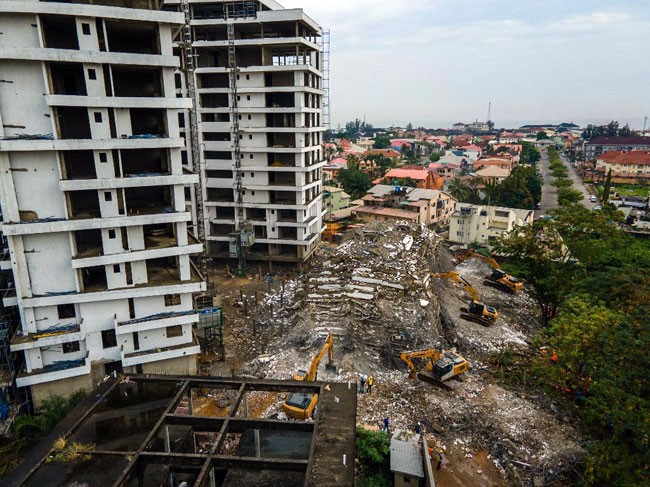
To curb the incidents of building collapses, the Federal Government inaugurated an expanded Ministerial Task Team aimed at finding lasting solutions, which experts said were overdue. BERTRAM NWANNEKANMA reports that six months after this groundbreaking event, buildings continue to crumble to the dismay of many professionals in the built environment.
Recurring incidents of building collapses in Nigeria have remained a monstrous reality in the country’s built environment. Each incident reopens old wounds, deepening a tragedy earlier forewarned.
While the first recorded building collapse took place in October 1974 in Oyo State when a multi-storey building caved in due to excessive loading, resulting in 27 deaths, about 1,621 people have died in 658 building collapses in 50 years.
The most disastrous of the incidents occurred on November 1, 2021, when a 20-storey building under construction collapsed in Ikoyi, Lagos, claiming 52 lives, including the developer.
Since that incident, various initiatives have emerged to change the narrative, including the introduction of the Certified Accreditors Programme (CAP) by the Lagos State government through the Lagos State Building Collapse Control Agency (LASBCA), which allows professionals to participate in mitigating the malaise.
However, since November 2021, Nigeria has recorded 206 building collapses, with Lagos alone accounting for about 64 of these incidents.
Also, a total of 273 deaths have been recorded nationwide from subsequent building failures, including 83 in Lagos State alone, a stark reminder of the worsening crisis.
In 2025, 18 incidents have been recorded so far, with the first in Rivers State on January 4. Lagos leads with nine, Ekiti has two, Anambra, Yobe, Rivers, Ogun, Oyo, and Taraba each have one.
The outlook for the recorded building collapse incidents in Nigeria from October 1974 to June 17, 2025, shows that Lagos has 363 cases, Abuja has 28, Anambra, 27; Oyo, 23; Kano, 21; Rivers, 18, Ogun, 17; Delta, 16; Ondo, 13; and Abia State recorded 12, while Enugu and Plateau states both recorded 11 among others totalling 658 cases with 1,621 deaths.
Not even the recent Federal Government’s inauguration of an expanded Ministerial Task Team on June 18, 2025, to address the alarming rate of building collapses has yet offered any remedy.
This was reinforced by the ugly incident on Tuesday, October 28, 2025, at No. 43/45, Coates Street, Oyingbo, Ebute-Metta, Lagos, that left two individuals dead.
Every new building collapse is a dirge in the advocacy expedition of the Building Collapse Prevention Guild (BCPG).
The task team, comprising representatives from key professional bodies and regulatory agencies in the built environment, as well as experts from the ministry’s technical departments, was formally inaugurated in Abuja.
Agencies represented on the task team include the Architects Registration Council of Nigeria (ARCON); Council for the Regulation of Engineering in Nigeria (COREN); Quantity Surveyors Registration Board of Nigeria (QSRBN); Town Planners Registration Council (TOPREC); Surveyors Council of Nigeria (SURCON); Estate Surveyors and Valuers Registration Board (ESVARBON); Council of Registered Builders of Nigeria (CORBON), and the Building Collapse Prevention Guild (BCPG), represented by its pioneer president, Kunle Awobodu.
The Minister of Housing and Urban Development, Ahmed Musa Dangiwa, who inaugurated the Ministerial Task Team, decried the increasing frequency of building collapses, describing them as “avoidable tragedies” and a “national embarrassment.”
“These incidents have resulted in the painful loss of lives, permanent disabilities, destruction of property, and psychological trauma. It is unacceptable, and this administration is determined to bring it to an end,” he said.
The newly expanded task team was tasked with reviewing the 18 recommendations of the previous committee and proposing phased, actionable strategies for implementation. It will develop a comprehensive roadmap to address technical, systemic, legal, and institutional challenges linked to building collapses.
Additionally, the task team will propose national legislation to enhance federal oversight of building construction, create a compliance checklist and framework for regulatory and professional bodies, and promote accountability by ensuring strict adherence to standards and ethics.
The inauguration was a culmination of a motion on building collapse that was moved on the floor of the Senate in Abuja on Tuesday, July 4, 2023.
Senator Abubakar Sadiku Okere, representing Kogi Central, presented the urgent need to curb the incessant cases of building collapses, bridges, and infrastructural facilities in Nigeria.
In the motion, the Senate requested that the Federal Government explore the modalities for liaising with stakeholders in the construction industry to address the factors that necessitate affordability and quality challenges in reinforcement materials.
However, stakeholders expressed concerns about the team’s composition, arguing that it excluded important professionals in the built environment, such as structural engineers and quantity surveyors.
To reinforce the task team for maximum effect, the immediate past president of the Nigerian Institution of Structural Engineers (NIStructE), Johnson Adeyoye, called for the inclusion of structural engineers in the task force team, which he said has been taken up by the president of the Nigerian Society of Engineers (NSE).
Lamenting the increasing frequency of building collapses across the country, he called for the employment of qualified professionals in critical roles.
Adeyoye commended COREN for recognising the vital role of structural engineers in the built environment and for gazetting the Regulation of Structural Engineering Practice into law.
He stressed the need for stricter enforcement of professional standards and alignment with global best practices, stating, “Only COREN-registered and NIStructE-certified structural engineers should design and supervise the construction of multi-storey buildings and other major structures in Nigeria.”
Also, the Chairman of the Lagos State Chapter of the NIQS, Rilwan Balogun, lamented the exclusion of quantity surveyors, emphasising their roles in ensuring detailed bills of quantities and specifications for materials and workmanship.
He advised the government to prioritise bills of quantities when granting building approvals to determine the estimated cost of completing a building before approval is given.
For the Permanent Secretary, Lagos State Ministry of Urban Development, Gbolahan Oki, there is a need for stronger partnerships between government and professionals in the built environment to curb unethical practices.
Raising concerns about the situation, members of the BCPG Lekki Cell identified the lack of official investigation into collapsed buildings as a reason for recurrence.
According to them, the collapse of buildings in Lekki in quick succession, without an official investigation into the causes, portends a serious danger of recurrence.
The Coordinator of BCPG Lekki Cell, Wunmi Agbaje, and the General Secretary, Godfrey C. Godfrey, catalogued a series of interventions made by the guild, which were rejected by the government and its agencies.
Stressing that the lack of consequence begets impunity, BCPG Lekki Cell stated that such inaction on the part of the government could be interpreted as deliberate protection of culpable individuals.
The guild reiterated that unravelling the cause(s) of building collapse and implementing the recommendations will help prevent future building collapses of a similar nature.
They highlighted the need for policy implementation and official investigations to forestall future tragedies, describing the recent collapse of the three-storey building with three suspended floors under construction for a fourth storey on Saturday, April 19, 2025, as a blow to their collective conscience.
The BCPG emphasised that the pain and regret within the guild became more profound after eight bodies were recovered and 20 people sustained injuries.
According to the guild, the fact that this collapse and its accompanying loss of innocent lives were preventable has deepened the emotional wound inflicted on its members.
Also, the BCPG Ikoyi-Obalende Cell urged government agencies to consistently and transparently enforce building codes to curb the rising number of building collapses across the country.
Its coordinator, Bola Arilesere, and secretary, Adebola Adeyera, lamented that since the collapse of the 20-storey building in Ikoyi four years ago, a total of 273 deaths have been recorded nationwide from subsequent building failures, including 83 in Lagos State alone, a stark reminder of the worsening crisis.
They noted the significance of November 1 in Nigeria’s built environment calendar, as it marks the anniversary of the tragic collapse of the high-rise building on Gerrard Road, Ikoyi, which occurred on November 1, 2021, raising urgent questions about construction standards, professional oversight, and regulatory enforcement.
According to them, last year, to mark the third anniversary of the collapse, the BCPG Ikoyi-Obalende Cell convened a virtual meeting of stakeholders from the construction and built environment sectors.
The gathering served as a reflection on the lessons from the Gerrard collapse, highlighting the consequences of neglecting professional standards, cutting corners, and the weak enforcement of building regulations.
They reiterated the importance of professional supervision, adherence to approved designs, quality control in materials, and strict compliance with building codes to prevent future disasters.
It stated that the message from the collapse remains valid four years later, with an even greater sense of urgency. According to the guild, the continued frequency of such incidents shows that the systemic issues exposed by the Ikoyi tragedy have not been adequately addressed.
To reverse this trend, they said: “Developers must prioritise safety over cost-cutting, professional bodies must strengthen monitoring and accountability, and communities and clients must insist on qualified, licensed professionals at every stage of construction.
“Nigeria has the expertise, capability and knowledge to build safely. What is needed now is the collective will to ensure that safety, professionalism and integrity are upheld without exception.
The memory of the Gerrard collapse must continue to drive reforms that protect lives, safeguard cities and uphold the dignity of the built environment,” they added.
Cataloguing the way forward, a member of the ministerial task team, Awobodu, urged the government to expedite action on building condition surveys that include structural appraisal of existing buildings, especially buildings erected by uncertified developers.
Awobodo, the pioneer National President, Building Collapse Prevention Guild (BCPG), and Past National President, Nigerian Institute of Building (NIOB), also advocated that the price of non-destructive tests should be made affordable.
According to him, the government should provide transit camps or temporary relocation shelters for occupants of distressed buildings. Deconstruction or demolition of structurally distressed buildings must not be delayed.
He said: “The government needs the essential political will to overcome influence peddling and sentiments that do arise in the process of building demolition decisions and their execution. The importance of insurance cannot be overemphasised, considering the need to provide compensation for victims of collapsed buildings. Developers should be encouraged to register with the federal government-initiated Real Estate Developers Association of Nigeria (REDAN) and get examined for proper accreditation. Most importantly, buildings must be constructed correctly from the outset because preventing failure is far easier and cheaper than managing collapse,” he said.
Awobodu also called for a change in people’s negative attitude towards compliance, which will make the robust extant building regulations less undermined during implementation.
“When the pendulum of the distressed building swings between demolition and renovation, the regulators must overcome inertia and be decisive. Compliance must cease to be negotiable. Building regulations, no matter how well written, are meaningless unless society respects them. We cannot plaster over structural decay. We cannot paint away danger. We cannot continue to bury citizens from preventable tragedies. Until we confront this reality, the ground beneath us will continue to betray us. Lives will continue to be lost – not to fate, but to negligence disguised as renovation,” he added.

