 Follow Us on Google News
 Follow Us on Google Discover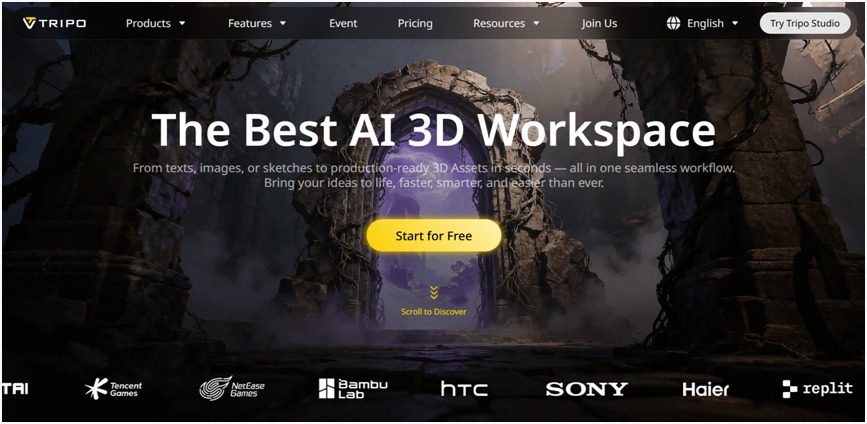
For years, the process of creating 3D assets has been synonymous with specialized skill sets, costly software licenses, and high-performance computing. Even for experts, the journey from concept to final model often involves navigating a disjointed series of applications—each dedicated to a single task like sculpting, retopology, UV mapping, or rigging. This fragmentation not only consumes valuable time but also interrupts creative momentum, transforming artistic exploration into a technical marathon.
Tripo Studio emerges as a solution to this longstanding challenge. Functioning as a comprehensive AI 3D model generator, it redefines asset creation by consolidating traditionally separate stages into a single, fluid workflow—drastically reducing complexity while ensuring the creator retains complete artistic control.
Why Modern Projects Demand a Tool Like Tripo
An indie game developer captured the shift perfectly: “What used to take a week of jumping between five different programs now takes an afternoon in one cohesive environment. The biggest change isn’t just speed—it’s the ability to maintain creative focus without constant technical interruptions.”
Tripo AI fundamentally broadens access to 3D generation by both expanding the pool of who can create and dramatically accelerating how ideas become tangible assets. Complex tasks that once demanded meticulous manual effort—such as designing intricate product forms or unique stylized characters—can now be initiated almost instantaneously through intelligent, guided creation.
Whether used by seasoned artists to elevate their throughput or by entrepreneurs and marketers with clear visions but no 3D modeling degree, this AI 3D model generator establishes a more direct bridge from imagination to usable asset. Below, we detail how creators are leveraging Tripo to transform concepts into finished 3D content—more rapidly, with fewer constraints, and with greater creative freedom.

Foundational Features Powering Your Efficient 3D Pipeline
To support creators from initial idea to final export, Tripo integrates several core capabilities designed to streamline production and minimize technical hurdles.
Image to 3D Model
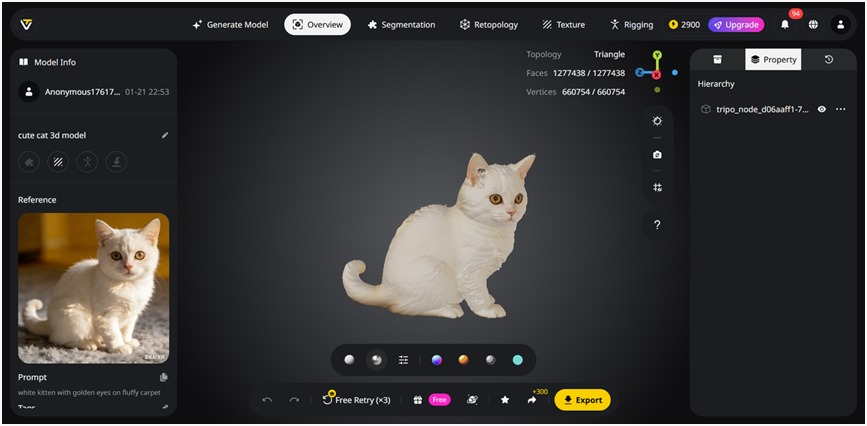 Have a photograph, a sketch, or a digital render that you wish to bring into the third dimension? Tripo’s robust 2D image to 3D model capability allows you to generate a three-dimensional asset from a single reference image. Simply upload your picture, and within minutes—often seconds—you receive a reconstructed 3D model. The image to 3D model feature produces a clean, well-structured mesh that faithfully captures the form and proportions of your original image, providing an excellent foundation for further detailing, texturing, or integration into larger scenes.
Text to 3D Model
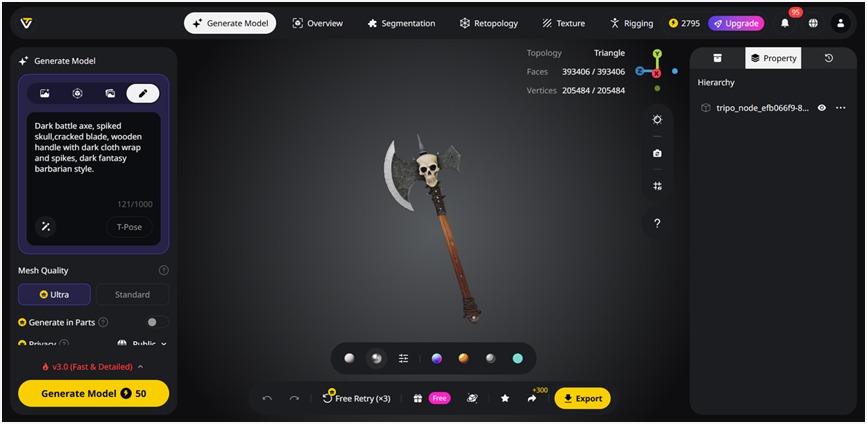 Have a concept in mind but lack a visual reference, or simply want to explore how a written description might translate into form? Tripo’s text to 3D model feature interprets descriptive language, turning phrases into fully realized 3D models in moments. The generated assets come with organized topology and clean geometry, making them immediately suitable for editing, animation setup, or use in downstream applications, thereby revolutionizing the initial stage of 3D generation.
AI Model Segmentation
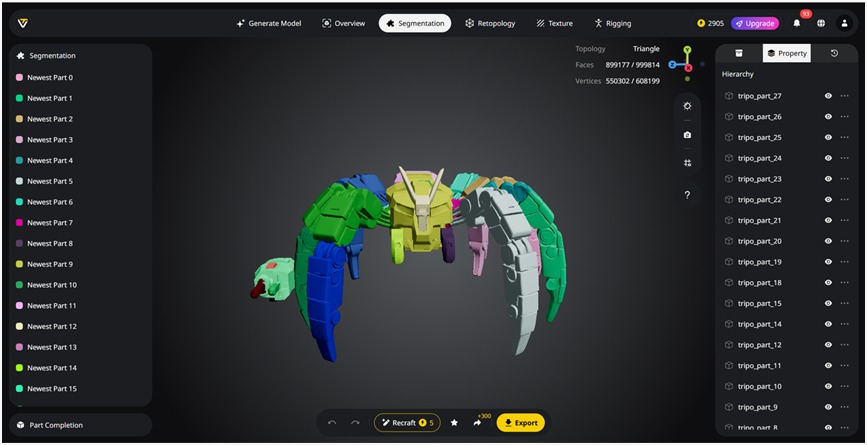 Precise control over model components is crucial for professional results. Tripo’s AI Model Segmentation automatically breaks down complex models into logical, individually editable parts. This allows creators to modify, combine, or enhance specific sections without affecting the entire asset. The process maintains clean topology and clear grouping, significantly simplifying tasks like part replacement, detailed sculpting, or preparation for animation. Once segmented, components can be exported separately for use across various projects or workflows.
Smart Retopology
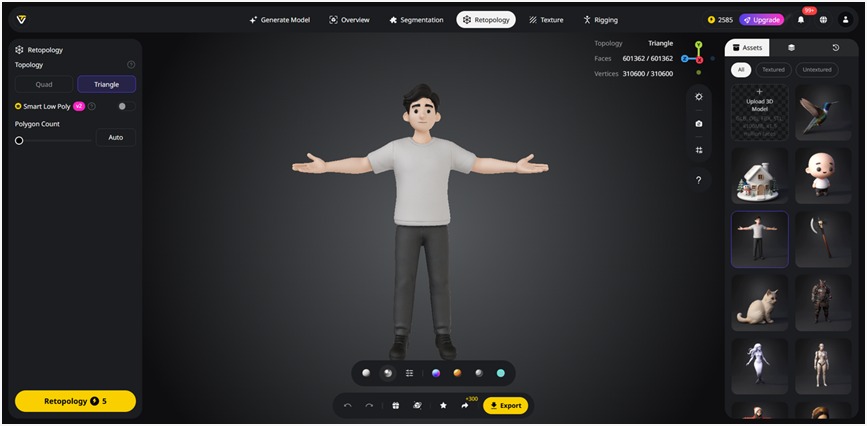 Smart Retopology addresses one of the most time-consuming and technical stages of 3D production: creating an efficient, animation-ready mesh structure. Rather than treating retopology as a separate, final cleanup step, Tripo bakes it directly into the creation process. Users can preset their topology preferences—such as quad-dominant or triangle-based layouts, or optimized Smart Low Poly meshes—ensuring assets are structurally sound from the moment of generation.
When project requirements change, retopology can also be applied to existing models. Powered by AI-driven geometry analysis, the system intelligently rebuilds meshes to reduce polygon count while preserving critical shape and detail. This flexibility lets creators easily adapt a single model for diverse applications, from high-fidelity cinematic renders to lightweight assets for real-time engines, without manual remodeling.
AI Texturing with Magic Brush
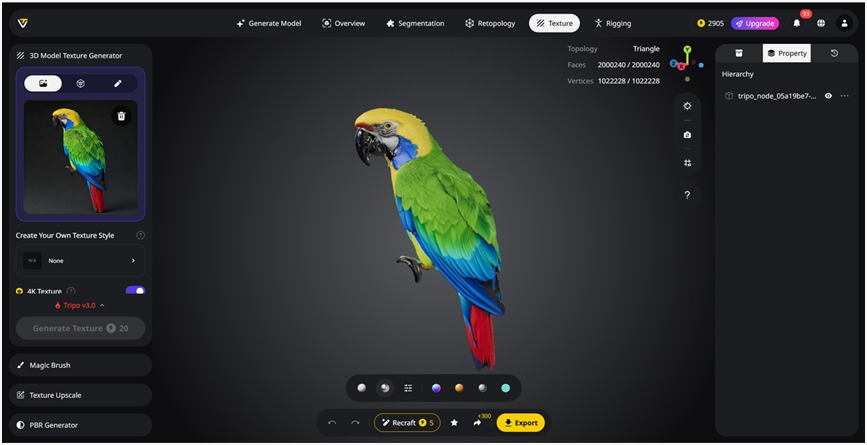 Within this integrated AI 3D model generator, the AI Texturing with Magic Brush feature transforms bare meshes into visually rich, render-ready objects in seconds. A one-click global texturing function applies consistent materials, colors, and styles across the entire model, while AI upscaling generates high-resolution textures with sharp details. For targeted refinements, the Magic Brush allows for precise texture edits through intuitive brushing—fixing imperfections, changing the color of specific areas, or adding wear and tear without redoing the entire texture set. The system exports industry-standard PBR maps (Base Color, Normal, Roughness, etc.), ensuring seamless compatibility with all major rendering and game engines.
Auto Rigging
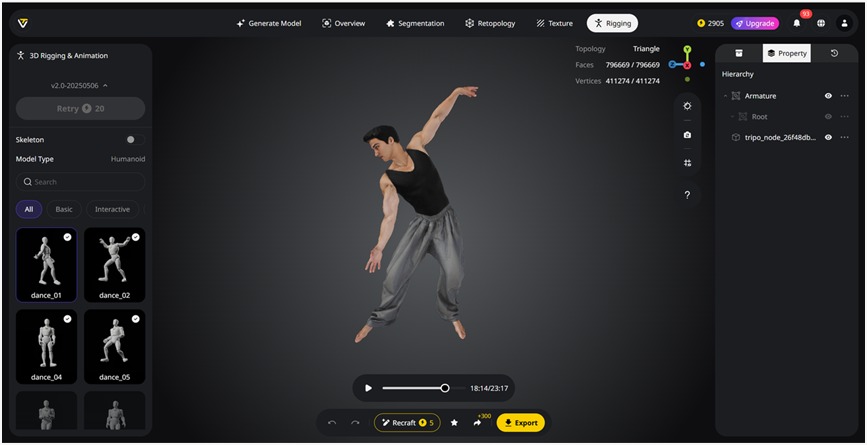 The AI-powered auto rigging system converts static meshes into animation-ready characters by automatically generating clean skeletons and deformation rigs. It intelligently identifies joint placements and bone structures for humanoids, creatures, and stylized figures, eliminating the need for manual joint placement.
AI-driven skinning assigns accurate skin weights to ensure smooth, natural movement, removing the tedious process of weight painting. Rigged models can be exported in universal formats like FBX, GLB, or OBJ, making them instantly usable in tools such as Blender, Maya, Unity, Unreal Engine, and Mixamo.
Recent updates have further enhanced animation workflows with a growing library of motion-capture-quality animations and features like Lock Frame, which allows users to freeze an animation at any pose and export it as a static model—ideal for creating rapid previews, keyframe poses, or preparing models for physical fabrication.
Strategies for Maximizing Efficiency
Combine Generation Methods for Complex Creations
For intricate projects, layering Tripo’s features yields the best results. Start with text to 3D model to block out the primary form, then use image to 3D model to add specific, detailed components based on reference images. Assemble and refine everything within Tripo Studio’s unified environment to ensure visual and topological consistency across all parts.
Utilize API Access for Batch Production
In studio or enterprise settings, API integration enables automated, large-scale 3D generation. By connecting Tripo’s API to existing content pipelines, teams can programmatically generate, process, and manage vast volumes of assets with minimal manual oversight, perfect for projects requiring hundreds of unique variations.
Tap into the Community for Insights
The Tripo Discord community is an active hub for users to share techniques, showcase work, get feedback, and stay informed about the latest platform updates and feature releases.
Use Cases: Bridging Digital and Physical
As a versatile AI 3D model generator, Tripo Studio delivers tangible value across a spectrum of industries.
Game Development: Rapid Prototyping to Final Assets
Small studios and solo developers can generate a diverse array of props, environment pieces, and character concepts in a fraction of the traditional time. This speed accelerates iteration cycles and allows for more creative risk-taking, with the assurance that outputs are production-ready.
Product Design & Marketing: From Idea to Visual
Concept sketches and mood-board images can be rapidly transformed into detailed 3D models for design review, client presentation, or marketing visualization. This reduces reliance on physical prototypes and enables faster design validation cycles.
Architecture & Real Estate: Creating Immersive Previews
2D floor plans and elevation drawings can be converted into fully realized 3D environments. This helps architects and realtors provide clients with immersive, understandable visualizations, facilitating faster feedback and approval on design modifications.
3D Printing: From Digital Design to Physical Object
Tripo Studio closes the loop between digital creation and the physical world through its integrated 3D printing service. After designing a custom piece—be it a personalized figurine, a functional prototype, a decorative item, or a specialty keychain—users can directly order professional-grade 3D printing and delivery through the platform. This end-to-end solution manages the entire process from model optimization for print, material selection, and manufacturing to shipping, making it simpler than ever to move from a virtual 3D AI model to a hold-in-your-hand product.
Conclusion: Where Creative Vision Meets Technological Empowerment
For those seeking an accessible entry point into 3D design, Tripo also serves as a powerful AI 3D model generator, offering advanced tools without a prohibitive learning curve or financial investment. By automating the repetitive, technical tasks—retopology, UV unwrapping, texturing, rigging—it frees creators to focus on artistic direction, narrative, and innovation—areas where human creativity is irreplaceable.
As an early adopter noted, “Tripo doesn’t act as a replacement for the artist; it acts as a force multiplier. It removes the gatekeeping technical barriers that have historically stood between great ideas and their full 3D realization.”
In essence, Tripo Studio points toward a future where 3D generation is guided less by manual technical skill and more by creative intent—a future where AI 3D model generator technology and human ingenuity collaborate seamlessly to bring visions to life, both on-screen and, through services like its 3D printing service, in the physical world.

