 Follow Us on Google News
 Follow Us on Google Discover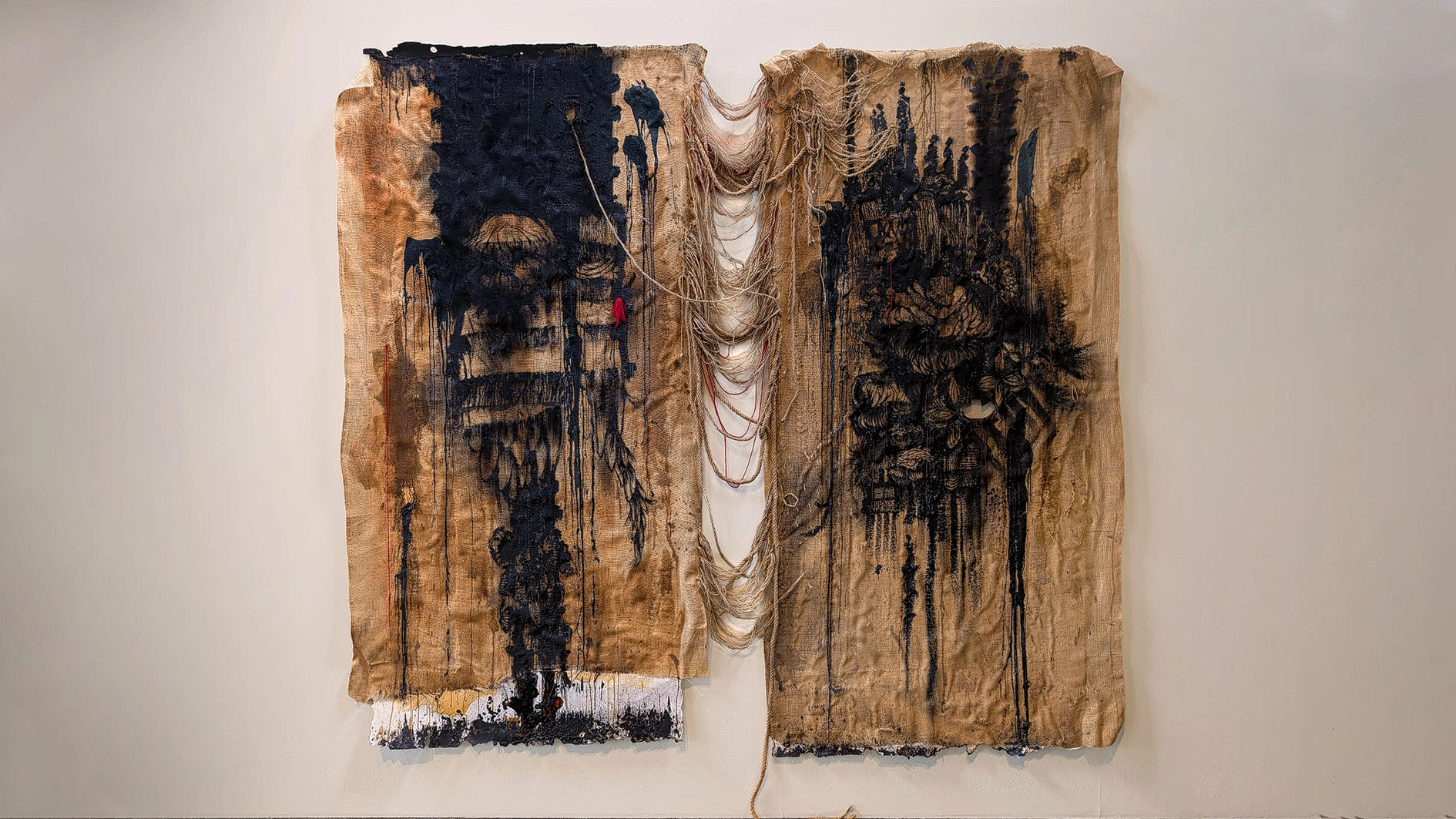
By Ayọ̀ Akínwándé
Entering What Grows in Between at The New Art Gallery Walsall, one encounters three distinct artistic propositions on connection, ecology and transformation. Yet it is Abraham Babajide Cole’s works that immediately arrest the viewer through their quiet intensity and material presence. Installed within the gallery are two recent works, Body Leave to Enter, Body Leave to Remain and Elsewhere Has Entered the Body, which together reveal an artist increasingly concerned with the body not merely as a represented form but as a site where histories, memories and movements are accumulated, excavated and transformed.
The exhibition marks a significant moment in Cole’s practice. Long recognised for his drawings and paintings that investigate migration, identity and the human condition, he now extends these concerns into sculptural and spatial forms. The shift feels less like a departure than an expansion. His recent works suggest an artist pushing beyond the boundaries of the picture plane, allowing memory and migration to become physical, inhabitable experiences.
Cole has described his interest as “how the body carries memories into new spaces, whether that’s through geographical movement or shifts in consciousness.” This statement is perhaps the key to understanding his practice. Migration, in his work, is never simply a matter of crossing borders. It is an interior condition. The body itself becomes a repository of elsewhere, carrying traces of places, encounters and histories long after the physical journey has ended.
This idea finds its most poignant expression in Body Leave to Enter, Body Leave to Remain. Composed of two monumental jute panels joined by suspended threads, the work explores the unseen realities of migration and departure. The title itself immediately evokes notions of duality: one body leaves while another remains; one enters as another departs. The diptych refuses any easy separation between these conditions.
The work resonates profoundly within a Yoruba philosophical context. The artist’s own name, Babajide—meaning “father has returned”—carries within it the idea of ancestral continuity and reincarnation. Within Yoruba cosmology, departure is never entirely final, and absence does not necessarily imply disappearance. The one who leaves remains present in memory, in lineage and in spiritual continuity.

Such ideas seem to echo throughout the work. The suspended threads connecting the two panels are particularly significant. They are not severed. They insist upon relation. Distance does not cancel connection; rather, it creates another form of proximity. As Cole himself notes, “the one who leaves and the one who remains continue to shape one another across distance; the memory of one cannot exist without the other.”
The materiality of the work reinforces these concerns. Jute, with its coarse and labour-intensive associations, becomes a metaphor for survival and endurance. Layers of clay, charcoal and beeswax carry visible traces of labour and memory. Subtle strands of red thread function as gestures of repair, suggesting that healing is never seamless but always marked by effort and struggle.
Indeed, material has become increasingly central to Cole’s practice. He speaks of clay as a reminder that “from earth we come, to dust we return.” It recalls childhood memories of making objects from soil and points towards human origins and mortality. Beeswax speaks of vulnerability and fragility. Charcoal offers an instinctive and unapologetic form of mark-making, one capable of recording subconscious movements and emotional states. The materials themselves become carriers of memory.
This relationship between material and memory has been developing in Cole’s work for several years. His 2024 solo exhibition Suns of Egypt, presented in Athens, offered important clues to his evolving concerns. The twelve drawings in that exhibition drew inspiration from Biblical and Quranic narratives, positioning Egypt not as a geographical location but as a metaphorical figure.
For Cole, Egypt became a landscape of interior migration—a voyage within. The works were deeply autobiographical, produced over twelve months in response to emotional and spiritual encounters in the artist’s life. The exhibition proposed migration as a psychic and spiritual process rather than simply a physical one.
Suns of Egypt also demonstrated the maturation of Cole’s distinctive visual language. His figurative works have gradually moved away from conventional representation toward a more abstracted and psychologically charged approach. Working with charcoal, deep tonalities and dark surfaces, he has developed a visual vocabulary that feels markedly different from much contemporary Nigerian figurative painting.
At a moment when many painters have embraced polished realism and highly saturated portraiture, Cole’s works often occupy an altogether different register. His figures emerge from darkness. Their forms are frequently fragmented, unresolved and suspended between appearance and disappearance. What matters is not likeness but atmosphere; not representation but memory.
This evolution becomes even more apparent in Elsewhere Has Entered the Body I, arguably the most powerful work in the Walsall exhibition. The terracotta sculpture marks Cole’s first significant engagement with sculpture, and it signals an important expansion of his practice.
Encountering the work, one has the sense of entering a shrine.
The gallery space itself seems transformed into an altar or ritual environment. Scattered terracotta fragments on the floor resemble offerings or deposits left after ceremonial acts. They evoke the placement of kola nuts during divinatory processes within Yoruba traditions, creating an atmosphere that oscillates between contemplation and invocation.
The sculpture itself resists easy categorisation. It is simultaneously figure and architecture, body and monument. Its form recalls the earthen architectures of shrines found across various West African traditions. There is a sense of gravity and monumentality in its installation, a deliberate use of space that imbues the work with spiritual presence.
The use of clay is particularly resonant. Cole appears to breathe life into the material itself. The sculpture seems suspended between formation and dissolution, between birth and return to earth. In this sense, the work speaks not only about migration but also about creation, ancestry and transformation.
Perhaps the most illuminating statement made by the artist is his description of the body as “an archaeological site—one that keeps traces of every journey it has travelled just to survive. Everything leaves a mark.”
This formulation provides a compelling framework through which to understand his entire practice.
The body, for Cole, is neither a stable container nor a fixed identity. It is a layered terrain composed of sediments, traces and accumulated histories. Journeys are inscribed upon it. Encounters leave residues. Memory becomes geological.
Such an understanding also transforms how we think about belonging in his work. Belonging is never fixed or static. It is continually reshaped by movement, environment and encounter. As humans migrate, they learn from new ecologies, adapt to unfamiliar landscapes and rebuild themselves through relationships with materials, people and places.
Migration, therefore, becomes a process of perpetual becoming.
This idea is perhaps what ultimately connects the diverse strands of Cole’s practice—from the introspective drawings of Suns of Egypt to the monumental installations of What Grows in Between. Throughout his work, there is a persistent insistence that bodies remember, that places continue to inhabit us, and that the experience of movement is carried long after the journey itself has ended.
Abraham Babajide Cole’s recent works suggest an artist entering a new and ambitious phase of his practice. By extending his investigations of memory and migration into sculpture and installation, he has begun to create environments in which these concerns are not merely represented but physically enacted.
His works ask us to consider what remains after departure, how histories become embodied and how acts of repair might emerge from fragmentation. Most importantly, they remind us that elsewhere is never entirely elsewhere. It enters the body, settles within it and continues to shape who we become.
In Cole’s hands, the body becomes an archaeological site of memory—a terrain of departures and returns, of traces and transformations, where every journey leaves its mark.
About the Reviewer
Ayọ̀ Akínwándé is a British-Nigerian artist working across painting, lens-based media, installation, sound, and performance. His work examines power, socio-political realities, and the interplay of tradition and modernity. He is also a curator, researcher, and writer, with international exhibitions and curatorial projects, including co-curating the inaugural Lagos Biennial (2017).
The exhibition is on at The New Art Gallery Walsall, UK until 11 October 2026.

