 Follow Us on Google News
 Follow Us on Google Discover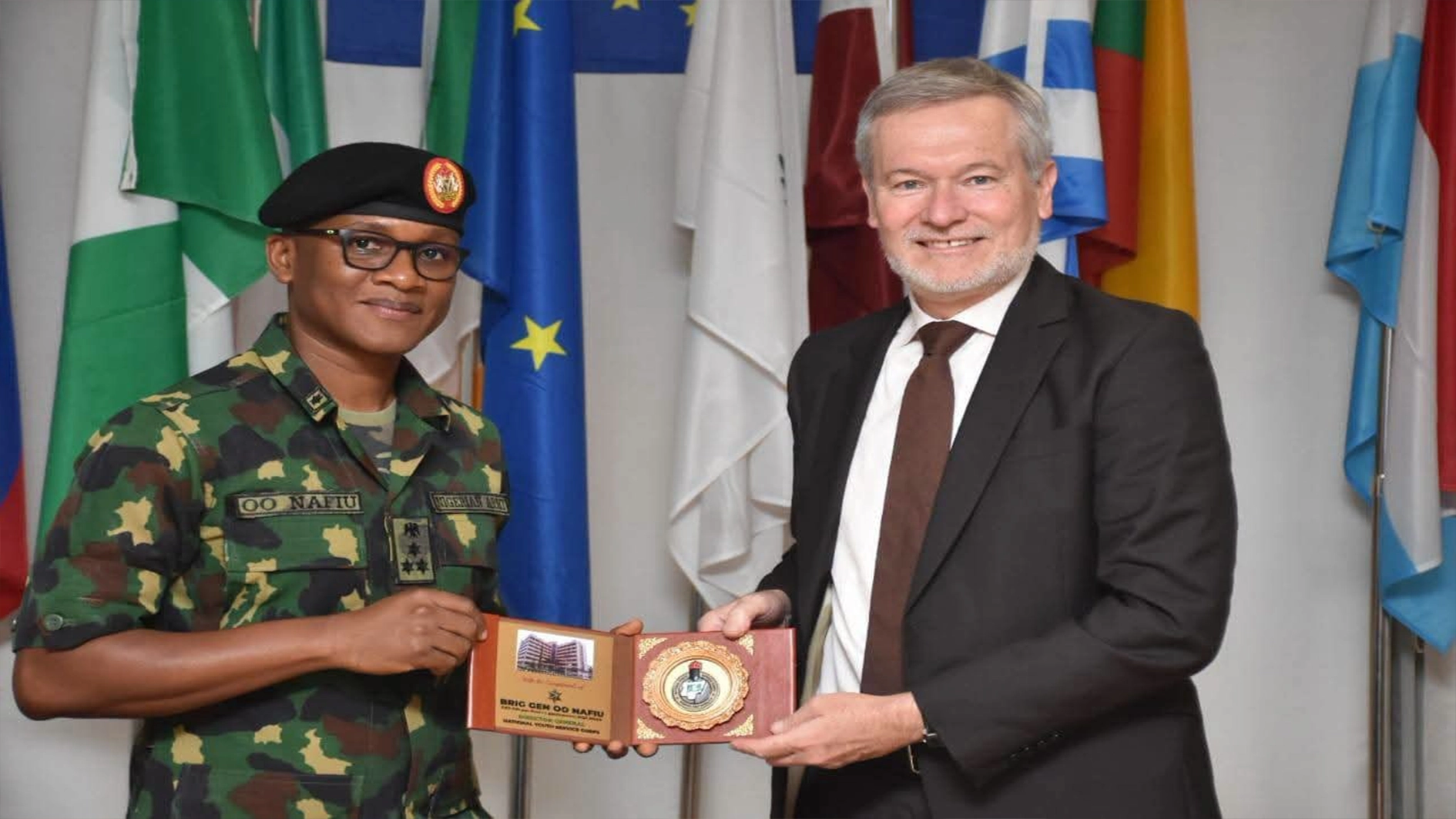
The National Youth Service Corps (NYSC), on Saturday, expressed its readiness to deepen partnership with the European Union (EU) in advancing digital support for the Scheme’s Skills Acquisition and Entrepreneurship Development (SAED) programme.
Director-General of NYSC, Brigadier General Olakunle Oluseye Nafiu, disclosed this in Abuja, during a courtesy visit to the European Union Ambassador to Nigeria and ECOWAS, Mr. Gautier Mignot, at the EU Mission.
General Nafiu said staff capacity development remains critical to the effective delivery of the Scheme’s mandate, adding that NYSC is willing to embrace partnerships that will enhance the training and professional development of its workforce through seminars, workshops and other capacity-building initiatives.
He commended the European Union for its sustained support for Nigerian youths and its commitment to programmes that promote skills development and economic empowerment.
The DG explained that the NYSC Skills Acquisition and Entrepreneurship Development (SAED) programme was introduced in response to the growing unemployment rate among graduate youths, with the objective of equipping Corps Members with practical and entrepreneurial skills that would enable them to become self-reliant and create employment opportunities for others.
According to a statement issued by the NYSC Director of Information and Public Relations, Caroline Embu, the programme has, since its inception, empowered thousands of Corps Members with marketable skills, many of whom have gone on to establish successful businesses and become employers of labour. The statement added that the initiative has also attracted grants and support from several development partners.

In his remarks, the European Union Ambassador to Nigeria and ECOWAS, Mr. Gautier Mignot, said the EU works with implementing partners to design and execute development projects across various sectors.
He praised the NYSC Management for institutionalising the SAED programme, describing it as a strategic initiative with immense potential for national development that deserves broad-based support.
The Ambassador explained that the European Union’s priority areas include digital technology, women and youth empowerment, children’s development, agriculture, renewable energy, healthcare and other sectors that promote inclusive growth.
He further disclosed that some European financial institutions have commenced operations in Nigeria to expand access to financing for small and medium-sized enterprises (SMEs).
Mignot identified limited access to finance as one of the major challenges confronting small business owners in Nigeria.
He said that the European Union also supports young people through academic and educational initiatives designed to improve their employability and facilitate their transition into the labour market.

