 Follow Us on Google News
 Follow Us on Google Discover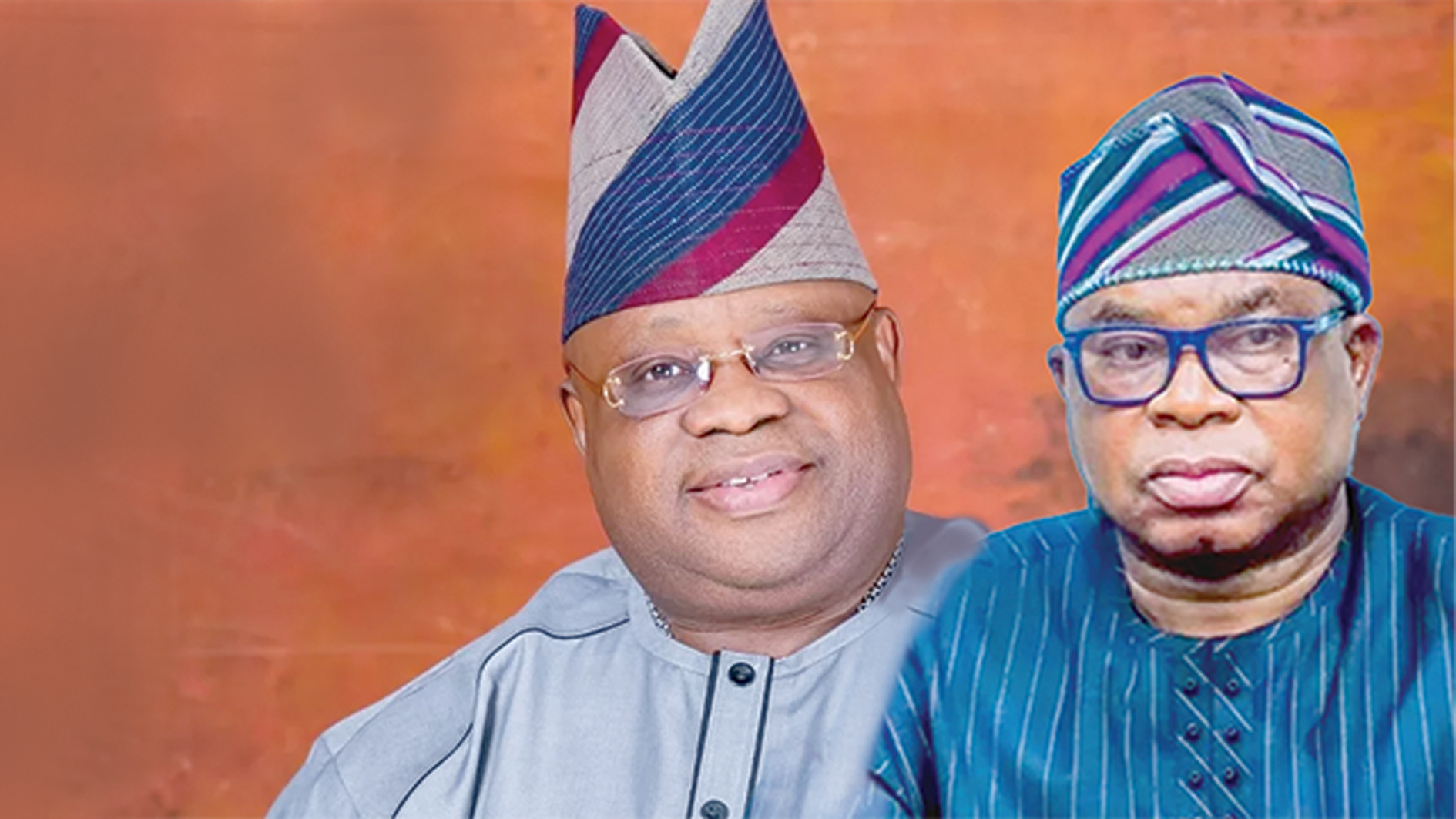
With just one week to the Osun State governorship election, the outcome remains too close to call. The contest between the incumbent, Governor Ademola Adeleke of the Accord Party, and the candidate of the All Progressives Congress (APC), Munirudeen Bola Oyebamiji (AMBO), has evolved into a fierce battle in which both camps are confident of victory. Ultimately, however, the electorate will have the final say, provided the electoral process is transparent, peaceful and offers all contestants a level playing field. SEYE OLUMIDE and OLUWOLE IGE examine the intrigues, shifting political dynamics and factors that may determine Saturday’s poll.
The freezing of the Osun State government’s accounts by the Economic and Financial Crimes Commission (EFCC) on Tuesday appears to have altered the political dynamics ahead of Saturday’s governorship election, as public discourse across markets, motor parks, palace courtyards and commercial centres has increasingly centred on the development and its possible implications for the poll.
Although it remains too early to predict the outcome, history suggests that Osun has consistently produced some of the most fiercely contested governorship elections in Nigeria’s Fourth Republic. For nearly two decades, the contest has largely been a straight battle between the All Progressives Congress (APC) and the Peoples Democratic Party (PDP).
This time, however, the political landscape has changed. Governor Ademola Adeleke, elected in 2022 on the platform of the PDP, is seeking a second term under the Accord Party after political developments compelled him to leave the party that brought him to office.
As of Thursday and Friday, interactions with residents across several communities suggested that, irrespective of political affiliation, many viewed the EFCC’s intervention, coming barely days before the election, as a development capable of influencing the political atmosphere ahead of the poll.
While opinions differed on the legality of the commission’s action, many respondents questioned its timing, arguing that it had shifted public attention from campaign promises to concerns about fairness, governance and the role of state institutions during elections.

For supporters of Governor Adeleke, the development has reinforced an existing narrative that the administration is under intense political pressure. They argued that rather than weakening the governor politically, the controversy could generate sympathy among sections of the electorate, particularly undecided voters who interpret the dispute through a political, rather than purely law enforcement lens.
Beyond the controversy surrounding the state’s finances, many residents interviewed contrasted the outgoing administration’s record with those of previous APC governments. Several respondents argued that despite the APC’s control of Osun between 2010 and 2022 under former governors Rauf Aregbesola and Adegboyega Oyetola, the state still grapples with unemployment, infrastructure deficits and limited industrial growth. While acknowledging projects executed during those administrations, they questioned whether the pace of development matched public expectations.
The APC, however, enters the election with significant political assets. It remains one of the state’s best organised political structures, enjoys the advantage of being the ruling party at the centre and retains substantial support in many traditional strongholds. Party leaders argue that their previous administrations laid solid foundations through investments in roads, schools, healthcare and social intervention programmes.
Its candidate, Munirudeen Bola Oyebamiji (AMBO), has campaigned on promises of fiscal discipline, infrastructure renewal, investment promotion, youth employment and stronger collaboration with the Federal Government. According to APC leaders, political alignment with Abuja would accelerate economic growth and attract more development projects to Osun.
However, interactions with residents across the state by The Guardian suggest that Saturday’s election may ultimately be shaped less by campaign promises than by public perception and the emotional impact of developments in the closing days of the campaign.
Some commercial bus operators at Aregbesola Motor Park in Osogbo, who requested anonymity, observed that Osun elections have historically been influenced by last-minute developments capable of stirring strong public emotions and altering voter behaviour.
One of them said: “The EFCC intervention was a calculated error and it is still possible for the narrative to change. Although both parties have an equal chance of winning, many people believe Governor Adeleke enjoys considerable popularity across Osun. His simple lifestyle and easy-going public persona have endeared him to many, particularly women. The influence of popular musician, David Adeleke, popularly known as Davido, could also boost the governor’s electoral fortunes.”
Not everyone shares that assessment. Some political observers, particularly in the Iwo axis, argued that while Adeleke may enjoy considerable personal popularity, the APC retains a formidable grassroots structure, superior organisation and more cohesive political machinery capable of offsetting that advantage. They also contend that the Accord Party lacks the extensive ward-to-ward structure required to match the APC’s election-day mobilisation.
For many analysts, the contest is likely to be decided by two contrasting strengths. Adeleke is banking on his personal popularity and record in office, while the APC candidate is relying on the party’s established grassroots network, organisational capacity and election-day mobilisation to reclaim the state.
Thursday’s political atmosphere also reflected heightened tension across parts of the state. Reports of security operations involving some political actors circulated widely, fuelling anxiety among supporters of different parties. While the circumstances surrounding those reports remain disputed, they underscored the increasingly charged environment ahead of Saturday’s vote.
Another development observed on Friday was the noticeably low public profile of several key political figures associated with Adeleke. Multiple sources suggested that some had deliberately stayed out of the public eye because they feared possible arrest by security agencies before the election. The Guardian also gathered that some official engagements scheduled for election week had been put on hold.
Some political observers compared the development with events preceding the 2003 general election, when leaders of the then opposition in Lagos alleged that security agencies targeted some of their prominent members ahead of the polls. Whether the low-profile posture reportedly adopted by some Accord Party leaders in Osun is informed by similar concerns remains unclear. Their activities in the final hours before Saturday’s election may provide a clearer indication.
Another intriguing dimension of the poll is the role of other opposition parties and influential political stakeholders. While the APC insists that several key figures, who stood with Adeleke during his successful 2022 campaign have since joined its fold, the governor’s camp maintains that it still enjoys the support of influential political actors, including former governor Rauf Aregbesola, now the National Secretary of the African Democratic Congress (ADC). Although the ADC has remained relatively subdued throughout the campaign, Adeleke’s supporters believe Aregbesola’s political influence could still affect voting patterns in parts of the state.
Assigning responsibility for the pre-election violence between supporters of the APC and the Accord Party remains difficult, as both camps have traded accusations while denying culpability. While the APC has been accused by its opponents of deploying federal influence, security agencies and alleged non-state actors to intimidate the ruling party, some security analysts argue that the Adeleke administration, feeling inadequately protected by state security agencies, may also have sought protection from non-state actors. None of these allegations has been independently verified.
Security experts warn that such a development, if left unchecked, could further heighten tension ahead of Saturday’s poll.
Director-General of the Institute for Police and Security Policy Research (IPSPR), Professor Charles Omole, recently cautioned against the growing reliance on non-state actors during elections, stressing that only professionally trained and accountable security agencies should be responsible for election security. According to him, the increasing involvement of informal armed groups undermines public confidence, fuels political violence and poses a serious threat to democratic governance.
Against this backdrop, observers maintain that the peaceful conduct of the election will depend largely on the willingness of political actors to abide by the peace accord and on the ability of the police and other security agencies to act impartially, enforce the law without fear or favour, and reassure voters that their safety will be guaranteed throughout the electoral process.
Another factor that may prove decisive in Saturday’s governorship election is the incumbent’s perceived support among civil servants, artisans, traders and residents, many of whom argue that the Adeleke administration has had a more direct impact on their livelihoods than previous governments.
Despite the intense political pressure surrounding the administration and the heightened campaign by the APC to reclaim the state, findings by The Guardian indicate that Adeleke is banking heavily on his performance in office, particularly infrastructure projects, regular salary payments, pension reforms and programmes that many residents believe have stimulated the local economy.
The governor also appears to enjoy considerable goodwill among sections of the organised labour movement. At a recent programme tagged One Day with Mr. Governor, organised by the Office of the Head of Service, the Chairman of the Nigeria Labour Congress (NLC) in Osun State, Comrade Christopher Arapasopo, urged workers not to support a return to the APC.
“We must not go back to the dark days under the APC government. Enough of intimidation and harassment. Tell them that we cannot be intimidated. Oyebamiji served as commissioner under both Aregbesola and Oyetola, yet workers suffered. Before now, some pensioners received as little as N300, N1,500 and N3,000. Today, the story has changed and pensioners receive improved payments,” he said.
Beyond organised labour, many residents who spoke with The Guardian said their voting decisions would be influenced more by their assessment of the governor’s performance than by party affiliation.
An Osogbo-based realtor, Adedamola Taiwo Tolulope, argued that Adeleke deserved another term because of the economic opportunities created through ongoing infrastructure development.
“Adeleke deserves a second term if we objectively compare his performance with previous administrations.
The local economy has improved because the government created an enabling environment for artisans, skilled workers and property developers through road construction and urban renewal projects. Since he assumed office, Osogbo and other major towns have witnessed increased development activities, creating jobs and improving livelihoods,” he said.
For Mrs. Akindoju Lateefat, a foodstuffs trader at Igbonna Market, Osogbo, the decision is personal.
Speaking in Yoruba, she said: “I will vote for Governor Adeleke at my polling unit in Oke Baale. I do not want the APC to return because my business has improved in the last three years. I went through hardship before now, but I believe this government has helped businesses.”
Bukola Adetoyese, who operates a restaurant in Osogbo, expressed a similar sentiment.
“I am not a politician, but I will support Adeleke in this election. When former Governor Rauf Aregbesola sought re-election, I voted for him because I believed his government was people-friendly. I feel the same about Adeleke’s administration. Osun is essentially a civil service state, and regular salary payments have helped businesses like mine because workers are our customers. Although the administration is not perfect, I believe it deserves another opportunity.”
A commercial mini-bus driver, Azeez Abiodun, also said members of his family would vote for the Accord Party.
“Apart from the fact that my daughter recently secured employment as a teacher, many people around me believe the governor has performed well in key sectors. That is why my family will support him.”
While such sentiments may strengthen the governor’s standing among workers, traders and artisans, elections are ultimately won through votes rather than perceptions. They argue that the APC’s well-established grassroots structure and election-day mobilisation remain formidable assets capable of neutralising the incumbency advantage.
Consequently, one of the defining questions ahead of Saturday’s poll is whether Adeleke’s popularity among ordinary residents and public sector workers will translate into votes sufficient to withstand the APC’s organisational strength and extensive political network across the state’s 30 local councils.
Ultimately, the election may be decided less by campaign rhetoric than by how voters interpret the dramatic events of the final week. Whether those developments translate into renewed support for the incumbent or provide the momentum the APC needs to reclaim the state will become clear only when Osun voters cast their ballots.
Despite rising political tension and allegations from the major parties, INEC has insisted that it is fully prepared to conduct a free, fair and credible election, while the police and other security agencies have pledged to remain neutral, protect voters and electoral officials, secure identified flashpoints and deal decisively with anyone attempting to disrupt the process.
Whether those assurances translate into public confidence and a peaceful election will become evident when Osun voters head to the polls on August 15.

