 Follow Us on Google News


 Follow Us on Google Discover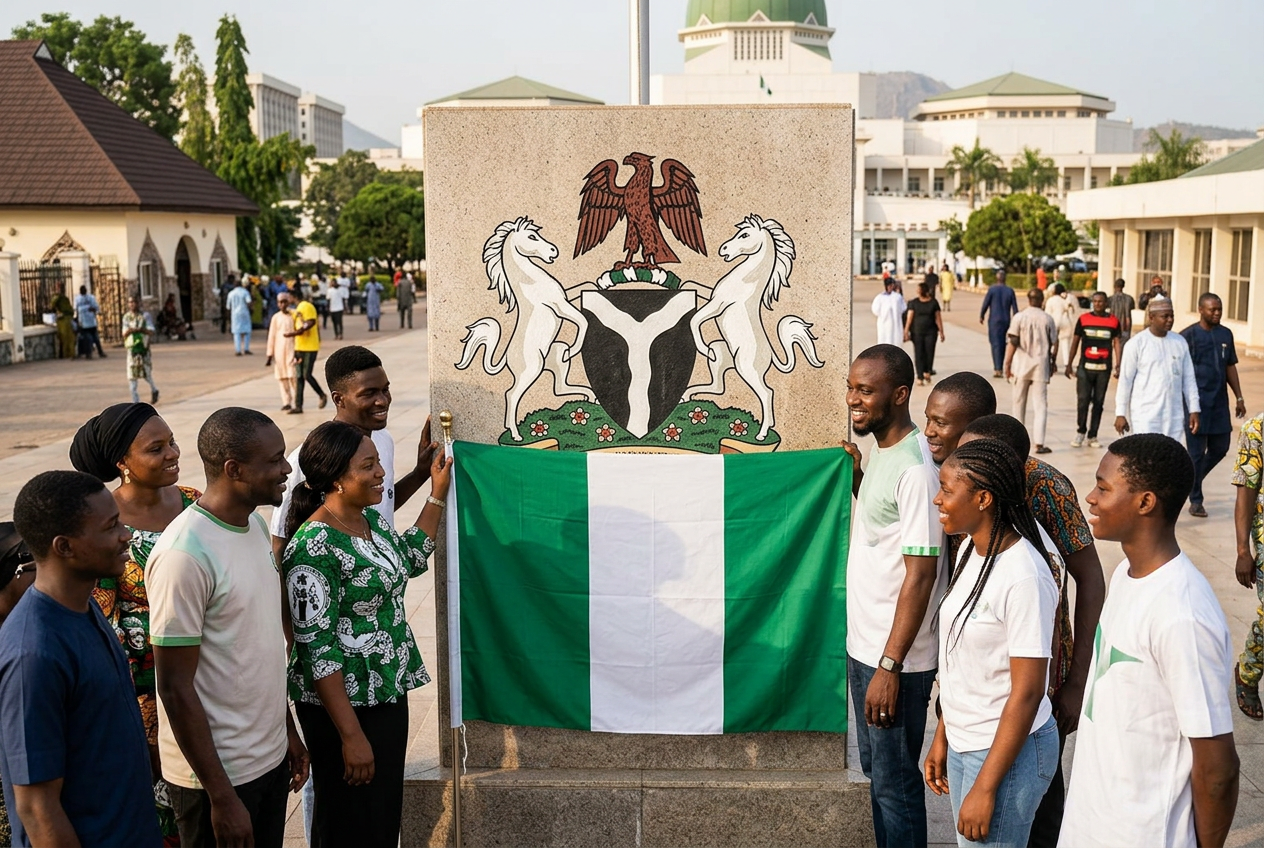
Welcome, and thank you for stopping by.
If you have ever watched a green and white cloth climb a school flagpole in Ibadan and wondered what symbolizes Nigeria beyond that one piece of fabric, you are in the right place. This piece is the conclusion of months of research through statute books, bank circulars and archive photographs, layered on top of years spent writing about Nigerian identity. Our emblems mostly gather in one crowded picture: the black shield where the Niger and the Benue finally shake hands.
Most of us learned these things at seven years old and have not revisited them since.
That is a shame, because the story underneath is far better than the classroom version. There is a twenty-three year old student in London who sketched a flag on a scrap of paper and won ₦0 for it, because the naira did not exist yet. There is a flower that the artists painted the wrong colour and nobody has ever fixed. There is an anthem that was buried in 1978 and dug back up in 2024, to the loud annoyance of roughly half the country.
Let us go through all of it properly.
What colours represent Nigeria?
Green, white, green. In that order, in three vertical bands of exactly equal width.

The green stands for Nigeria’s agricultural wealth and the forests and farmland that cover so much of the country. The white in the middle stands for peace and unity. That is the whole vocabulary of the flag, which is precisely why it works. A country with more than 250 ethnic groups could not have chosen a design that honoured some and quietly skipped others, so it chose one that honours the land itself and leaves everyone room to stand on it.
The man behind it was Michael Taiwo Akinkunmi, born in 1936, who was studying engineering in London when he spotted a newspaper advertisement calling for national flag designs ahead of independence. He posted off his entry and it beat somewhere between two thousand and three thousand rivals, depending on which archive you trust. His prize was £100. His original sketch had a red sun with radiating rays sitting in the white band, a nod to divine guidance, but the selection committee took the sun out and left the design bare.
He never got the sun back. He did eventually get the Order of the Federal Republic from President Goodluck Jonathan in 2014, and when he died in Ibadan in August 2023 at the age of 87, the tribute issued from Aso Rock described the green and white as a legacy reflecting the fruitfulness, resilience and harmony of the nation. Rather like a songwriter who writes one perfect hook at twenty-three and spends sixty years watching a whole country sing it, Pa Akinkunmi lived long enough to become the thing he made.
Now, the design specifics, because this is where most people go wrong.
The flag’s proportion is 1:2, height to length. So a flag one metre tall must be two metres long, and each of the three bands is exactly 66.7 centimetres wide. Get that ratio wrong and the flag looks subtly off in a way people notice without being able to explain, which is why so many roadside banners in Lagos look cheap.
The green is not just any green. It is a deep emerald that printers know as Pantone 349C, roughly #008751 in hex, and the white is a clean unbroken white with no cream or ivory drift. If you are designing anything patriotic, a bottle green will read as Nigerian Army rather than Nigerian flag, and a lime green will read as a football kit. Stay in the emerald family.
A styling tip I give anyone printing independence day material: give the green room to breathe. The flag has no crest, no star and no motto on its face, and that emptiness is the point. Cramming a logo into the white band, which brands do every October, breaks the one rule the design has.
Seven steps to flying the green-white-green correctly
- Check the ratio before you buy. Any flag that is not twice as long as it is tall has been made carelessly, and the three bands should measure identically when you fold them against each other.
- Raise it at sunrise and lower it at sunset, briskly on the way up and slowly on the way down. The old civil service phrase is that a flag does not sleep, so an unlit flag left out overnight is poor form.
- Never let it touch the ground, the floor, a car bonnet or a market table. If it does, take it in, wash it and dry it before flying it again.
- Give it the highest position. Where the national flag shares a compound or a room with a state flag, a company flag or a foreign flag, nothing may be flown above it and nothing may be larger than it.
- Fly it at half mast only for national mourning or a state funeral, and raise it fully to the top first before lowering it to the halfway point. Reverse the order when you bring it down.
- Retire it once it fades. Section 7 of the Flags and Coats of Arms Act makes flying the national flag in a defaced or bad condition an offence, and a police officer may seize a flag involved in such an offence.
- Keep it out of adverts unless you have authority. Using the flag or the coat of arms as a commercial prop without a licence sits on the wrong side of the same Act, however patriotic the campaign feels.
What are the five national symbols of Nigeria?
Here is something the textbooks never admit: there is no single statute that lists five and stops. Different agencies count seven, others eleven. What has settled into common usage, and what your child will be marked on in a Nigerian classroom, is this set of five.
The national flag. Adopted 1 October 1960, governed by the Flags and Coats of Arms Act, and covered in detail above.
The coat of arms. Adopted in May 1960, and by far the densest of our emblems. The black shield stands for fertile soil and mineral wealth. The wavy white pall, that Y shape running down the middle, marks the point near Lokoja where the Niger and the Benue converge into one river, which is as neat a metaphor for a federation as anybody has managed. Two white horses flank it for dignity. A red eagle sits on top for strength, perched on a green and white torse that echoes the flag. At the base sit four flowers and the motto. The official description maintained on the tourism authority’s site sets all of this out plainly, and it is the version civil servants work from.
The naira. Introduced in 1973 when Nigeria moved off pounds and shillings into a decimal currency of its own, the naira is legal tender and, more than that, a working symbol of sovereignty. This is not sentimental language. Section 21 of the Central Bank of Nigeria Act 2007 makes spraying, dancing on, stepping on, mutilating, defacing or trading in the currency an offence, and the Central Bank’s own guidance on handling banknotes sets the penalty at not less than six months imprisonment, a fine of not less than ₦50,000, or both. Refusing to accept naira as payment is separately unlawful under Section 20(5).
The enforcement has become real rather than theoretical. Courts have convicted actresses, influencers and celebrity barmen over the last three years, and in 2025 the EFCC chairman told a Lagos gathering plainly that spraying money at parties is a punishable offence rather than a cultural practice, describing the naira as a symbol of our sovereignty. Whether you think that is proportionate policing or a distraction from bigger crimes is a fair argument to have. What is no longer arguable is the law.
The national anthem. And this is the one most reference sites still get wrong. On 29 May 2024, President Bola Tinubu signed the National Anthem Act 2024, retiring “Arise, O Compatriots” after forty-six years and restoring “Nigeria, We Hail Thee”, the anthem sung from independence in 1960 until the military dropped it in 1978. The lyrics came from Lillian Jean Williams, a British expatriate working at the Federal Ministry of Labour, with music by Frances Benda.
That colonial authorship is exactly why the change split opinion. Guardian columnists laid out the argument well at the time, splitting the country into those who wanted the founding anthem back and those who saw the 1978 replacement as the more Nigerian document. Others argued the restored words carry a genuine aspirational charge, reading the anthem as a prayer and a projection of unity in diversity rather than a relic. Two years on, the line about tribe and tongue differing while we stand in brotherhood turns up in presidential speeches often enough that it has become the administration’s shorthand for national unity.
The national pledge. Written by Professor Felicia Adebola Adedoyin in September 1976 and made a daily fixture in schools shortly afterwards by the Obasanjo military government. It is recited standing, immediately after the anthem, and promises faithfulness, loyalty and honesty, service with all one’s strength, and the defence of Nigeria’s unity, honour and glory.
Some lists swap the naira out for the national flower, the Costus spectabilis, or for the Seal of the President, first used by Shehu Shagari in 1979 and revived in 1999. Both are legitimate national emblems. The five above are simply the five you will be examined on.
Nigeria’s five core national symbols compared
| National symbol | Year adopted | Legal basis or authority | What it stands for |
|---|---|---|---|
| National flag | 1960 | Flags and Coats of Arms Act | Agriculture, natural wealth, peace and unity |
| Coat of arms | 1960 | Flags and Coats of Arms Act | Fertile soil, river confluence, strength, dignity |
| Naira | 1973 | Central Bank of Nigeria Act 2007 | Economic sovereignty and legal tender |
| National anthem | 1960, restored 2024 | National Anthem Act 2024 | Brotherhood across tribe and tongue |
| National pledge | 1976 | Federal government directive | Loyalty, honesty and service to the country |
What the table shows is that four of the five predate or coincide with independence, and every one of them except the pledge sits on a named piece of legislation. Nigeria did not accumulate its symbols casually. It legislated them, and it has amended them, most recently in 2024.
So what symbolizes Nigeria, in one answer?
If somebody stops you in a lift and gives you twenty seconds, here is the answer.
Nigeria is symbolised, officially, by five emblems fixed in law and convention: the green-white-green flag standing for farmland and peace, the coat of arms with its black shield and red eagle, the naira as the currency of a sovereign state, the anthem “Nigeria, We Hail Thee”, and the national pledge. Sitting alongside them are a cluster of secondary emblems that carry almost as much weight in daily life: the eagle as national animal, the Costus spectabilis as national flower, the Seal of the President, the National Theatre in Iganmu with its distinctive military cap silhouette, Independence Day on 1 October, Democracy Day on 12 June, and the motto “Unity and Faith, Peace and Progress”. Unofficially, and no list will ever capture this, Nigeria is also symbolised by jollof rice, by Afrobeats, by the Super Eagles shirt, and by the sheer volume of a Lagos market at nine in the morning.
The official set tells you what the state decided in 1960. The unofficial set tells you what 230 million people decided since.
Both are true. Neither is complete without the other, which is roughly the condition of the country itself.
What animal symbolizes Nigeria?
The eagle.
It sits at the very top of the coat of arms, wings spread, rendered in red, and it stands for strength. In heraldic terms it is the king of birds, which is precisely the note a newly independent nation wanted to strike in 1960. Nigeria was the most populous country in Africa then and it is the most populous now, and the eagle was chosen to say so without saying it.
Here is the subtlety most people miss. The eagle on the coat of arms is not a specific species. It is a heraldic eagle, a symbol rather than a portrait, which is why it is red rather than any colour an actual bird has ever been. If you want living counterparts, Nigeria’s savannah and forest do host genuinely formidable raptors, including the crowned eagle, sometimes called the leopard of the air for its habit of taking prey several times its own weight, and the martial eagle, Africa’s largest, with a wingspan approaching 2.6 metres.
The horses deserve a mention too, because they are the other animals on the arms and they get overlooked. Two white horses support the shield on either side, and they stand for dignity. Not power, not speed, dignity. Somebody in 1960 chose that word deliberately, and given what the preceding sixty years of colonial administration had done to Nigerian dignity, you can see why.
Then there is the unofficial eagle, which may honestly be the more powerful one. The senior men’s national football team has been the Super Eagles since 1988. The women are the Super Falcons. The under-twenties are the Flying Eagles. When Nigerians talk about eagles, they are usually talking about football, and that is not a dilution of the symbol so much as proof it landed.
Ask a child in Aba what animal represents Nigeria and you will get the right answer for the wrong reason. Ask me whether that matters and I will tell you it does not.
What is Nigeria’s national motto?
“Unity and Faith, Peace and Progress.”
You will find it on the banderole curling around the base of the coat of arms, beneath the flowers and the horses’ hooves. Four words, two pairs, adopted in 1978.
It replaced an earlier motto, and this is the detail that surprises people. From 1960 to 1978 Nigeria’s motto was “Peace, Unity, Freedom”. The military government of the day swapped it out, keeping peace and unity, dropping freedom, and adding faith and progress in its place.
Sit with that for a second.
A country that had just come through a civil war, and was seventeen years into an independence that had spent most of its life under military rule, quietly removed the word freedom from its national motto. Nobody put it to a referendum. The same administration that year also retired “Nigeria, We Hail Thee” for being a colonial artefact, which means 1978 was the single biggest rewrite of Nigerian national symbolism since independence, and almost nobody remembers it happening.
Whether the swap was cynical or simply bureaucratic is a question I have gone back and forth on for months, and I do not think the archive settles it. What I do think is that the current motto is a better sentence than people give it credit for. Unity and faith are what you need to hold a federation of this size together. Peace and progress are what you get if you manage it. The order is a sequence, not a list.
And if you find yourself curious about how much else in our national story has been renamed, redrawn or reissued along the way, the question of what Nigeria was called before covers ground that runs directly into this one.
The motto also does something quietly clever that mottos elsewhere do not. It makes no claim about God, no claim about a founding people, and no claim about destiny. It names four conditions and leaves the achieving of them to us. That is either admirably humble or a bit of a cop out, and on a good day I think the former.
Final Thoughts on What Symbolizes Nigeria
After all these months in the archives, the thing that stays with me is how young these symbols still are.
The flag is sixty-five years old. The naira is fifty-two. The motto we currently use has only been in place since 1978, and the anthem we currently sing was restored two years ago, in the lifetime of every adult reading this. These are not ancient inheritances handed down through centuries. They are recent decisions, made by identifiable people, some of whom were still alive very recently. Pa Akinkunmi died in 2023.
That should be encouraging rather than deflating. Symbols that were decided within living memory can be understood, argued about, and where necessary revised, which is exactly what happened in 2024. A nation that can hold a real public argument about its own anthem is a nation still actively deciding who it is.
So here is what I would actually do with all this.
- Get the specifications right when you use them. A 1:2 flag in Pantone 349C green, an unmodified coat of arms, and a naira note you have not sprayed at a party. The rules exist and, in the case of the currency, they now carry a custodial sentence.
- Learn the second verse of the anthem and the full pledge, not the first line of each. Most of the meaning sits in the parts we mumble through, and the restored anthem’s second verse in particular reads as a genuine prayer for the country.
- Teach the stories, not the list. A child who knows about the student in London, the removed red sun, and the flower painted the wrong colour will remember the symbols for life. A child who memorises five bullet points will forget them by August.
Related Articles
If the naming and renaming of this country interests you, my piece on what Nigeria was called before traces the journey from Royal Niger Company territory through the 1914 amalgamation, and it explains where the name itself came from, which is a story with a British journalist at the centre of it.
And because so much of our symbolism is now something visitors encounter first at the airport and last at the departure gate, you may also want to read whether Nigeria is friendly to tourists, where I look at how the country presents itself to people arriving with no context at all.
Key Takeaways
- Nigeria’s five commonly cited national symbols are the green-white-green flag, the coat of arms, the naira, the national anthem and the national pledge, with the eagle, the Costus spectabilis flower and the presidential seal close behind.
- The national anthem changed on 29 May 2024 back to “Nigeria, We Hail Thee”, so any source still naming “Arise, O Compatriots” is out of date.
- Misusing the flag or the naira is a criminal offence, not a matter of etiquette, with naira abuse carrying at least six months imprisonment or a fine of at least ₦50,000.
Frequently Asked Questions About What Symbolizes Nigeria
What symbolizes Nigeria?
Nigeria is symbolised officially by the green-white-green flag, the coat of arms, the naira, the national anthem and the national pledge. Alongside these sit the eagle, the Costus spectabilis flower, the presidential seal and Independence Day on 1 October.
What animal symbolizes Nigeria?
The eagle is Nigeria’s national animal and appears in red at the top of the coat of arms, where it represents strength. Two white horses also feature on the arms as supporters, standing for dignity.
What are the five national symbols of Nigeria?
The five most commonly taught are the national flag, the coat of arms, the naira, the national anthem and the national pledge. No single statute fixes the number at five, so some official lists count seven or eleven emblems instead.
What is Nigeria’s national motto?
Nigeria’s national motto is “Unity and Faith, Peace and Progress”, adopted in 1978 and displayed on the banderole at the base of the coat of arms. It replaced the earlier motto “Peace, Unity, Freedom”, which had been in use since independence in 1960.
What colours represent Nigeria?
Green and white represent Nigeria, arranged as three equal vertical bands of green, white and green. The green stands for agriculture and natural wealth while the white stands for peace and unity.
Who designed the Nigerian flag?
Michael Taiwo Akinkunmi designed the flag as a student in London, winning a national competition held ahead of independence and receiving £100 for it. He was awarded the Order of the Federal Republic in 2014 and died in Ibadan in August 2023 at the age of 87.
What is Nigeria’s current national anthem?
The current anthem is “Nigeria, We Hail Thee”, restored on 29 May 2024 when President Bola Tinubu signed the National Anthem Act 2024. It had been Nigeria’s anthem from independence in 1960 until the military replaced it with “Arise, O Compatriots” in 1978.
What does the coat of arms of Nigeria mean?
The black shield represents fertile soil and mineral wealth, and the wavy white Y shape marks where the Niger and Benue rivers meet near Lokoja. The red eagle above stands for strength, the two white horses for dignity, and the flowers at the base are the national flower.
What is Nigeria’s national flower?
Nigeria’s national flower is the Costus spectabilis, a yellow trumpet-shaped wildflower that grows across every region of the country. It was chosen precisely because of that nationwide spread, though the artists rendered it in red on the coat of arms rather than yellow.
Is it illegal to spray naira notes in Nigeria?
Yes, spraying, stepping on, dancing on or mutilating naira notes is an offence under Section 21 of the Central Bank of Nigeria Act 2007. The penalty is imprisonment of not less than six months, a fine of not less than ₦50,000, or both, and courts have handed down convictions in recent years.
What is the correct ratio for the Nigerian flag?
The national flag has a height to length proportion of 1:2, so a flag one metre tall must be two metres long. The three vertical bands must be exactly equal in width, which works out to roughly 66.7 centimetres each on a one metre flag.
Who wrote the Nigerian national pledge?
Professor Felicia Adebola Adedoyin wrote the national pledge in September 1976. The Obasanjo military government then directed that schoolchildren recite it daily, immediately after the national anthem, and that practice continues today.

