 Follow Us on Google News


 Follow Us on Google Discover
Hello, and thank you for stopping by. If you have ever paused over an old map of West Africa and wondered what was Nigeria called before the country we recognise today ever existed, you have landed on exactly the right page. This piece is the result of months of patient digging through colonial records and archives, sat on top of years spent writing about the long story of this land for a living, and I promise the answer is far richer than the single date most of us were handed in school.
Here is the honest truth I have come to accept. The country we call Nigeria is barely older than some of our grandparents, yet the ground beneath it has carried names, crowns, and currencies for well over a thousand years.
So let us walk back through time together.
What Was There Before Nigeria?
Long before any British journalist reached for a pen, this stretch of West Africa was not empty, and it certainly was not one country. It was a busy patchwork of kingdoms, caliphates, city states, and village republics, each with its own ruler, its own market day, and its own way of settling a quarrel.
Think of the Kanem-Bornu Empire in the north east, trading salt and horses across the Sahara while Europe was still stumbling through the Middle Ages. Picture the Hausa city states of Kano, Katsina, and Zaria, walled and prosperous, humming with dyers and leatherworkers. Further south sat the Oyo Empire and the ancient Benin Kingdom, whose bronze casters produced work so fine that it now sits behind glass in museums across the world. To the east, the Igbo communities ran affairs through councils and assemblies rather than kings, a quietly radical idea for their time.
The Nigerian Ministry of Foreign Affairs puts it plainly on its own history of Nigeria pages, noting that these civilisations, kingdoms, states, empires, and a caliphate all flourished before the founding of the Nigerian nation state in 1914. That single line rearranges everything, does it not? What we call our national history is, in truth, the meeting point of dozens of much older histories.

Go back further still and you reach the Nok culture, whose people were firing striking terracotta sculptures and working iron in central Nigeria more than two thousand years ago. When you see those hollow-eyed Nok heads in a museum today, you are looking at the artistry of a society that flourished here long before Rome fell, let alone before any European set foot on the coast.
And then there is the Sokoto Caliphate, founded in the early nineteenth century after Usman dan Fodio’s reform movement swept across the north. At its height it was one of the largest states in Africa, running a sophisticated system of governance, scholarship, and trade that stretched across much of what is now northern Nigeria. This was no scattered wilderness waiting to be organised. It was an established order with its own courts, its own scholars, and its own tax rolls.
None of these peoples woke up one morning calling themselves Nigerian. That word had not been invented yet.
Did Nigeria Have Another Name Before 1914?
Now here is where things get tangled, and rather interesting.
Between the arrival of the British on the coast and the amalgamation of 1914, this territory did not have one tidy name. It had a whole succession of them, each reflecting who was in charge of which patch of ground at the time. Rather like a house that changes its nameplate every time it is sold, the region wore several labels in quick succession.
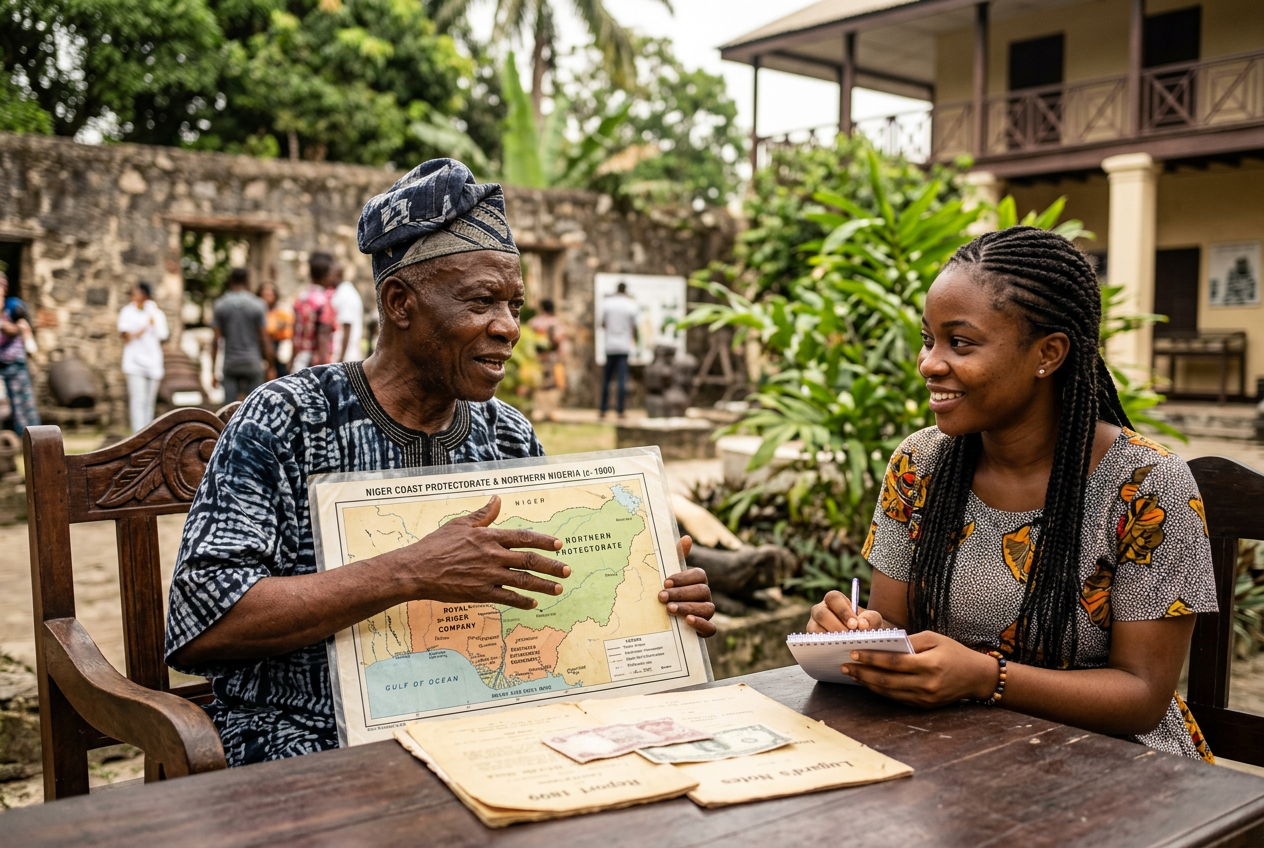
It began with the Colony of Lagos, annexed by Britain in 1861. Then came the Oil Rivers Protectorate in 1885, declared over the Niger Delta to control the roaring trade in palm oil, which is precisely why those creeks and rivers were nicknamed the oil rivers in the first place. In 1893 that protectorate was enlarged and renamed the Niger Coast Protectorate.
Inland, a private company was running the show. The Royal Niger Company governed vast territories under a royal charter, and the whole area was often referred to, rather clumsily, as the Royal Niger Company Territories. When the company’s charter was revoked in 1899, it sold its holdings to the British Crown for the almost insultingly small sum of £865,000. On the first day of 1900, those lands were reorganised into two new entities, the Protectorate of Northern Nigeria and the Protectorate of Southern Nigeria.
The Nigerian government’s own history of Nigeria confirms this staged, piecemeal process, and it is worth sitting with for a moment. For fourteen years, there were effectively two Nigerias, governed separately, with different laws, different capitals, and different colonial officers. One respected Guardian columnist, writing about the mistake of 1914, captured it beautifully by noting that Nigeria’s existence was little more than the outcome of balancing the colonial accounting books.
The Names This Land Has Carried Through Time
Before we go further, it helps to see the whole sequence laid out in one place. The table below tracks how the same stretch of earth was renamed again and again across roughly a century.
| Period | Name or Designation | Who Controlled It | What Changed |
|---|---|---|---|
| Before 1861 | Independent kingdoms and empires (Benin, Oyo, Sokoto Caliphate, Kanem-Bornu, Hausa states, Igbo communities) | Indigenous rulers | Sovereign African states with their own governments |
| 1861 | Colony of Lagos | Britain | Lagos annexed as a crown colony |
| 1885 | Oil Rivers Protectorate | Britain | Coastal delta trade brought under formal British control |
| 1893 | Niger Coast Protectorate | Britain | The Oil Rivers Protectorate enlarged and renamed |
| 1900 | Northern and Southern Nigeria Protectorates | Britain | Royal Niger Company charter revoked, territory sold for £865,000 |
| 1906 | Colony and Protectorate of Southern Nigeria | Britain | Lagos merged with Southern Nigeria |
| 1914 | Colony and Protectorate of Nigeria | Britain | Northern and Southern protectorates amalgamated |
| 1960 | Federation of Nigeria | Independent Nigeria | Full independence from British rule |
What the timeline shows is that Nigeria was assembled in stages rather than born in a single moment, and that almost every name it wore before 1914 described a trading interest rather than a people. The country came together on paper long before it came together in spirit.
That gradual stitching together, incidentally, is a theme other Guardian writers have wrestled with too, including a thoughtful column on the north and the rest of us that traces how three colonial administrations were reduced to two and then fused into one.
What Was Nigeria Called Before? The Direct Answer
Let me now answer the question squarely, because you came here for clarity, not just a history lesson.
What was Nigeria called before? Before the name Nigeria was coined in 1897 and formally adopted in 1914, the territory had no single unifying name at all. Across the colonial decades it was known through a shifting set of administrative labels, chiefly the Colony of Lagos, the Oil Rivers Protectorate, the Niger Coast Protectorate, the Royal Niger Company Territories, and finally the separate Protectorates of Northern and Southern Nigeria. Reach back further, before the British ever landed, and there was no Nigeria to name, only a constellation of independent states such as the Sokoto Caliphate, the Oyo Empire, the Benin Kingdom, the Kanem-Bornu Empire, and countless Hausa and Igbo communities, each answering to its own name and its own throne.
In short, there was never one old name for Nigeria, because there was never one old Nigeria. There were many. As a recent Guardian column on religion, power and the future of the Nigerian federation argues, the 1914 union was ultimately a purely administrative decision, taken for British convenience rather than out of any shared national design.
And here is a detail that delights me every time. The name arrived before the nation did. Flora Shaw suggested Nigeria in 1897, yet the amalgamated country only appeared in 1914, which means for seventeen years the word was a label in search of a country. Even the money in your pocket eventually caught the echo, since the Central Bank of Nigeria’s own history of the currency records a decimal currency whose very name, as we will see shortly, was carved out of the word Nigeria itself.
What Is the Original Meaning of Nigerian?
So where did this new word actually come from, and what does it truly mean?
The name Nigeria was built from the River Niger, the great waterway that snakes through the country and empties into the Gulf of Guinea. Add the suffix “ia”, long used in European naming to signal a region or land, and you arrive at Nigeria, meaning something close to the land of the Niger. A Nigerian, by simple extension, is a person of that land.
It was Flora Shaw, a British journalist writing for The Times, who proposed the name in an article dated 8 January 1897. She was frankly tired of the cumbersome phrase Royal Niger Company Territories, and she offered Nigeria as a shorter, more dignified alternative for the Niger area. She later married Lord Frederick Lugard, the very man who would stitch the protectorates together in 1914, which gives the story an almost novelistic symmetry.
Now for the part that surprises many readers. The word Niger itself is not Latin, and it has nothing whatsoever to do with any racial term, a misunderstanding I have had to gently correct more times than I can count. Historians trace it instead to a Tuareg phrase, egerew n-igerewen, used by communities living along the middle reaches of the river, meaning roughly a river of rivers. The name, in other words, is far older and far more African than the colonial spelling suggests.
If you would like to trace the deeper roots of your own community, here is a simple approach I recommend to anyone starting out.
- Begin with the River Niger and its tributaries, since so many of our oldest settlements grew up along the water.
- Identify which precolonial kingdom or community once governed your home area, whether Oyo, Benin, Sokoto, Kanem-Bornu, or a Delta or Igbo community.
- Visit a National Museum branch under the National Commission for Museums and Monuments, where regional collections often hold the earliest physical records.
- Speak with your oldest living relatives and note the town’s traditional name, which frequently predates any colonial spelling.
- Cross check colonial era maps, watching for renamed towns and protectorate borders that no longer exist.
- Read at least one academic history of your region rather than relying solely on oral memory.
- Write down what you find and share it, because a name remembered by one family is a name saved for everyone.
Follow those steps and you will often discover that your own doorstep carried a proud name centuries before Flora Shaw ever reached for hers.
Who Gave the Naira Its Name?
If the country’s name is a colonial inheritance, our currency’s name is a homegrown act of independence, and I love it for that.
The Naira was introduced on 1 January 1973, replacing the Nigerian pound that Nigeria had carried over from British rule. The changeover was neat, with one Naira set as the equivalent of ten shillings, and a hundred kobo making up a single Naira. Out went a currency named after a foreign crown, and in came one named after home.
So who gave the Naira its name? The credit goes to Chief Obafemi Awolowo, who served as Federal Commissioner for Finance. According to his own family, he simply took the word Nigeria and collapsed it, trimming and folding the letters until Naira emerged. It is a tidy piece of linguistic craft, and every time you count out notes at the market you are, in a sense, spelling a shortened version of the country’s name.
The smaller unit, the kobo, has a humbler origin still. It is widely held to be a local rendering of the English word copper, chosen because the earliest coins were struck in that metal. Awolowo’s own portrait, fittingly, now graces the one hundred Naira note.
There is a certain poetry to all of this. The British handed us a name drawn from a river, and a generation of Nigerians took that name, reshaped it in their own hands, and pressed it onto the money that now passes between millions of us every single day.
Final Thoughts on What Nigeria Was Called Before
So, what was Nigeria called before? The most honest answer is that it wore many names and, for most of its long history, no single one at all. It was a gathering of ancient kingdoms and empires, then a scattering of colonial protectorates with trade-driven labels, and only from 1914 did it become the unified Nigeria we now call home. The name we carry was suggested by a British journalist in 1897, drawn from the River Niger, and adopted almost two decades later for reasons that had more to do with imperial bookkeeping than with any love for the peoples involved.
Yet there is something quietly hopeful in knowing all this. A name given to us by others has, over more than a century, been filled with meaning entirely our own, from the bronzes of Benin to the Naira in our wallets.
If you want to carry this further, start close to home. Ask an elder what your town was called before the maps were redrawn, take a Saturday to visit your nearest National Museum, and read one solid history of your region. You will come away understanding not just what Nigeria was called before, but who we were long before anyone thought to give us a single name.
Related Articles
If this journey through our national story has caught your interest, you may enjoy my earlier piece on which country is the giant of Africa, which looks at how Nigeria earned that towering reputation across the continent. I would also point you towards my article on the racial makeup of Nigeria, where I explore the many peoples who were folded into one country in 1914 and who still give our nation its remarkable variety today.
Key Takeaways
- Nigeria never had one single old name, because before 1914 it was a collection of independent kingdoms and, later, several separate British protectorates rather than one country.
- The name Nigeria was coined by journalist Flora Shaw in 1897, drawn from the River Niger, and formally adopted when Lord Lugard amalgamated the Northern and Southern Protectorates in 1914.
- The Naira, introduced in 1973, was named by Chief Obafemi Awolowo, who created the word by collapsing the name Nigeria itself.
Frequently Asked Questions About What Nigeria Was Called Before
What was Nigeria called before?
Before the name Nigeria was coined in 1897 and adopted in 1914, the territory had no single name and was known through colonial labels such as the Oil Rivers Protectorate, the Niger Coast Protectorate, and the Royal Niger Company Territories. Earlier still it was a mosaic of independent kingdoms and empires rather than one unified country.
Who came up with the name Nigeria?
The British journalist Flora Shaw suggested the name Nigeria in an article for The Times on 8 January 1897. She built it from the River Niger and the phrase Niger area, offering it as a shorter alternative to Royal Niger Company Territories.
When did Nigeria officially become Nigeria?
The name was formally adopted on 1 January 1914, when Lord Frederick Lugard amalgamated the Northern and Southern Protectorates. That merger created the single Colony and Protectorate of Nigeria.
What does the name Nigeria mean?
It means, roughly, the land of the Niger, combining the River Niger with the suffix ia that European naming uses for a region or country. The river gave the country its identity long before the country itself existed.
What was the Oil Rivers Protectorate?
It was a British protectorate declared over the Niger Delta in 1885 to control the lucrative trade in palm oil flowing through the creeks. It was enlarged and renamed the Niger Coast Protectorate in 1893.
Was Nigeria one country before the British arrived?
No, the land was home to many separate and sovereign states, including the Sokoto Caliphate, the Oyo Empire, the Benin Kingdom, the Kanem-Bornu Empire, and numerous Hausa and Igbo communities. These groups had their own governments, economies, and languages for centuries.
Who named the Naira?
Chief Obafemi Awolowo, as Federal Commissioner for Finance, coined the name Naira by collapsing the word Nigeria. The currency was introduced on 1 January 1973 to replace the Nigerian pound.
What was Nigeria’s currency before the Naira?
Before 1973, Nigeria used the Nigerian pound, divided into shillings and pence, inherited from British colonial rule. One Naira was set as the equivalent of ten shillings at the changeover.
Where did the word Niger come from?
The name is thought to derive from a Tuareg phrase, egerew n-igerewen, used by people living along the middle reaches of the river. It has nothing to do with any Latin or racial term, despite a common misconception.
Why did Britain create Nigeria?
The amalgamation of 1914 was largely an accounting exercise, allowing the wealthier South to subsidise the administration of the North under a single treasury. It was designed for British convenience rather than for the benefit of the peoples being joined together.
Did the name Nigeria exist before the country did?
Yes, and curiously so, because the name was coined in 1897 but the unified country only appeared in 1914. For seventeen years, Nigeria was effectively a name in search of a nation.
Is the Republic of Niger related to Nigeria’s name?
Yes, both countries take their names from the same River Niger that runs through the region. They are separate nations that happen to share a common geographic namesake.

