 Follow Us on Google News


 Follow Us on Google Discover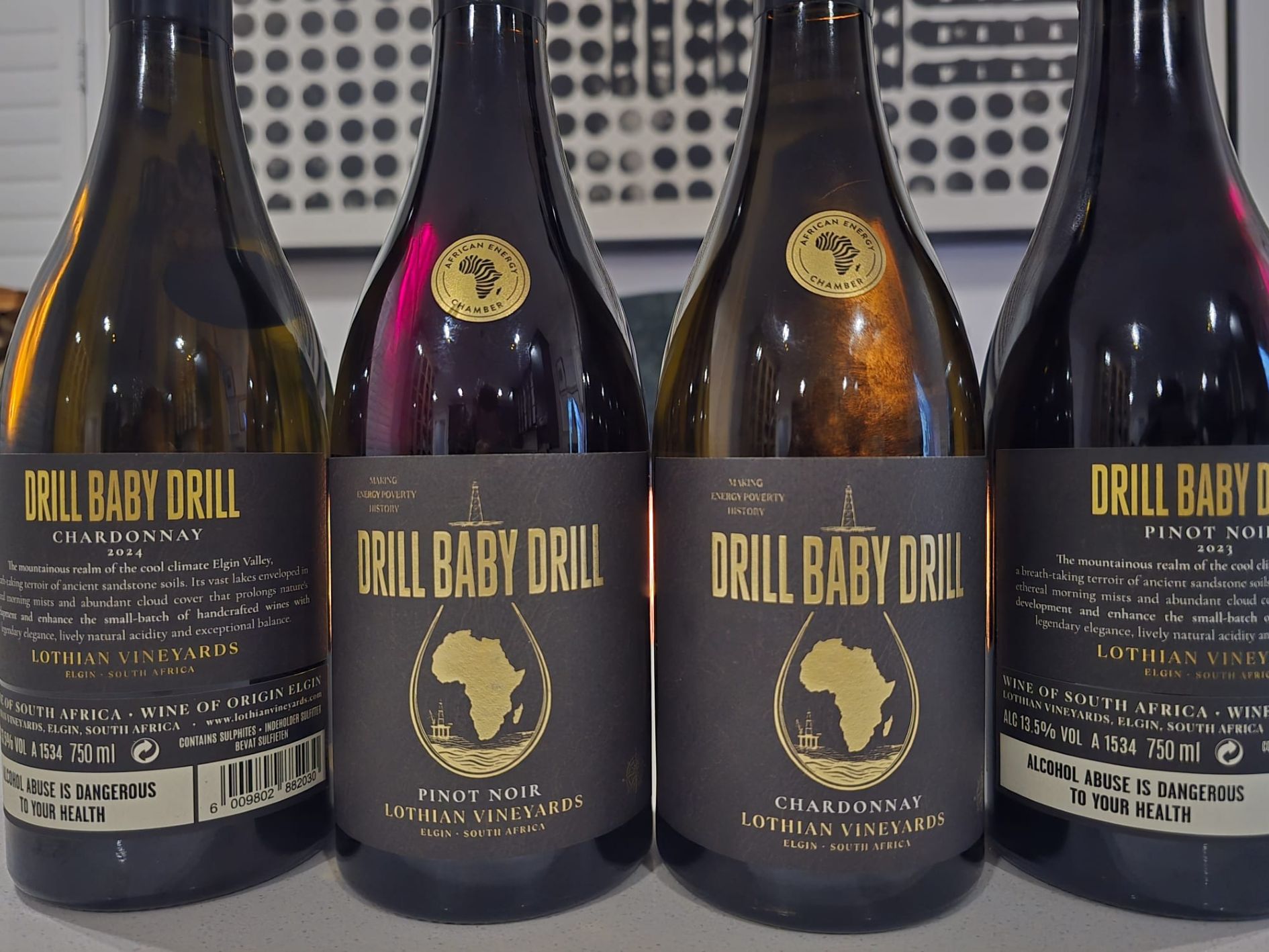
African Energy Chamber backs an unconventional South African wine launch that blends lifestyle branding with a provocative message on energy poverty.
The African Energy Chamber is taking its campaign on energy poverty into unfamiliar territory with the unveiling of “Drill Baby Drill”, a South African wine brand designed to carry an energy-development message far beyond the traditional oil and gas industry.
The new label, presented in a promotional video featuring African Energy Chamber Executive Chairman NJ Ayuk, includes a Pinot Noir and Chardonnay associated with Lothian Vineyards in Elgin, South Africa.
The bottles are difficult to mistake for conventional wine branding. Black-and-gold labels carry the words “Drill Baby Drill”, alongside an African silhouette, an oil-drop motif and drilling imagery. The packaging also bears the line: “An initiative to make energy poverty history.”
That combination turns what might otherwise have been a lifestyle product launch into something more politically charged: an attempt to put Africa’s energy-access argument into everyday consumer culture.
A provocative name with a deliberate purpose

“Drill Baby Drill” is one of the most recognisable slogans associated with support for expanded oil and gas development.
Its use on a wine bottle is therefore unlikely to be accidental.
The African Energy Chamber has long argued that African countries should retain the right to develop hydrocarbons as part of a broader energy mix, particularly while large parts of the continent continue to struggle with unreliable electricity, limited industrial capacity and inadequate infrastructure.
The wine appears to extend that message into a new form.
Rather than presenting the energy argument through a conference speech, policy paper or industry panel, the Chamber is attaching it to a premium consumer product.
That makes the launch unusual, but also potentially effective from a communications standpoint.
From the oil conference to the dinner table
The promotional video adopts the visual language of luxury branding.
There are close-up shots of bottles being opened, wine being poured, corks releasing with smoke effects, and bottles positioned against firelight, urban scenery and mountain backdrops.
Ayuk appears in the video wearing African Energy Chamber-branded clothing, reinforcing the connection between the product and the Chamber’s wider advocacy agenda.
The overall presentation suggests that “Drill Baby Drill” is intended not simply to be consumed but discussed.
That may be the more important part of the concept.
Energy poverty is usually treated as a technical or policy subject. By putting the issue onto a wine label, the campaign attempts to make it more visible and culturally accessible.
A bottle sitting on a dinner table can potentially trigger a question that an energy report might not.
Why is an African energy organisation putting this slogan on wine?
The answer leads directly back to the continent’s broader development debate.
South African wine, continental message
The labels identify the wines with Lothian Vineyards in Elgin, one of South Africa’s established cool-climate wine regions.
That gives the product a strong South African identity, while the branding points deliberately to a continental message.
South Africa is also closely associated with the African Energy Chamber through African Energy Week, its annual industry gathering in Cape Town.
The launch therefore brings together two very different elements of South African economic and cultural life: wine production and the energy sector.
The result is a product whose provenance is local but whose intended argument is continental.
More than a branding exercise?
The biggest question surrounding the launch is whether the product is intended primarily as a branding platform or whether it will also have a direct development impact.
The promotional material reviewed links the wine to the ambition of making energy poverty history, but does not spell out whether sales proceeds will fund specific projects, programmes or advocacy initiatives.
That distinction matters.
If part of the revenue is directed toward measurable energy-access interventions, the product could become a fundraising vehicle as well as a branding exercise.
If not, its principal value may lie in generating attention and extending the Chamber’s messaging to new audiences.
Either way, further details on pricing, retail availability, distribution, launch date and the precise commercial relationship with Lothian Vineyards will be important as the rollout develops.
A brand built to trigger debate.
The slogan itself almost guarantees that the product will attract both support and criticism.
Advocates of expanded African oil and gas development may see it as a bold statement about energy sovereignty and the continent’s right to determine its own development pathway.
Critics of fossil-fuel expansion are likely to see the branding as deliberately confrontational at a time when climate policy is increasingly focused on decarbonisation and renewable energy.
That tension may be part of the brand’s strategy.
A neutral name would attract less attention.
“Drill Baby Drill” invites reaction.
And reaction creates conversation.
The bigger story is the message
The launch ultimately raises an interesting question about how institutions communicate complex policy positions.
The African Energy Chamber has spent years arguing that Africa’s energy debate should not be defined solely by climate targets or external transition models, but also by the continent’s need for electricity, industrialisation, jobs and economic growth.
With this wine, that argument has been given an entirely different vehicle.
The bottle is the product.
But the real proposition is the conversation around it.
If the campaign succeeds, “Drill Baby Drill” may be remembered less as an unusual wine label and more as an attempt to make Africa’s energy-development argument impossible to ignore.

