 Follow Us on Google News
 Follow Us on Google Discover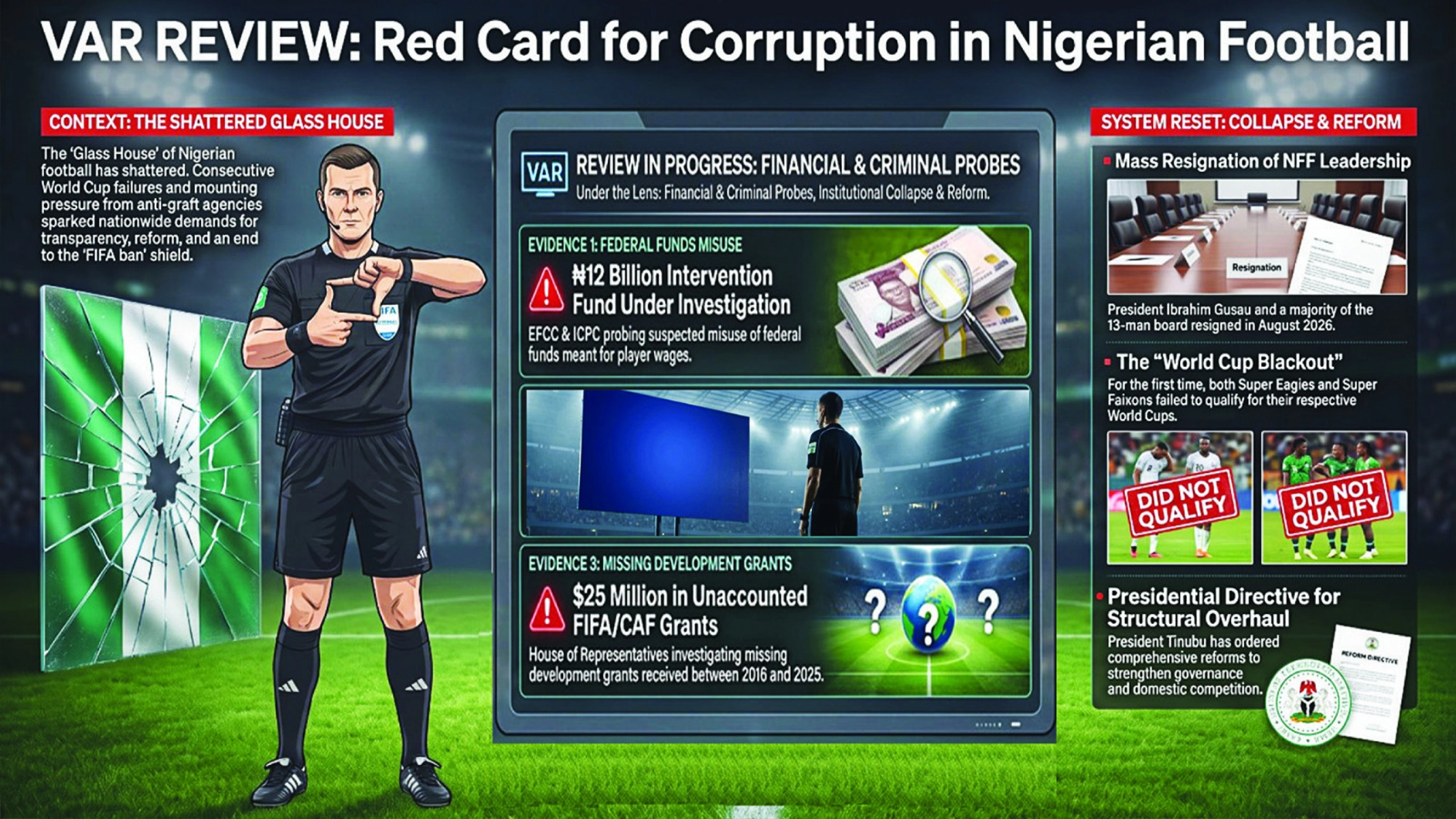
• Gusau, Sanusi yield to pressure as board members resign en masse
• Emergency NFF meeting to find new helmsmen
• Fashola, Soname, Amadu, Ekeji, others on the cards of football reorganisation committee
• Tinubu calls for comprehensive reform of football
The global push for accountability in football federations and their funding yesterday recorded its latest casualty in Nigeria, with the forced resignation of the entire leadership of the Nigerian Football Federation (NFF).
The Ibrahim Gasau-led NFF board caved in to pressure following a series of dismal results across Nigeria’s national teams, leaving many football followers disenchanted and intensifying calls for financial scrutiny of the Glass House.
Besides Gusau, the federation’s General Secretary, Dr Mohammed Sanusi, the entire board and all members of the executive committee resigned their positions after earlier insisting on completing the four-year tenure and seeking reelection later this year.
Following the exit, however, football stakeholders yesterday renewed calls for the restructuring of the federation before the next elective congress, urging people with a proven track record in sports and public administration to midwife a new board.
Coincidentally, it came at the time the Fédération Internationale de Football Association (FIFA) is facing major legal, criminal, and institutional investigations over deep-seated allegations of financial mismanagement, fraud, and a lack of accountability.
European football’s governing body (UEFA) has launched explosive criminal legal proceedings in Switzerland against FIFA and its president, Gianni Infantino. The investigations centre on a secret, year-long strategy to sell off massive commercial stakes in flagship global tournaments to private investors.
Gasau said his resignation followed consultations with his family, friends, and stakeholders within the football community. He added that he had communicated his decision to the members of the executive committee.
The NFF president confirmed that the decision to resign has been taken after careful consideration and in the overriding interest of Nigerian football.
“My resignation is intended to give way to a comprehensive and orderly reform process aimed at addressing the longstanding institutional, governance and developmental challenges confronting Nigerian football.”
At a press conference inside the NFF Secretariat in Abuja, Gusau, who also served as president of WAFU B, said he was leaving office with a sense of satisfaction over what his administration had achieved during his tenure.
He highlighted the renewed, vigorous focus on coaching education, noting that coaching courses have been organised across virtually all licence categories, with the long-awaited CAF A-License course set to commence on September 13.
He also pointed to the improved stability in the domestic league calendar, progress in the refereeing sector and infrastructure in the form of a 68-room players’ hostel and new training pitches at the MKO Abiola National Stadium, not forgetting silver- and-bronze medal earnings of the Super Eagles from the past two Africa Cup of Nations tournaments, and the Super Falcons’ WAFCON triumph in Morocco in 2025.
The forced exit is not unconnected with many poor results, including the Super Falcons’ failure to qualify for the next World Cup. It is Nigeria’s first absence since the competition was launched in China 35 years ago. Earlier, the Super Eagles had also failed to reach the 48-team FIFA World Cup finals held in the United States, Canada and Mexico in the summer. Similarly, the U-20 boys’ failure to qualify for next year’s Africa U20 Cup of Nations.
The poor results have brought the federation under scrutiny, with Gusau and his members being scrutinised over the federation’s handling of government funds. The Guardian learnt that anti-corruption agencies are examining the utilisation of a N17 billion federal government intervention fund approved for the NFF.
The financial probe follows years of player unrest. In November 2025, the Super Eagles boycotted training in Morocco ahead of a World Cup play-off over outstanding allowances dating back to 2019. In April 2026, members of the U-20 Flying Eagles revealed they were owed qualification bonuses and camp allowances.
Stakeholders begin search for new helmsmen
REPORTS yesterday had it that an emergency NFF congress is on the cards, and it seems the resignation fever will spread to state FA chairmen.
Insiders in top football circles are already saying that former Lagos State Governor, Babatunde Raji Fashola, owner of Remo Stars, Kunle Soname, former NFF Secretary General, Musa Amadu and former Director-General of the National Sports Commission (NSC), Patrick Ekeji, are among frontline candidates being tipped to head the committee.
Sources at the National Sports Commission (NSC) said yesterday that Soname, who also owns a betting outfit, Bet9ja, has been approached to head the committee, but it seems that the business mogul is reluctant to take up the job “due to his busy schedule.”
“We are trying to get the Presidency to encourage Soname to take up the mantle because helping to restructure Nigerian football and getting it working again is one of the greatest things anybody can do for this country,” the source said.
The Guardian learnt that former NFF Secretary-General, Musa Amadu, a lawyer, is being tipped to head the committee.
A former candidate for the NFF’s top post, Amadu is seen as the ideal person to address the numerous issues dogging the federation at the moment.
The Guardian also learnt that names like Fashola, a football-lover, and that of Ekeji, a former Green Eagles player, were also mentioned as top candidates to head the committee to run football affairs, and put in place some of the missing links in NFF’s electoral status.
But Fashola, like Soname, has not agreed to head the committee, citing “very busy schedules,” but some top officials in the Presidency are still “on his neck” because they believe he has the capacity to reorganise the football house.
Ekeji, on his part, has a good track record that speaks volumes as both a player and an administrator. He led Team Nigeria’s campaign at the COJA 2003 Africa Games hosted in Abuja and was part of the then Green Eagles team that won Nigeria’s first Africa Nations Cup trophy in 1980.
Tinubu calls for comprehensive reforms
PRESIDENT Bola Tinubu has directed a comprehensive reform of to overcome repeated failures to qualify for major regional, continental and world tournaments.
The directive was contained in a press statement released to the media by Bayo Onanuga, the Special Adviser to the President on Information and Strategy.
“The reform must respond to a longstanding need to strengthen governance, administration, stakeholder representation, development pathways, domestic competitions and accountability across Nigerian football,” he said.
The President noted that while other sports had recorded meaningful progress since the reset of the sports sector under the re-established National Sports Commission, football has continued to struggle because of structural weaknesses within the system.
“Football, Nigeria’s most popular sport and the greatest beneficiary of public support, investment and national attention, has continued to struggle basically due to structural deficits within the system,” Tinubu said.
He stressed that Nigerian football must begin to match the country’s exceptional talent, passion and resources with stronger institutions and sustained performance.
President Tinubu directed the Chairman of the National Sports Commission to work with the NFF Secretariat and relevant football stakeholders to ensure continuity in essential football administration and facilitate a broad, consultative reform process.
The process will include appropriate engagement with FIFA and CAF while safeguarding Nigeria’s obligations within the international football framework.
The President called on football stakeholders and Nigerians to support the transition and work together to build a stronger, more accountable and successful football system.
Meanwhile, former Super Eagles and Shooting Stars of Ibadan goalkeeper, David Aigbovo, has said that Gusau should have resigned long ago to save his face.
“I have been sending messages to Gusau to resign following the freefall of Nigerian football, but he refused. He should have done that long ago to save his face. The next stage should be the purging of the NFF Technical Department and some staff who have been in the system for the past 20 years. Even the State FA Chairmen, who have been holding our football to ransom in the last 15 to 20 years, must not find their way back into the system. They have to go for our football to grow,” Aigbovo said.
Before Gusau and his board finally bowed out yesterday, some of his loyalists threatened that the world football governing body, FIFA, would ban Nigeria if Gusau was not allowed to feature in September’s elective congress.
But United States-based former Flying Eagles and Super Eagles player, Paul Okoku, had erased such a threat a few days ago, saying that Nigerians should stop allowing the threat of FIFA’s ban to shut down legitimate governance and accountability at home.
Okoku, now a sports analyst, told The Guardian that, though FIFA has repeatedly warned Nigeria about interference, statutes and good governance, Nigerians should stop allowing the threat of a “FIFA ban” to shut down legitimate governance and accountability at home.
“National associations, confederation leaders, senior FIFA officials and supporters are questioning transparency and accountability inside FIFA itself, so Nigerians should stop allowing the threat of a
“FIFA ban” to shut down legitimate governance and accountability at home.
“For years, one warning has carried extraordinary weight whenever Nigerian football enters another administrative dispute.
FIFA itself is facing one of the most serious leadership and governance crises of Gianni Infantino’s presidency. Member associations are withdrawing their support from the former UEFA secretary-general.
Already, three confederations are discussing whether a no-confidence challenge is possible, Okoku said, adding that what Nigerians were demanding was governance reform. “None of that makes FIFA powerless, and none of it cancels FIFA’s statutes. But Nigeria should have enough institutional self-respect to stop behaving as though every domestic disagreement must be carried to Zurich and every mention of FIFA suspension should end the conversation.
“There is something deeply inconsistent about demanding unquestioning deference to an institution whose own members and senior officials are now demanding greater transparency and accountability from its leadership. Before Nigerian football stakeholders rush once again to FIFA with domestic disputes, perhaps we should ask a harder question: Are we using FIFA’s rules to protect football independence — or using the fear of FIFA to protect people and institutions from legitimate accountability?” Okoku queried.
The President of the Super Eagles Supporters Club, Vincent Okumagba, told The Guardian yesterday that Gusau’s resignation is a significant development in Nigerian football.
While wishing Gusau and his board well in their future endeavours, Okumagba said that, as supporters and stakeholders, their greatest desire is to see Nigerian football thrive and regain its rightful place on the global stage.
“The failure of both our senior national teams—the Super Eagles and the Super Falcons—to qualify for the World Cup is undoubtedly a bitter pill for every Nigerian football lover to swallow,” he said.
“However, we must look ahead with renewed hope. Nigerian football has the talent, passion and enormous potential to rise again.”
The chief executive officer of Monimichelle Sports Management Company, Ebi Egbe, described the development as the beginning of sincere hope and a new chapter for Nigerian football.
“This is not a time for triumphalism, revenge or the replacement of one faction with another,” Egbe said.
“This is the time to rebuild. Nigeria needs an NFF that is an inclusive, transparent, accountable, professional, and united administration where football development comes before personal interests, factional politics, and individual gain.
“We must now chart a new path built on inclusive representation, transparent and credible elections, professional football administration, strong grassroots development, better welfare for players and coaches, world-class facilities and pitch management, proper accountability for public funds, a clear maintenance and development policy and unity among all stakeholders. Let there be no victor and no vanquished. The only victor must be Nigerian football,” Egbe stated.
While the debate over who should take over leadership of Nigerian football rages, some stakeholders say it is time to look inward and engage real professionals to run the affairs of the NFF.
The names of former Super Eagles midfielder Seyi Olofinjana and Chelsea’s former director, Michael Emenalo, have come up in discussions.
Olofinjana, who led the National Sports Commission (NSC)’s Diaspora football recruitment in London in July, is said to be backed by some influential figures within the Sports Commission.
The 46-year-old has built impressive experience in football administration since retiring from playing.
He worked with Wolverhampton Wanderers as Loans Pathway Manager, and later became Sporting Director at Grasshopper Club Zürich in Switzerland.
In 2024, he joined Chelsea as Head of Scouting, focusing on identifying talent across Africa. Olofinjana also holds a UEFA Pro Licence and a master’s degree in Sports Directorship and Project Management.
Emenalo, who is currently head of football development in Saudi Arabia, was the brain behind the new Saudi Pro League, which has risen to become one of the big players in the global game.

