 Follow Us on Google News
 Follow Us on Google Discover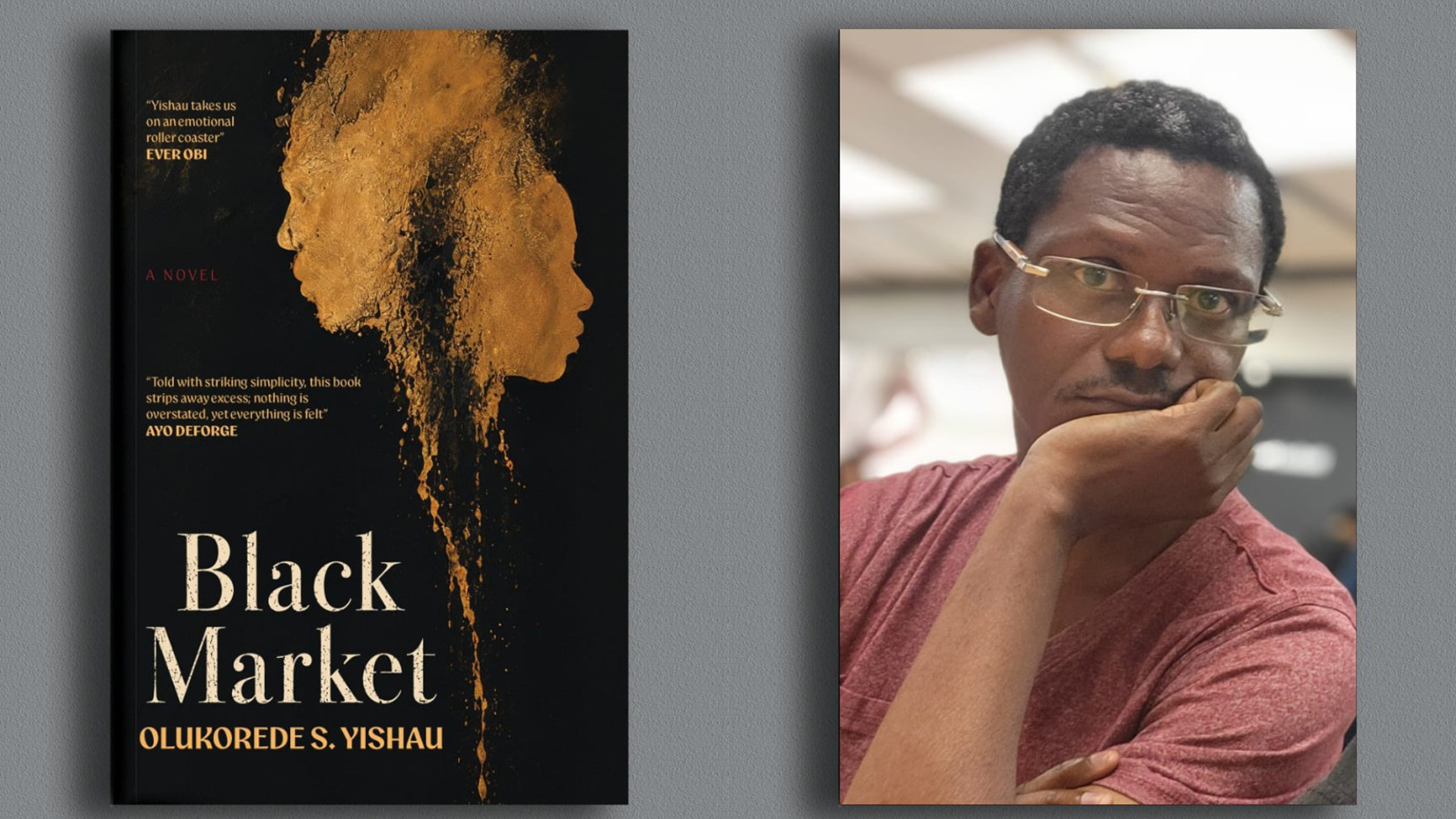
There is an irony in the title of Olukorede S. Yishau’s new novel, ‘Black Market’. The title sounds like a place where something is bought cheaply, secretly or illegally. It suggests currency changing hands beneath a table, fuel being sold from the boot of a car, or a commodity finding its way through a channel that respectable commerce would rather pretend does not exist.
But Yishau is not writing about the parallel economy. His black market is marriage. More precisely, it is the Yoruba idea of ‘Oja Okunkun’, a phrase that, as the author explains, is sometimes used to describe marriage. The phrase becomes the key to unlocking a story about Nigerians who have crossed the Atlantic in search of something better and discovered that geography can change a person’s address without necessarily changing the person. They also find out that sometimes the most important border a person must cross is not the one between Nigeria and America, but the one between the person we pretend to be and the person we really are.

“I never set out to moralise,” Yishau says in an interview.
That sentence may be the best entry point into ‘Black Market’.
The novel, his third, is not presented as a sermon on marriage, migration or the Nigerian diaspora. Instead, it places people inside complicated circumstances and allows their choices, wounds, secrets and desires to speak for themselves.
Scheduled for release on September 29, 2026, by Masobe Books, ‘Black Market’ follows two Nigerian couples living in Texas, Eyitayo and Yewande, and Tobi and Bukola. But beneath the apparent simplicity of two marriages is a larger question that many Nigerian immigrant families may recognise: does bringing a spouse from Nigeria really make a marriage safer, more culturally compatible or more likely to succeed?
Yishau says the idea began with observation. When he moved to the United States about five years ago, he took more than a cursory interest in a practice that had existed in Nigerian immigrant communities for decades. Nigerians living in America often return home to find spouses, partly because of the belief that somebody raised within Nigerian culture would make a better partner than a foreigner unfamiliar with Nigerian traditions.
There is another belief too, he says. Single Nigerians already living in America are sometimes regarded as less desirable marriage material than those who could be brought from home.
But the reality he encountered in Houston did not always support that assumption.
Bringing a spouse from Nigeria, he observes, was no guarantee of a good home. Marriage still came with its ordinary complications, except that migration could add another layer to them. Two people might marry without truly knowing each other, and one partner might discover unpleasant truths only after the move to America. Then there are the expectations and interventions of extended families. That is where ‘Black Market’ becomes more than a conventional immigrant story. The familiar diaspora narrative usually begins with departure. Someone leaves Nigeria. There is an airport. There is excitement, fear, the first snow, the first paycheck, the first encounter with racism, the first American supermarket and the inevitable struggle to retain one’s identity. Yishau begins somewhere else. His characters have already crossed the border. The drama is what happens afterwards, including the realisation that there is no currency strong enough to buy back time.
Masobe Books’ synopsis introduces “Eyitayo as a successful accountant whose apparently orderly Houston life begins to crack when his ageing parents arrive from Nigeria. His father’s failing health, his wife’s resentment and a secret threaten the stability he believes he has constructed. Elsewhere, Bukola is trying to rebuild after an abusive marriage that cost her almost everything, including her children. Just when she begins to believe that love may offer another beginning, betrayal intervenes”.
These are not characters who are simply trying to survive America. They are trying to survive themselves. And that distinction matters.
Yishau’s earlier fiction has often been interested in what lies beneath the surface of ordinary lives. His debut, ‘In the Name of Our Father’, explored religion, power, poverty, dictatorship and the moral compromises of Nigerian society. The novel was longlisted for the 2021 Nigeria Prize for Literature and attracted considerable critical attention, including academic papers.
His short-story collection, ‘Vaults of Secrets’, returned repeatedly to the things people conceal, particularly within families and relationships. Critics noted its attention to family, abuse, violence and the secrets that shape ordinary lives.
Then came ‘After the End’, a novel about grief, betrayal, love and the discovery that a person one thought one knew could have lived another life entirely. Critics repeatedly point out Yishau’s fascination with duality and the secrets people carry behind apparently respectable lives.
‘Black Market’ appears to continue that interrogation, but the geography has changed. This time the houses are in Texas. The emotional baggage remains.
Yishau is particularly careful not to make immigration the villain. Asked about the hidden costs of the immigrant dream through Eyitayo’s story, he refuses to reduce the marital problems in the book to migration. Every marriage, he says, has challenges. Some are minor. Others are devastating. The difference is that where the characters live affects how those problems are handled.
“No sugarcoating, no pun, just plain facts,” he says of his approach to depicting the competing pressures faced by his characters.
It is a revealing statement because ‘Black Market’ appears interested in the uncomfortable space between what Nigerians say they believe and what human beings actually do. It shows that when Nigerian family values travel, expectations go with them, old wounds refuse to be left at home, secrets ensure they are not left behind and once they cross over, America does not magically erase any of them.
Yishau says Nigerians abroad remain connected to family values and cultural obligations even when they are physically distant from Nigeria. The difficulty is that those obligations can collide with an individual’s desire for freedom. That collision appears to sit at the heart of the novel.
For the Nigerian immigrant, America can mean personal freedom, economic opportunity and a chance to escape some of the restrictions of home. Yet the immigrant does not arrive empty-handed. He or she arrives with parents, siblings, religion, expectations, memories, shame, ambition and an idea of what success should look like. Sometimes the most difficult part of migration is not leaving home. It is discovering that home has followed you. That is particularly significant when spouses are selected partly because they are considered culturally familiar, mistaking cultural familiarity with personal compatibility.
Yishau does not directly answer the question for the reader. Instead, he asks several others: Has bringing spouses from Nigeria really produced better marriages? Do those marriages escape the ordinary difficulties of marriage? If cross-cultural marriages can work, why assume that a Nigerian spouse automatically offers greater security? And perhaps the sharpest question: if somebody who cheats in Nigeria moves to America, does the change of country turn that person into a different human being? Yishau wonders whether “a cheat imported from Nigeria” will somehow become a saint in America. This inquisition assumes greater meaning when one remembers that behind it are real homes, real children and real heartbreak.
This may also explain why the title works. The marriage market, like every market, can create the illusion that the right transaction will produce the right result, but people are not commodities and a marriage cannot be contracted with the expectation that geography will provide the warranty and migration will repair a character flaw that existed before the plane took off.
That is where the novel’s Houston setting becomes important; it is not merely a backdrop. It is the city in which Nigerian aspirations, American realities and expectations meet; a city where a person can work hard, earn well and still feel profoundly alone, a place where Nigerian social life can flourish alongside American individualism. It is a landscape the author intimately knows, where his professional life straddles journalism and fiction.
Masobe Books describes him as a multiple award-winning journalist, a beneficiary of the U.S. Department of State’s International Visitor Leadership Programme and a graduate of the University of Iowa’s African cohort writing programme. He has also been recognised by the Nigeria Media Merit Awards, including as Columnist of the Year.
His double life as journalist and novelist matters because journalism makes him observe and fiction allows him to interpret and in ‘Black Market’, the two instincts appear to meet.
“I just want to show the realities in its raw forms,” he says.
That is perhaps why Bukola is particularly important. Her story introduces another dimension to the novel: the woman who arrives in a new place carrying the weight of an old life. Masobe Books describes her as a woman rebuilding herself after an abusive marriage that cost her almost everything, including her children. Yishau does not tell readers what to think about her. He says that is deliberate because one reader may sympathise with one character and another reader may reach the opposite conclusion.
“I have made peace with it,” Yishau says of the inevitability of readers interpreting his characters differently.
And that is a useful philosophy for a novel about marriage because often marriage is a story told by two people who witnessed the same events and remember them differently; when one remembers sacrifice, the other remembers neglect; one calls it love and the other calls it control; one says there was no choice and the other says there were many choices and the wrong ones were made. ‘Black Market’ appears to inhabit that uncomfortable territory.
Masobe Books, which acquired the novel as Yishau’s third novel and fifth book, describes it as a story about “family, marriage, migration, betrayal, and the hidden transactions people make” in their pursuit of love, belonging and survival. The publisher has set the book at 280 pages and categorised it as literary fiction. The choice of “transactions” is striking and it brings the title back into view and raises posers: What do people trade for marriage? What do they trade for migration? What do they trade for acceptance? What do they sacrifice for the appearance of success? And what happens when the price turns out to be higher than expected?
The three endorsements published by Masobe Books point to the emotional quality of the novel. Ever Obi, the author of ‘Men Don’t Cry’, describes it as an emotional journey through the vulnerable states of two immigrant couples. Nathaniel Bivan, the author of ‘Boys, Girls and Beasts’, says Yishau’s scenes feel too real to be confined to the page, while Ayo Deforge, the author of ‘Tearless’, praises the book’s simplicity and restraint.

