 Follow Us on Google News


 Follow Us on Google Discover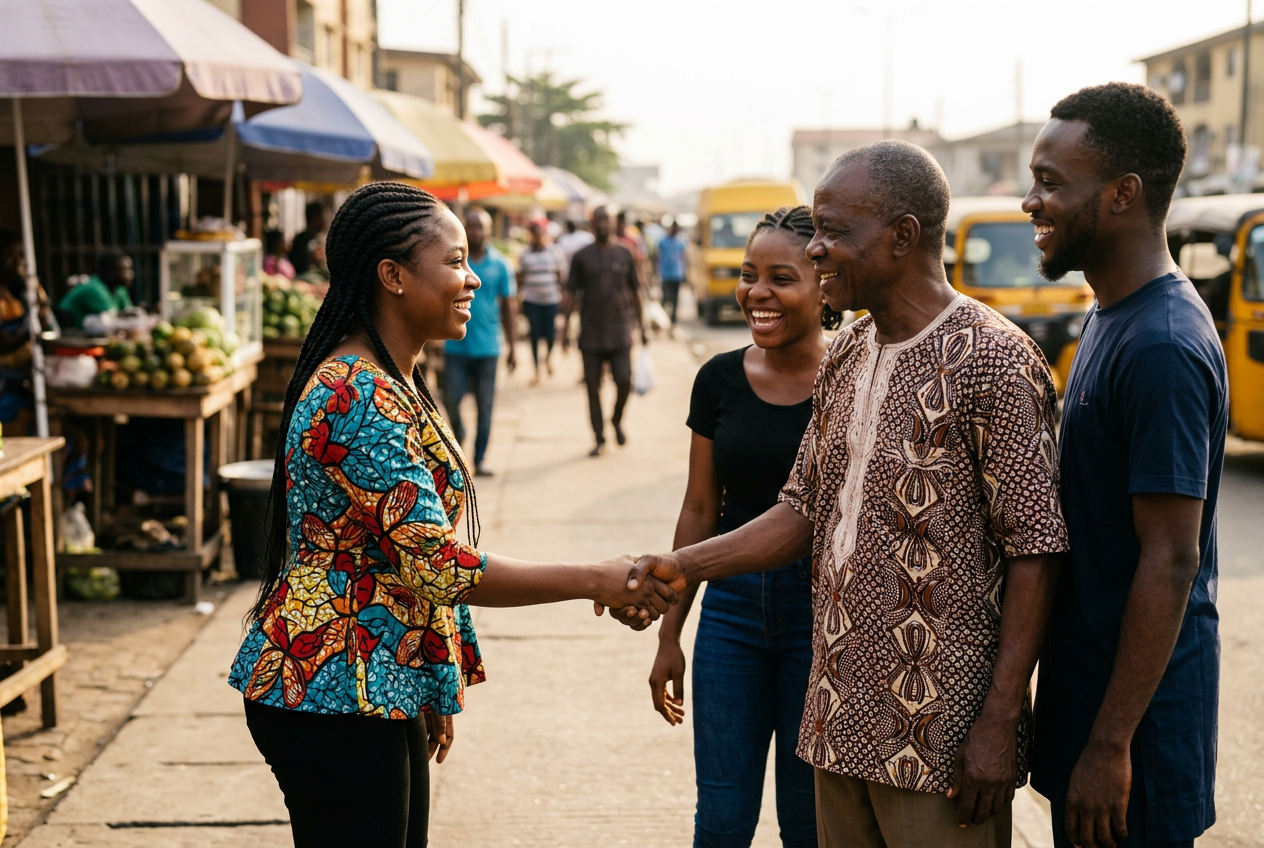
Hello there, and thank you for finding your way here. What follows comes out of months of research and years of getting this wrong in public before slowly getting it right. So, how do you say hello in Nigerian? The slightly annoying answer is that there is no single Nigerian language to say it in. What there is instead is a country of more than five hundred living tongues, three enormous regional languages, English inherited from the colonial period, and the creole that stitches the whole thing together in markets from Warri to Wuse.
I have been writing about Nigerian culture and identity for years now, and no topic generates more email than this one. People want a phrase they can carry into a room. Something short. Something that will not make an aunty wince.
I understand the impulse completely. When I first started travelling regularly between the South West and Kano for work, I carried a folded sheet of paper in my wallet with about twelve phrases on it. Half of them were wrong. Two of them were, I later discovered, borderline rude when used by someone my age towards someone twenty years older. My Hausa colleague eventually took the paper off me, read it, laughed for an uncomfortably long time, and then spent an afternoon teaching me the version that actually works.
That afternoon changed how I think about this question entirely.
Because a greeting in Nigeria is not a word. It is a small negotiation about age, rank, region, time of day, whether you are related, whether the other person has eaten, whether they have travelled, and whether you are in a hurry (you should not be). Get the word right and miss the negotiation, and you have still failed. Get the word slightly wrong but handle the negotiation with warmth, and most Nigerians will meet you more than halfway.
So let me give you the phrases. But let me also give you the thing behind the phrases, because that is the part nobody puts on a flashcard.

What Is a Greeting in Nigeria, and Why Does It Carry So Much Weight?
Start here, because everything else follows from it.
In most of the places I have lived and worked outside Nigeria, a greeting is a doorway. You pass through it quickly to get to the actual conversation. In Nigeria, the greeting frequently is the conversation. I have watched two men in Kano spend a full four minutes greeting each other, working steadily through health, night, family, work, the road, and the general state of things, before either of them mentioned the business that had brought them together.
Four minutes. For a transaction that took ninety seconds to complete.
That is not inefficiency. That is the transaction. The greeting establishes that you are people to each other before you are parties to a deal, and skipping it marks you as someone who sees the other person purely as a means to an end.
There is a structural reason for the weight, too. Nigeria is not linguistically neutral ground. The country’s language question runs directly through education policy, national identity, and regional politics, and it has been unusually live in recent years. The Federal Ministry of Information and National Orientation confirmed that the National Council on Education reaffirmed English as the medium of instruction from primary through tertiary level, cancelling the 2022 policy that had prescribed mother tongue teaching in the earliest primary years. The reversal was contested immediately. The Nigerian Academy of Education pressed the minister to restore mother tongue instruction, arguing that pupils taught first in their own languages perform better academically, including in English.
You can hear that argument continuing in the broadcast coverage of calls to promote the mother tongue within the national system. It is not a settled matter, and it will not be settled soon.
Why does a schools policy argument belong in an article about saying hello? Because it tells you what the stakes are. When a Nigerian hears you attempt their language, however badly, they are not just hearing a phrase. They are hearing someone treat their tongue as worth the effort at a moment when a good many Nigerians feel their languages are quietly losing ground. Guardian’s opinion pages have covered the slow erosion of Nigeria’s indigenous languages in some detail, including the classification of Igbo as endangered by UNESCO and the pattern of young speakers unable to hold a conversation in the language of their grandparents.
So the effort registers. Genuinely.
There is also a hierarchy embedded in almost every Nigerian greeting system, and it is the single most common thing outsiders get wrong. The younger person greets first. Not the person who arrives, not the person who has business to raise, but the younger one. Waiting for an elder to greet you is a small social offence in Yoruba culture and an odd move almost everywhere else.
Remember that one thing and you are already ahead of most visitors.
So How Do You Say Hello in Nigerian? The Direct Answer
Right. Here is the answer, stated plainly, because you have been patient.
There is no single word for hello in Nigerian, because there is no language called Nigerian. What you actually need is a small set of four phrases, each of which covers a large chunk of the country, plus one universal fallback. In Hausa, across the North, you say “Sannu”. In Yoruba, across the South West, you say “Bawo ni” to a peer and a time-based greeting such as “E ka aro” to anyone older. In Igbo, across the South East, you say “Ndewo” or “Kedu”. In Nigerian Pidgin, which crosses every regional and ethnic line in the country, you say “How far?” or “How you dey?”. And if you have no idea where the person is from, a warm English “Good morning, sir” or “Good afternoon, ma” is understood everywhere and read as respectful rather than lazy.
Those five options cover the overwhelming majority of everyday situations you will encounter. The closely related entities worth knowing alongside them are the honorifics, which do a surprising amount of work on their own:
- Sir and ma (or madam), used far more freely in Nigeria than in Britain, and attached to anyone senior in age or position
- Aunty and uncle, used for non-relatives who are roughly a generation above you
- Oga and madam, in Pidgin, for a boss or anyone whose authority you are acknowledging
- Baba and mama, for genuinely elderly people, warm rather than presumptuous
- Nna and nne in Igbo, and egbon for an older sibling or senior in Yoruba
Attach the right honorific to even a clumsy greeting and you will be forgiven a great deal. Drop the honorific and deliver a perfect greeting, and you may still land badly.
Hello Across Six Nigerian Languages Compared
The table below sets out the everyday form, the time-specific alternative, the standard reply, and a rough sense of scale for each. Speaker figures include second-language users and vary considerably between sources, so treat them as orders of magnitude rather than precise counts.
| Language | Main region | Everyday hello | Time-specific form | Usual reply | Approximate speakers |
|---|---|---|---|---|---|
| Hausa | North West and North East | Sannu | Ina kwana (morning), Ina wuni (afternoon) | Lafiya lau | Around 60 to 80 million |
| Yoruba | South West | Bawo ni | E ka aro, E ka san, E ku irole | Mo wa daada | Around 45 to 55 million |
| Igbo | South East | Ndewo or Kedu | Ututu oma, Ehihie oma, Mgbede oma | O di mma | Around 30 to 45 million |
| Nigerian Pidgin | Nationwide | How far, How you dey | Good morning o, You don wake | I dey fine | Well over 100 million |
| Efik and Ibibio | South South, Akwa Ibom and Cross River | Mesiere | Emesiere idem | Idem odiong | Several million |
| Edo or Bini | Edo State and surrounds | Koyo | Obokhian (welcome) | Vbe obo | Around one to two million |
Two things jump out of that table. First, Pidgin has quietly become the largest greeting system in the country by reach, outstripping every indigenous language while holding no official status whatsoever. Second, the time-specific forms matter far more in Hausa and Igbo practice than the generic hello does, which is precisely the detail a phrasebook tends to flatten.
How Do You Say Hello in Igbo, and What Else Should You Know?
Igbo deserves its own section, partly because it is the language readers ask about most and partly because the popular answer is slightly off.
The two words you will see everywhere are “Ndewo” and “Kedu”. They are not interchangeable. “Ndewo” is a greeting proper, roughly equivalent to a respectful hello, and it works well with elders and in formal settings. “Kedu” is a question, meaning how are you, and it functions as a friendly opener among peers. To greet several people at once, “Ndewo” becomes “Ndewonu”.
The standard reply to “Kedu” is “O di mma”, meaning it is fine, or “Adi m mma”, meaning I am well.
Now for the part that surprises people. Those tidy time-based greetings you find on every language app, “Ututu oma” for good morning, “Ehihie oma” for good afternoon, “Mgbede oma” for good evening, are relatively modern constructions. Several Igbo language authorities describe them as literal translations of the English forms rather than traditional greetings, and note that older speakers in Owerri, Anambra and Umuahia have their own patterns that predate them. In parts of Owerri you might hear “I bola chi”, asking whether the person has woken, answered with “Ee, i bola”.
I learnt this the awkward way at a wedding in Enugu, where I confidently produced “Ututu oma” to a man in his eighties and got a perfectly polite reply followed by a very small, very knowing smile from his daughter.
Nobody minds. Everybody notices.
The other thing worth carrying into an Igbo conversation is “Daalu”, which does double duty as thank you and as an acknowledgement, and “Nnoo”, which means welcome and is what you will hear the moment you step into someone’s compound. Respond to “Nnoo” with “Daalu” and you have already handled the exchange like someone who has been there before.
Physical form is gentler in Igbo custom than in Yoruba practice. A slight bow, a clasping of the hands, and offering or receiving with the right hand rather than the left will carry you comfortably. Women often bend a knee slightly for elders. Full prostration is not the Igbo pattern.
And a small note on tone. Igbo is tonal, and the pitch you use changes meaning. Do not let that stop you. Nigerians are used to hearing their languages spoken imperfectly by other Nigerians, let alone by visitors, and the tolerance for a wobbly tone is far higher than the tolerance for not trying.
What Is the Nigerian Word for “Hi” in Everyday Street Use?
If you want the single most useful informal greeting in the country, it is not in Hausa, Yoruba or Igbo. It is in Pidgin.
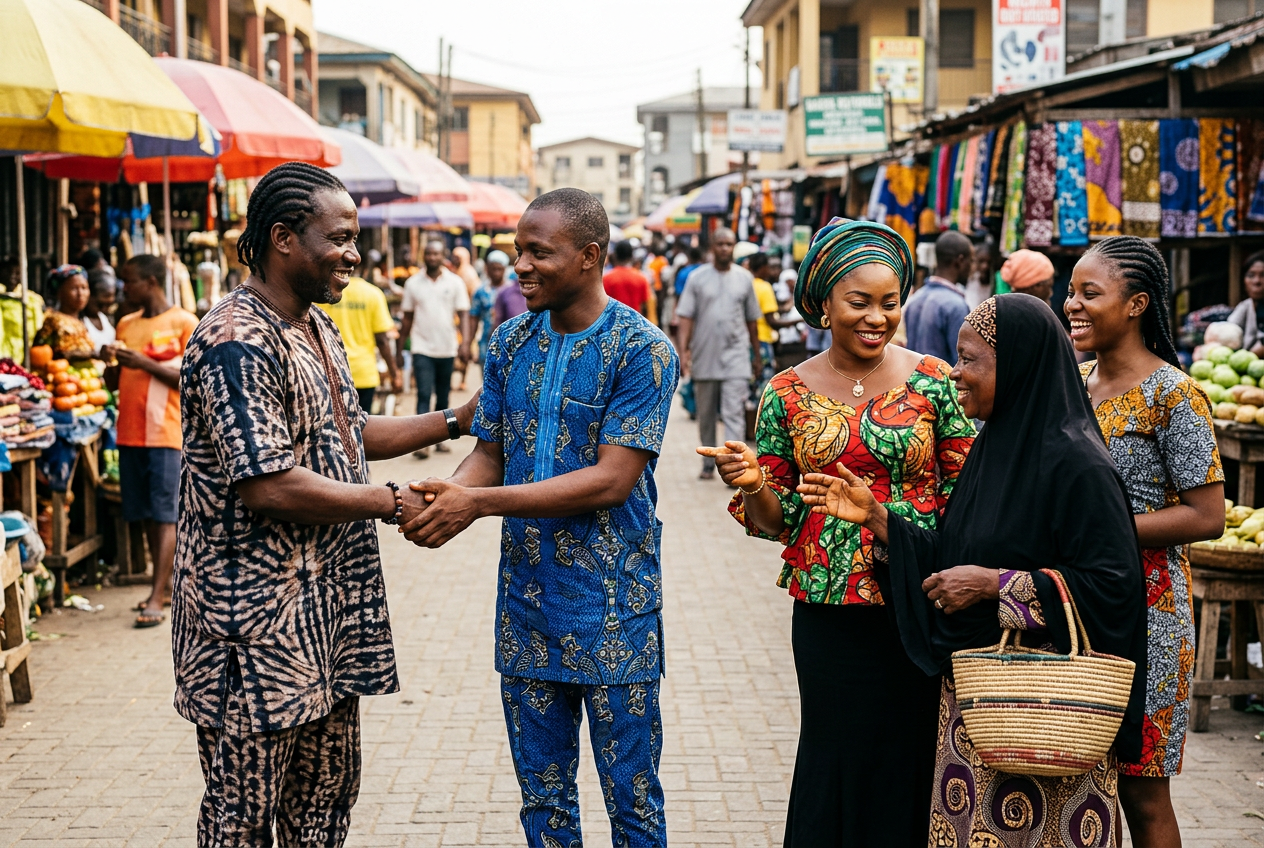
“How far?” is the closest thing Nigeria has to a national hi. You will hear it from a Lagos danfo conductor, a Port Harcourt undergraduate, a Kano trader switching registers for a southern customer, and an Abuja civil servant off the clock. It means, roughly, how are things, and it expects “I dey”, “I dey fine”, or the endlessly flexible “We dey manage”.
Its cousins are “How you dey?”, “How body?”, and “Wetin dey happen?”. All informal. All warm. None of them appropriate for a first meeting with someone senior.
Nigerian Pidgin is worth taking seriously rather than treating as broken English, which is what generations of Nigerian schoolchildren were taught to think of it. It has consistent grammar, its own tense and aspect markers, and a vocabulary drawn from English, Portuguese, Hausa, Yoruba and Igbo. Estimates of speaker numbers run from around 75 million to well over 100 million once second-language users are counted, which would make it the most widely spoken language in Nigeria by some margin. The BBC’s decision to launch a dedicated Pidgin news service in 2017 was a fairly loud acknowledgement of that reality.
Its appeal is not just practical. It is political, in a quiet way.
Pidgin belongs to nobody in particular, which is exactly why it belongs to everybody. Greeting a stranger in Hausa, Yoruba or Igbo makes an assumption about who they are. Greeting them in Pidgin makes no assumption at all. In a country where ethnicity does so much work in daily life, that neutrality is genuinely useful, and it explains why Pidgin thrives most in the places where Nigerians mix hardest: markets, motor parks, university campuses, comedy, Nollywood and Afrobeats.
A short vocabulary that will get you a very long way:
“Abeg” for please. “No wahala” for no problem. “Wetin be your name” for what is your name. “Na so” for that is right. “Well done” or “Sannu da aiki” if you meet someone working, which is a courtesy Nigerians extend constantly and visitors almost never think to offer.
That last one is worth practising. Walking past a woman frying akara at the roadside and saying “well done, ma” costs nothing and lands beautifully.
One caution. Pidgin is informal by design, so keep it away from your first meeting with a professor, a traditional ruler, a bank manager or your partner’s mother. In those rooms, English with the correct honorific is the safe choice, and nobody will think less of you for it.
How Do Nigerians Say “I Love You”?
Since we have covered hello, it seems only fair to cover the phrase people ask about second most often.
In Yoruba, “Mo nifẹ rẹ”, pronounced roughly moh-nee-feh-reh. In Igbo, “A hụrụ m gị n’anya”, which translates literally as I see you in my eye, meaning you are always in my sight. In Hausa, “Ina son ki” when speaking to a woman and “Ina son ka” when speaking to a man, the ending shifting with the gender of the person addressed. In Pidgin, most people simply say I love you, often decorated with “die” for emphasis, as in “I love you die”.
The Igbo phrasing is the one that stays with me. I see you in my eye. There is something more durable in that than in the English formulation, which is about a feeling the speaker has rather than a place the other person occupies.
But here is the cultural texture that the phrasebooks miss entirely.
Direct verbal declarations of love are a relatively recent and largely urban habit in Nigeria. Among older generations, and in many families still, love is demonstrated rather than announced. It looks like school fees paid without discussion. It looks like a father who has never once said the words driving four hours to sit in a hospital corridor. It looks like food kept warm. My own grandmother, to my certain knowledge, never said those words to anyone in eighty-nine years, and no one who knew her doubted the matter for a second.
Terms of endearment do a lot of the work instead. “Nkem” in Igbo, meaning mine. “Obi m”, my heart. “Olufe mi” in Yoruba, my beloved. “Asibiti” and similar affectionate constructions in Hausa. These slip into everyday speech far more easily than a formal declaration would.
Younger Nigerians, particularly in Lagos and Abuja, are considerably more direct, and Afrobeats has done a great deal to normalise saying the thing out loud. Wande Coal’s “Ololufe” alone probably taught a generation the Yoruba word for beloved.
Still, if you are trying to communicate affection to a Nigerian family, learn the phrase by all means. Then show up early, bring something, greet everyone in the room individually starting with the eldest, and stay to help clear up. That will be understood far more clearly than any sentence.
Seven Steps to Greeting Well Anywhere in Nigeria
Here is the sequence I now use, refined over a lot of trial and rather more error.
- Work out who is senior before you open your mouth. Age does most of the work, but position, title and whether someone is a host all count. If you are unsure, assume the other person is senior and adjust upwards from there, because over-respecting costs you nothing while under-respecting costs you the room.
- Greet first if you are the younger party. Do not wait to be greeted, do not wait for an introduction, and do not wait until you have something to say. The initiative itself is part of the courtesy, and in Yoruba settings especially, its absence is read immediately.
- Choose your register before your words. Formal English with sir or ma is safe everywhere. An indigenous greeting signals real effort. Pidgin signals ease and equality, which is wonderful with peers and risky with elders. Pick deliberately rather than defaulting.
- Match the greeting to the time of day where the language requires it. Hausa and Igbo practice both weight this heavily, so “Ina kwana” in the morning and “Ina wuni” in the afternoon will read as considerably more fluent than “Sannu” repeated at every hour.
- Handle your body as carefully as your words. Right hand for shaking, receiving and giving, never the left. Both hands, or the right hand supported at the wrist by the left, when receiving from someone senior. A slight bow for Igbo elders, a dip of the knee or a bend for Yoruba elders, and for Hausa men a slight crouch rather than prostration, since full prostration carries religious weight in an Islamic setting.
- Ask the follow-up questions and mean them. How is the family, how was the night, how is work, how was the road. Two or three of these turn a transaction into a relationship, and Nigerians notice which visitors bother. Budget an extra two minutes into every meeting and you will need them.
- Close properly rather than drifting away. “Ka emesia” in Igbo, “O daabo” in Yoruba, “Sai anjima” in Hausa, or simply “we go see” in Pidgin. Leaving without a closing greeting undoes some of the goodwill the opening one built.
None of this requires fluency. It requires attention, which is a much cheaper commodity and, frankly, the thing being tested.
Practical Notes on Learning, Cost and Getting It Wrong
A word on the practicalities, because readers ask.
If you want to go beyond phrases, private tutoring is widely available and reasonably priced by international standards. In Lagos and Abuja, a private Yoruba or Igbo tutor typically charges somewhere in the region of ₦8,000 to ₦20,000 an hour depending on experience and whether sessions run online or in person, with group classes at cultural centres coming in considerably lower. Church and mosque language groups often teach for nothing at all. Those figures move with inflation and the exchange rate, which sat at roughly ₦1,329 to the dollar at the official window in early September 2026, so treat them as a starting point for negotiation rather than a fixed price.
Free options are genuinely good now. BBC News Pidgin will train your ear faster than any app. Nollywood with subtitles works remarkably well for Yoruba and Igbo. And the most underrated resource of all is the person selling you tomatoes, who will almost certainly correct your pronunciation for free and enjoy doing it.
On getting it wrong: you will, repeatedly, and it matters much less than you fear. The mistakes that actually cause offence are not linguistic. They are skipping the greeting entirely, using the left hand, addressing an elder by their first name, or barrelling into business before the pleasantries have run their course.
Mispronouncing “Ndewo” is not in that category. It is, if anything, endearing.
There is a wider argument running through all of this, and it is worth knowing about if you are going to spend time in Nigeria. Guardian columnists have made a forceful case for defending indigenous languages against the education policy reversal, while the paper’s editorial position has described the cancellation of the language policy as a reversal worth revisiting. Nigerians are not neutral about their languages. Which is exactly why your attempt to use one carries more weight than you might expect.
Final Thoughts on How You Say Hello in Nigerian
If you take nothing else from this, take the reframing.
The question is not really which word to use. It is whether you are willing to spend thirty seconds treating another person as a person before you treat them as a shopkeeper, a colleague, a driver or a contact. Nigerian greeting culture has simply built that willingness into the language itself, so that skipping it becomes visible in a way it is not elsewhere.
Learn “Sannu”, “Bawo ni”, “Ndewo” and “How far?”. Attach sir, ma, aunty or uncle where age calls for it. Lead with your right hand. Ask about the family and wait for the answer.
That is genuinely the whole of it. Four phrases and a change of pace.
I have watched that combination open doors in Kano compounds, Enugu markets, Ikoyi offices and a great many places in between, and I have never once seen a Nigerian respond badly to a stranger who tried. The worst outcome available to you is a warm correction, and the correction is usually the beginning of the conversation rather than the end of it.
Actionable takeaways to leave with:
- Memorise four greetings and two honorifics this week, then use them within seven days rather than waiting until you feel ready, because the correction you receive in the field will teach you more than another hour of study
- Build an extra two minutes into every Nigerian meeting for greeting and follow-up questions, and treat that time as part of the business rather than a delay to it
- Fix the physical habits first, right hand only, greet the eldest person in the room first, greet before you are greeted if you are younger, since these carry more weight than perfect pronunciation ever will
Related Articles
If the linguistic picture behind these greetings interests you, my earlier piece on the tongues spoken across Nigeria’s thirty-six states and the Federal Capital Territory maps the full spread, from the three regional giants down to the smaller languages of the Middle Belt and the Niger Delta, and explains why English retained its official role after independence.
For the broader question of which cultural forms actually dominate national life, and why Pidgin arguably outranks every ethnic language in day to day influence despite having no official standing, I worked through the evidence in an examination of what leads Nigerian culture nationally. It covers the Hausa-Fulani, Yoruba and Igbo blocs, the role of English as neutral ground, and the reasons cultural dominance and demographic size do not always line up.
Key Takeaways
- Nigeria has no single language, so the practical answer is four greetings: Sannu in Hausa, Bawo ni in Yoruba, Ndewo or Kedu in Igbo, and How far in Pidgin, with English plus sir or ma as the universal fallback
- The social rules around the greeting matter more than the words themselves, particularly greeting first if you are younger, using the right hand, and asking after family before raising business
- Nigerian Pidgin is the country’s true common greeting system, spoken by well over a hundred million people across every ethnic and regional line while holding no official status at all
Frequently Asked Questions About How You Say Hello in Nigerian
How do you say hello in Nigerian?
There is no language called Nigerian, so the practical answer is four regional greetings plus one fallback: “Sannu” in Hausa, “Bawo ni” in Yoruba, “Ndewo” or “Kedu” in Igbo, and “How far” in Nigerian Pidgin. If you do not know the person’s background, a warm English “Good morning, sir” or “Good afternoon, ma” is understood across the entire country and reads as respectful rather than lazy.
What is a greeting in Nigeria, and is there one national form?
A Nigerian greeting is an extended social exchange rather than a single word, typically covering health, family, work, sleep and the journey before any business is raised. There is no single national form, though Nigerian Pidgin comes closest to functioning as one because it crosses every ethnic and regional boundary in the country.
How do you say hello in Igbo Nigerian?
The two main options are “Ndewo”, a respectful general greeting suitable for elders and formal settings, and “Kedu”, which literally asks how are you and works best among peers. To greet a group you say “Ndewonu”, and the standard reply to “Kedu” is “O di mma”, meaning it is fine.
What is the Nigerian word for hi?
The closest thing to a universal Nigerian hi is the Pidgin phrase “How far”, which is understood in every state and expects a reply of “I dey” or “I dey fine”. It is informal, so keep it for peers and casual settings rather than first meetings with elders, employers or traditional rulers.
How do Nigerians say “I love you”?
In Yoruba it is “Mo nifẹ rẹ”, in Igbo it is “A hụrụ m gị n’anya”, which translates as I see you in my eye, and in Hausa it is “Ina son ki” to a woman or “Ina son ka” to a man. Many older Nigerians express affection through action rather than declaration, so terms of endearment like “Nkem” and “Obi m” often do the work instead.
Is it rude to say “Bawo ni” to a Yoruba elder?
Yes, it generally is, because “Bawo ni” is a peer-level greeting and using it upwards signals that you have not registered the age difference. With anyone older, use the time-based forms instead, such as “E ka aro” in the morning or “E ka san” in the afternoon, where the initial E carries the respect.
Do I have to prostrate when greeting a Yoruba elder?
Full prostration, known as dobale for men and kneeling or ikunle for women, remains widely practised within Yoruba families and at ceremonies, but visitors are not expected to perform it. A respectful bow, a slight bend of the knee, and the correct verbal greeting are entirely sufficient and will be received warmly.
How do Hausa speakers greet at different times of day?
Hausa greeting practice is strongly time-specific, using “Ina kwana” in the morning, which asks how the night was, and “Ina wuni” or “Ina yini” later in the day. The usual reply to either is “Lafiya lau”, meaning I am well, and the exchange then extends into questions about family, work and health.
What does “Sannu” mean and when should I use it?
“Sannu” is the general Hausa greeting and works across most situations, formal or informal, at any hour. It also attaches to activities as a form of acknowledgement, so “Sannu da aiki” greets someone at work and “Sannu da zuwa” welcomes someone who has just arrived.
Is Nigerian Pidgin a real language or just broken English?
Nigerian Pidgin is a genuine English-based creole with consistent grammar, its own tense and aspect markers, and vocabulary drawn from English, Portuguese, Hausa, Yoruba and Igbo. It has no official status in Nigeria, yet estimates place its speakers well above one hundred million once second-language users are counted, and the BBC launched a dedicated Pidgin news service in 2017.
Which greeting should I use if I do not know someone’s ethnic group?
Use English with the appropriate honorific, so “Good morning, sir” or “Good afternoon, ma”, which is universally understood and carries no assumption about the person’s background. Among peers in an informal setting, the Pidgin “How far” achieves the same neutrality while sounding considerably friendlier.
How long should a Nigerian greeting actually take?
Budget between thirty seconds and two minutes for most encounters, and rather longer in rural areas or with elders, where the exchange may run several minutes before business is mentioned. Rushing the greeting is read as treating the other person purely as a means to an end, which does more damage than any pronunciation mistake.

