 Follow Us on Google News
 Follow Us on Google Discover
As the search for a safe, competitive and lucrative football league remains elusive after years, CHRISTIAN OKPARA reports that the clamour for the collegiate format, which some stakeholders believe will reduce the cost and dangers associated with travelling to hard-to-reach venues for league games, could be the joker that would provide some solutions and reduce the cost and dangers associated with the present format.
Worldwide, football teams travel to play away league games or championships. But the means of making such journeys vary from country to country. Indeed, determining the mode in any country takes cognisance of, among other things, the cost of the journey, team safety, and trip distance.
In England, for instance, a game between Arsenal and Chelsea typically requires the away team to travel by bus because they are both London-based sides. But a game involving Arsenal or Chelsea against either Manchester City or Liverpool, which are farther from London, requires the visiting team to travel by train or short flights.
In Europe, many football clubs own private jets, which they often employ for long-distance travel.
These are rich clubs that go all out to ensure their players are safe and comfortable, and arrive at match venues fresh despite the distances they have to cover.
These teams do not have to leave their cities days before a game because they know they will reach match venues on time using convenient travel modes.

In contrast, travelling for away games has remained Nigerian team managers’ nightmare as they have to plan for the many hazards on the roads. These range from accidents caused by bad roads, kidnappers and armed robbers’ attacks, as well as the activities of bandits and religious extremists.
Put differently, road travel between Nigerian cities for inter-state games is a long-standing logistical reality for NPFL clubs, and incidents on those journeys, while rare at the level of direct injury to squads, are not without precedent.
On June 4, 2026, some players and officials of Rivers United Football Club of Port Harcourt sustained injuries when their bus was involved in a road accident while travelling to Awka, Anambra State, for a cup game against Nasarawa United.
According to the club, some players and officials sustained minor injuries in the accident, but there were no fatalities or life-threatening injuries.
Earlier in January 2026, Bayelsa United Football Club narrowly avoided disaster while travelling to Kano State for their EuroMatch Nigeria Premier Football League (NPFL) clash against Barau FC.
According to the club, one of the tyres of the team bus reportedly came off while the vehicle was in motion on an Abuja road, sparking panic among players and officials.
The driver, however, managed to regain control, ensuring that no lives were lost. All players and officials were confirmed safe, with no serious injuries reported.
Nigerian roads are among some of the most dangerous in the world – killing thousands of people every year due to their poor state, badly maintained vehicles and reckless driving.
As the country’s socioeconomic challenges bite harder, clubs have been forced to cut their travel expenses, making hazardous road journeys unavoidable for most clubs.
In December 2008, 18 female players were killed in Plateau State when their team bus was involved in an accident. Barely a month later, 15 players from FC Jimeta of Adamawa were also killed in a road accident near Akwanga on their way to Abuja for a professional league match.
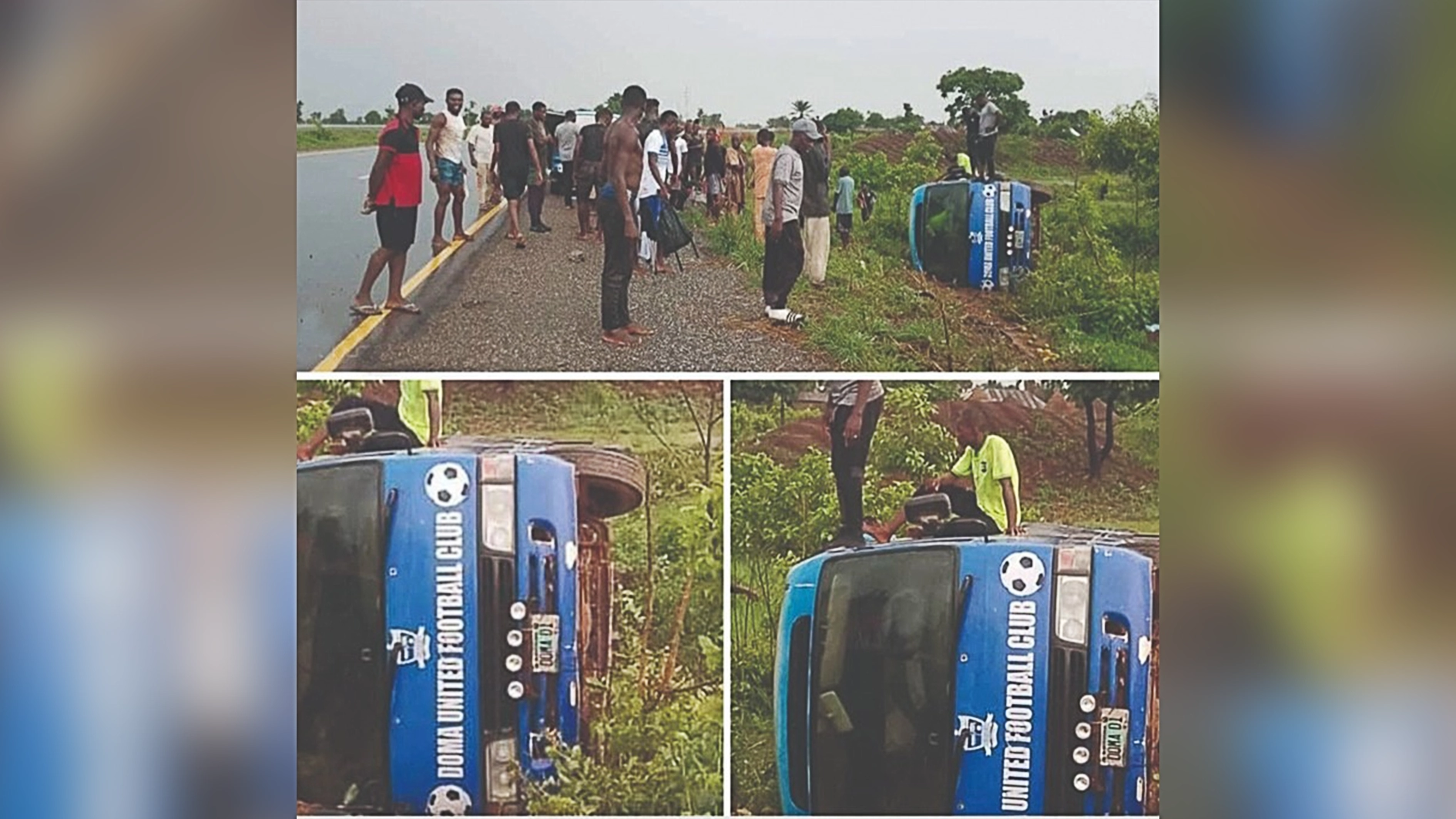
Apart from road accidents, attacks by armed men are also one of the hazards of the long trips for games in a country bedevilled by many security challenges.
In December 2024, players and officials of El-Kanemi Warriors were lucky to escape alive when their bus was ambushed by armed robbers at Rijiyar Malam village along the Jos-Bauchi road in Bauchi State.
Several players and officials were injured in that attack.
The team was returning to Maiduguri from Lagos after a league game against Ikorodu City.
According to reports, the attackers left several players and officials injured.
These attacks have once again brought to the fore the debate on the propriety of continuing with the 20-team, 38-week league that takes teams to far-flung venues in a society bedevilled by bad roads and criminals.
Travelling by air is the safer option, but some stakeholders say this mode of transportation eats deeply into teams’ finances, to the point that it sometimes becomes difficult for them to meet their obligations to players, workers and other partners.
For instance, Enyimba FC, which is based in Aba, Abia State, travelling with 18 players, five members of the technical crew, other backroom staff, and top executives of the club, usually spends approximately N13 million on flights alone to play Kano Pillars FC in Kano.
Sometimes, to cut costs, management reduces the number of personnel who travel by air to only the players, coaches, medical team, and senior officials, while others travel by road to the venue a day or two before the team arrives.
Because there is no direct flight from either Owerri or Port Harcourt, which are the nearest airports to Aba, the delegation is forced to lay over in Abuja and continue the journey from there.
The cost of a round-trip flight from Owerri to Kano is approximately N412,000 per person, which means that for only one game, Enyimba pays about N12.3 million on flights alone.
When you factor in accommodation, feeding and sundry expenses, the club would cough up up to N20 million to play one game. And there are 38 games in a season.
When the management of the NPFL proposed that the minimum salary clubs should pay their players is N2 million, most clubs kicked against it because they could hardly meet their current obligations to their players.
Many of the clubs are owned by state governments, who still see football, as well as other sporting activities, as entertainment and not the big business it is all over the world.
One of the club managers, who pleaded anonymity, told The Guardian that some state governments do not see why they should spend so much money on sports when they have other issues to tackle.
“I can tell you that if some state governments had the option, they would have disbanded their state clubs long ago. But they do not want to do so for political reasons. They don’t want to be seen as the politicians who killed the clubs. That is why you hear states voting huge sums of money for football clubs, when in fact they release only a paltry percentage of the budget to these clubs,” the source said.
Many football stakeholders have canvassed for the Conference system, as practised in the National Basketball Association (NBA) championship of the United States, for the Nigerian league to avoid the dangers of travelling to distant venues and to save costs for the teams, most of which are operating under severe financial stress.
The conference format means that the 20 teams in the EuroMatch NPFL are divided into two zones, with either the top three or top four from each zone qualifying for the championship playoff, which will determine the league champions for the given season.
This format will pit teams from the same zone against each other in an abridged competition, ensuring they do not have to make long trips to play their games.
At the last World Cup in North America, FIFA recognised logistical challenges for the games scattered across North America and tried to separate teams in geographical clusters where they were based and where they played most of their matches.
This is the system some stakeholders are calling for.
Sports development advocate, Yemi Idowu, believes that dividing the Nigerian league into two zones will help the championship solve many of the problems hindering its growth and allow the club managers to plan their campaigns better.
He said: “The national league cannot function effectively the way it is now because if you travelled from Zamfara to Cross River State by road, you would not recover properly even if I gave you one week.
That’s just a fact.
“We don’t have the trains… we don’t have the airports and everything. The football has to be local. That’s what I’m saying.
“If you want to play within Osun State, play within Osun State so that the travel time will be easy for both the players and the fans.”
Comparing the English League with the Nigerian league, Idowu, whose Nathaniel Idowu Foundation is involved in youth development programmes across the country, including the Ajegunle Youth League, said:
“In Liverpool, I can enter a train, and within two hours I am in London. Show me where you can move between Kano and Lagos within two hours. It’s not possible.
“You can’t have 5,000 fans moving within that. So, let us stop lying to ourselves. The national competition should be a collegiate type of competition.
He said that the Football Masterplan drawn up by a committee set up by the defunct Ministry of Sports has taken care of this proposed format for the league.
“They should stop lying to themselves. You set up a committee; you turn around to say that you have set up another committee to review the committees’ suggestions. You are fooling yourself.”
A former secretary of the Club Owners Association of Nigeria, Aloy Chukwuemeka, agrees with Idowu to the extent that it would help to curb the dangers that clubs face during their travels, as well as help them cut costs.
He said: “It could be discussed with the relevant stakeholders, but not based on North and South, rather a division of two equal groups.”
He said that the system had been tried in the past, “but stakeholders complained that it did not produce real champions due to fewer matches the teams played, as well as the diluted competitiveness.”
A former Enyimba defender, Ikechukwu Ogbonnaya, described the suggestion as a good idea that “will be shut down by those it is intended to help.”
According to Ogbonnaya, some team officials like the way things are because it helps them make money from the system. Some managers budget for 22 players for an away game and take only 17 to the match. You know where the rest of the money goes.
“The transport manager or the people who buy diesel and take care of other logistics, including budgeting for more hotel rooms than they actually use, will not take kindly to this type of suggestion.
I am not saying that all the clubs do this, but it happens.
“I am glad that we are talking of restructuring Nigerian football and this is the type of conversation we should all have to move the league forward.”
Reacting to the suggestion, the Head of Media and Publicity at GTI, the primary strategic and financial investment partner for the NPFL, Andrew Ekejiuba, sees nothing wrong with the current format.
He said that stakeholders in the league would be better served by working hard to grow the product instead of thinking about dividing it.
“We should still stick to the 20-team format to further reinforce our social integration and national unity.
“There are too many divisive activities that are not healthy for nation-building. The NPFL should not be part of it. It is our elite league and a unifying platform for nationhood bonding,” he said

