 Follow Us on Google News
 Follow Us on Google Discover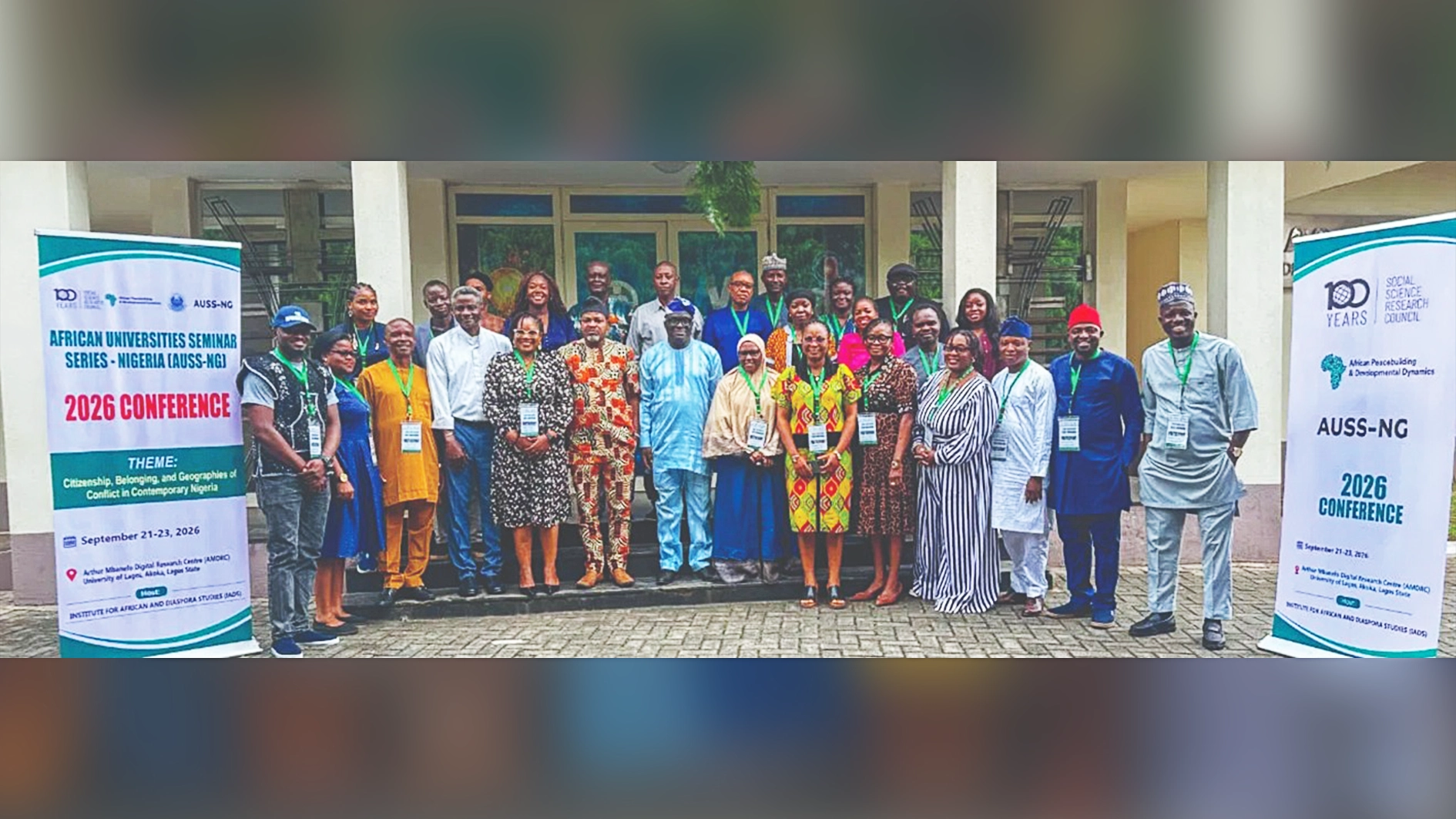
Scholars drawn from within and outside Nigeria have charged leaders to prioritise human security over elite protection and rethink the constitutional definition of citizenship as a panacea to the nation’s worsening security challenges.
They questioned how peace can be built in a country where identity is weaponised for exclusion, the police inspire fear instead of safety, and the son of the president enjoys more protection than millions of citizens.
They stated this at the opening ceremony of the African Universities Seminar Series – Nigeria (AUSS-NG) 2026 Conference, hosted by the Institute for African and Diaspora Studies (IADS), University of Lagos (UNILAG).
Held at the Arthur Mbanefo Digital Research Centre, the conference brought together scholars to interrogate one of Nigeria’s most urgent puzzles: citizenship, belonging, and the geographies of violence.
Setting the stage, Dr Cyril Obi, Director of the Social Science Research Council (SSRC), and African Peacebuilding and Development Dynamics (APDD) programme, said the gathering was designed to move beyond talk.
He said APDD is focused on providing mechanisms through research, collaborations and networking to advance peace and security, and expressed hope that the seminar would consolidate self-organised scholarly engagements in Africa.

“I am confident that this seminar will help catalyse the emergence of a critical mass that will generate innovative ideas and positively contribute towards shaping the future of our continent,” he added.
In his keynote address, Prof. Afe Adogame of Princeton Theological Seminary, New Jersey, United States, argued that Nigeria has mistaken state security for human security, to its own peril.
In his paper titled: ‘Holy violence, unholy embrace: The intersection of religious conflict and insecurity,’ Adogame noted that security and insecurity may mean different things to different people depending on context and perspective.
He, however, pointed out that security agencies and policymakers treat security from a purely physical perspective, which is a mismatch.
He argued that until the government prioritises human security over elite protection, peace will remain elusive.
“An uncritical focus on strengthening state security has historically led to the support of repressive regimes or corrupt elites. It is so problematic that even the president’s son has more security than the people. And then you ask, what are you hiding?”
According to him, the fixation on physical security ignores the real insecurities Nigerians live with daily, such as economic hardship, health crises, and environmental threats.
He saved his sharpest critique for policing. In Nigeria today, he said, the police is not your friend.”You are driving and approach a police checkpoint; the psychology of fear sets in immediately, even if your papers are in order. The whole concept of police, which is supposed to protect, has turned on its head. The police are there to extort money from you. The police are actually there to make you feel insecure,” he said.
For community-oriented policing to work, Adogame said Nigeria must adopt a human security perspective that considers trust, legitimacy, intimacy and accountability as social capital.
He linked Nigeria’s kidnapping, banditry and insurgency epidemics directly to failures in human security.
“These are frequently rooted in poverty, widespread youth unemployment and illiteracy. These are parameters for measuring human security. But we have a government that prioritises national security in away that fortifies elites and undermines human security,” he said.
On how to sustain peace, Adogame proposed a bottom-up approach anchored on epistemic humility and indigenous knowledge.
On his part, Prof. Jimam Lar of the University of Jos (UNIJOS), who spoke on ‘Citizenship, belonging, and the geographies of violence in contemporary Nigeria: Rethinking inclusion, exclusion, and peace building in a fragmented society,’ said citizenship in Nigeria has become a tool of exclusion rather than inclusion.
Lar emphasised the need to redefine what it means to be a Nigerian citizen in the constitution, saying that rather than using indigene as a means of citizenship, we should use residency.
Wherever you are a resident of Nigeria, you should be able to enjoy the benefits of being there. It should apply nationwide. It shouldn’t be a case of Lagos is different from Kano or Kano different from Jos. It should be a national reimagination of citizenship,” he added.
He warned that Nigeria’s diversity, though a blessing is being manipulated for violence.
“We have different ethnic groups, we have different cultures. We should celebrate our diversity, but we shouldn’t use it as a basis for exclusion or as a basis for perpetrating violence,” he said.
For change to happen, Lar noted that scholarship must meet power.
“We have to start putting pressure on political office holders so that they are accountable. There has to be a connection between those of us who are doing research and those who are in power. They have to listen to what we are saying, but also listen to the people,” Lar said.
For the conference co-chairs, Dr Joyce Agofure of the Department of English and Literary Studies, Ahmadu Bello University (ABU), Zaria, and Dr Sani Adam of the Department of History, Bayero University, Kano (BUK), the theme raises issues regarding governance, insecurity and grievances, especially geared towards peace building and conflict resolution.
There is no better time for us to talk about these issues based on the happenings in Nigeria. When we say geographies of conflict, we are not mainly concerned about where conflict originates. We are concerned about how conflicts can be transformed and how peace building can be constructed.
Specifically, Agofure listed the major objectives of the conference as sensitising people about issues, providing a platform for scholars to have conversations on topical issues relevant to the country, and providing recommendations that can be used by government and other agencies to address the security challenges.

