 Follow Us on Google News
 Follow Us on Google Discover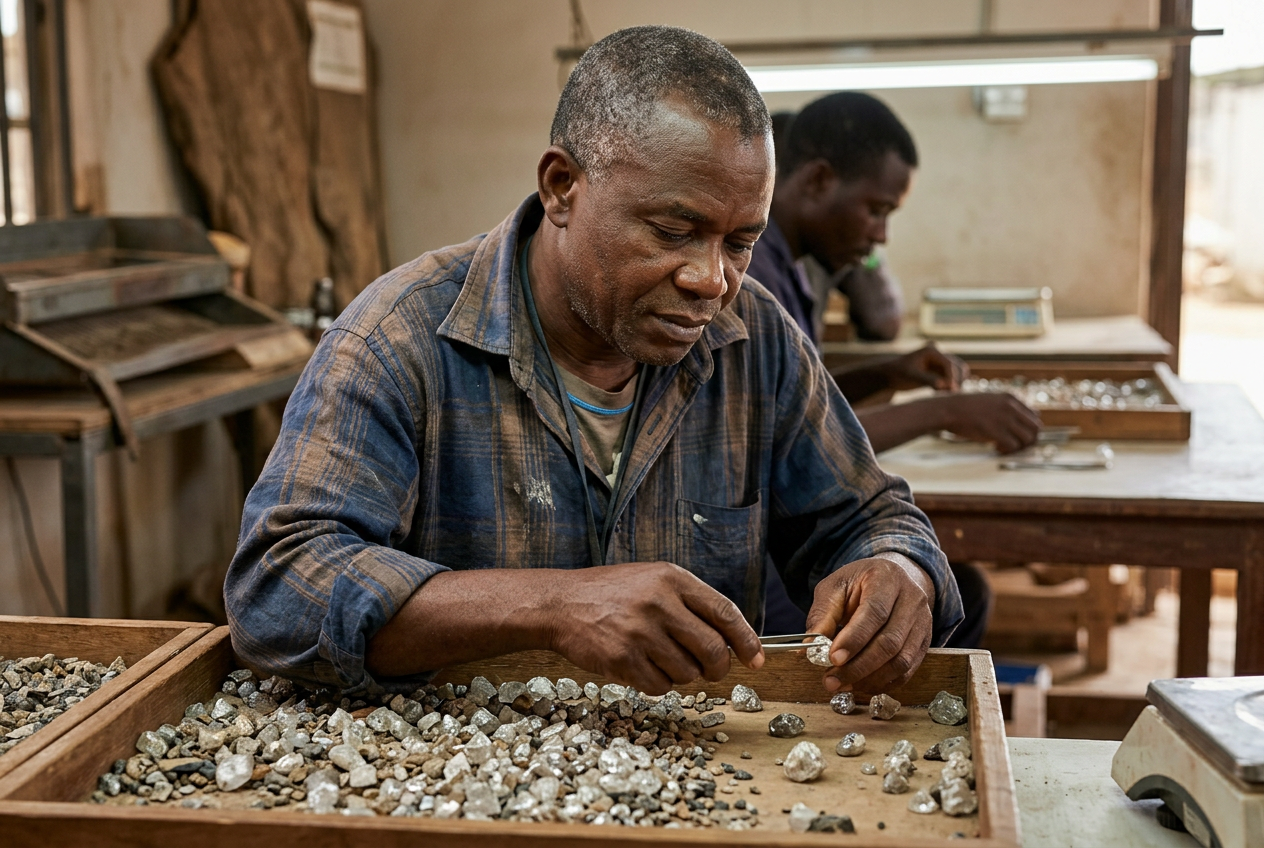
Welcome, and thank you for stopping by. Does Nigeria have diamonds? I have been asked that question at a wedding reception in Surulere, across the glass counter of a jeweller in Ikeja and, most memorably, by my nephew, who once held up a glittering pebble from a stream outside Jos and announced that the family’s money troubles were over. This article is the conclusion of months of research into a mining story that began with colonial tin surveys more than a century ago, sitting on top of years of experience writing about what lies beneath Nigerian soil and what it is genuinely worth.
My nephew’s pebble, for the record, was quartz. Pretty quartz. Worth nothing.
But his question was a fair one, and it deserves a better answer than the two you usually hear. One camp insists Nigeria is “sitting on diamonds” that some shadowy cabal is hiding from us. The other dismisses the idea outright. Neither is quite right, and the truth sits somewhere more interesting.
Here is what we know for certain. Nigeria is extraordinarily well endowed with minerals, and the foreign ministry’s own overview of the country’s natural resources lists precious metals, precious stones and industrial minerals, while admitting frankly that most are yet to be exploited and that exploitation is very low relative to what is in the ground. That admission matters, because “not exploited” and “not there” are very different statements.
We also know that one precious resource is being dug up, refined and banked right now. It just happens not to be diamonds. The Central Bank has been buying locally mined gold with naira, refining it to international bullion standards and adding it to the country’s reserves, a policy it describes in its own account of recent reforms at the apex bank. Gold, as you will see, is where the real Nigerian treasure story lives.
So in the pages ahead I will take you through the continent’s genuine diamond powers, translate diamond prices into naira you can actually use at a jeweller’s counter, explain what a gram of diamond costs (the answer will surprise you), give you the straight answer on Nigeria, and then turn to gold. I will finish with a practical, seven-step guide to buying either without being cheated.

Shall we begin?
Which African Country Is Richest in Diamonds?
If you want to understand why Nigeria is not a diamond country, it helps to look first at the countries that are. Africa is the heart of the world’s natural diamond trade, and the numbers are staggering.
According to the Kimberley Process, the international scheme that certifies rough diamonds as conflict-free, the world mined 98.8 million carats of rough diamonds in 2025, worth about $9.23 billion, at an average of $93.43 per carat. Russia remained the single largest producer, with 31.5 million carats worth $2.72 billion.
On African soil, the crown belongs to Botswana.
Botswana mined about 15.5 million carats in 2025, worth roughly $1.98 billion, which at today’s official rate of around ₦1,330 to the dollar is more than ₦2.6 trillion of rough stones in a single year. Angola ran it remarkably close, with 15.2 million carats worth about $1.81 billion. In fact, Angola briefly overtook Botswana on value in 2024, the first time that had happened in two decades, after De Beers deliberately cut Botswana’s output to prop up prices. So the honest answer to “which African country is rich in diamonds” is Botswana first, Angola a whisker behind, and both of them streets ahead of everyone else on the continent.
Then come the specialists. Namibia mines far fewer stones (about 2.1 million carats in 2025) but its diamonds, many recovered from the seabed off its Atlantic coast, averaged an astonishing $343.88 per carat, the highest of any producer in the world. Lesotho, a small mountain kingdom, is famous for enormous individual stones and averaged $330.90 per carat. South Africa, where the modern diamond industry was born around Kimberley in the 1870s and where the 3,106-carat Cullinan was found in 1905, still produced about 5.6 million carats.
And then there is the Democratic Republic of Congo, which is rather like the market trader who sells enormous volumes of tomatoes at ₦200 a heap. It mined 8.9 million carats in 2025, yet those stones averaged just $5.01 per carat, because the vast majority are industrial grade, destined for drill bits and grinding wheels rather than engagement rings.
What does it feel like to be a genuinely diamond-rich nation? In Botswana, diamonds have historically supplied roughly a third of GDP and the overwhelming majority of export earnings. The government is so entwined with the trade that under a 2025 agreement its share of the rough sold from its main mining joint venture is set to rise from a quarter to half. That is what “rich in diamonds” looks like in practice: an entire national budget shaped by stones.
Nigeria’s situation is very different, and our own records show it. The geological survey’s national mineral occurrence database catalogues deposits across all 36 states and the Federal Capital Territory, recording each commodity’s location, status, grade and associated geology, and it is precisely this kind of systematic data that tells geologists where to dig. Gold, lead, zinc, tin, lithium, barite and gemstones all appear in force. Diamonds, by contrast, turn up as scattered occurrences rather than proven, mineable deposits.
Before we come to the verdict on Nigeria, though, it helps to know what a diamond is actually worth once it leaves the ground, because that is where most of the myths begin.
How Much Is 1 Diamond in Nigerian Currency?
Here is the frustrating truth that every honest jeweller will tell you: there is no such thing as the price of “one diamond”.
Asking what one diamond costs is rather like asking what one car costs. A tired Tokunbo Corolla and a brand-new Range Rover are both cars. Diamonds are priced by the famous four Cs (carat weight, cut, colour and clarity), plus a fifth question that now matters more than any of them: was it mined from the earth or grown in a laboratory?
So let me give you the benchmark most buyers actually shop for, a one-carat round brilliant of good commercial quality (G to H colour, VS clarity, excellent cut).
A natural one-carat diamond currently sells for roughly $4,000 to $6,000 at international retail, which works out at about ₦5.3 million to ₦8 million at the official rate. Live listing data put the median one-carat natural round in the popular grades at about $3,550 this week, or roughly ₦4.7 million, and natural prices have fallen by around 14 per cent so far this year.
A lab-grown one-carat diamond of the same visual quality costs roughly $700 to $1,500 at retail, or about ₦930,000 to ₦2 million, with the median sitting near $670 (around ₦890,000). Chemically, physically and optically, it is a diamond. The only thing it lacks is geological rarity.
Take a breath. That is a gap of more than five times between two stones you could not tell apart with the naked eye.
A few practical notes on converting those figures in real life:
The parallel market rate has been running around ₦1,375 to ₦1,390 to the dollar this week, so if your jeweller prices off the street rate, add roughly 3 to 4 per cent to every figure above. Most imported diamonds sold in Lagos and Abuja also carry shipping, duties, insurance and a local retail margin, so in my own shopping around Victoria Island and Ikeja the quotes have usually landed above the international benchmark rather than below it.
And smaller stones are dramatically cheaper per carat. The tiny diamonds set around a wedding band (jewellers call them melee, usually a few hundredths of a carat each) cost a fraction of the one-carat rate, which is why a pavé band can sell for a few hundred thousand naira while a single one-carat solitaire costs millions. Size in diamonds is exponential, not linear. A two-carat stone does not cost twice a one-carat stone. It often costs three to four times as much.
Have you ever wondered why a jeweller seems to “round up” a stone’s weight in conversation? Now you know. The jump from 0.95 carats to 1.00 carats can add hundreds of thousands of naira, purely for crossing a psychological line.
How Much Is 1 Gram of Diamond in Nigeria Today?
This is my favourite question in the whole article, because the answer is so rarely explained properly.
First, the conversion. Diamonds are weighed in carats, and one carat is exactly 0.2 grams, so one gram of diamond is five carats. That is a surprisingly large amount of diamond. A single five-carat round brilliant measures roughly 11 millimetres across, about the width of your little fingernail.
Now the price, which depends entirely on what form that gram takes.
One gram of rough, uncut diamond at the world average is worth about $467, or roughly ₦621,000, based on the 2025 global average of $93.43 per carat. But that average hides enormous variation. A gram of Namibian rough averages around ₦2.3 million, while a gram of industrial-grade Congolese rough averages barely ₦33,000 (the table further down shows why the gap is so wide).
One gram of polished natural diamond is a different universe. If that gram is a single, good-quality five-carat stone, you are easily looking at well over ₦100 million, because large natural stones are rare and their price climbs steeply with size. Even measured through the one-carat benchmark, a natural stone at today’s median price works out at about ₦23.6 million per gram.
One gram of polished lab-grown diamond, as a single five-carat stone, would cost in the region of $12,900 at current per-carat averages for that size, or about ₦17.2 million.
Compare all of that with gold, which trades today at about $137.80 per gram, roughly ₦183,000. Gram for gram, rough diamond at the world average is worth about three times as much as pure gold, and a polished natural one-carat stone is worth well over a hundred times as much.
That explains why nobody sells diamonds by the gram in the market, and why you should be deeply suspicious of anyone in Nigeria who offers to.
Which brings us, at last, to the question you came for.
Does Nigeria Have Diamonds? The Honest Answer
If you only read one paragraph of this article, make it this one.
Nigeria does have diamonds in the narrow sense that small diamond occurrences have been reported, mostly as alluvial finds in stream gravels across the central belt (Plateau, Nasarawa, Kaduna and Kwara) and in parts of the Benue Trough, but Nigeria has no proven commercial diamond deposit, no operating diamond mine, no official diamond production and no seat in the Kimberley Process, the certification scheme whose members account for roughly 99.8 per cent of the world’s rough diamond output. Because Nigeria is not a participant, any rough diamond found here cannot legally be exported to the 85 or so countries inside the scheme, which effectively shuts a Nigerian stone out of the global trade. The deeper reason is geological: most economic diamonds come from kimberlite pipes punched through very old, stable blocks of continental crust called cratons, like the ones beneath Botswana and South Africa, whereas most of Nigeria’s basement rock belongs to a younger, reworked mobile belt squeezed between the West African and Congo cratons. That geology is superb for gold, tin, lithium and coloured gemstones, and disappointing for diamonds.
So the short version is: traces, yes; a diamond industry, no.
What Nigeria does have, in genuine commercial quantities, is a remarkable range of coloured gemstones. If someone in Jos or Ibadan offers you a “Nigerian diamond”, the stone is far more likely to be one of these:
- Sapphire, mined in Plateau and Kaduna, including deep blue stones prized by Thai cutters
- Tourmaline, including the rare copper-bearing Paraiba-type variety found in Oyo State
- Aquamarine and emerald, from pegmatites in Nasarawa, Plateau and around Gwantu in Kaduna
- Garnet, including the fiery orange spessartite from the Komu area of Oyo
- Topaz, zircon and amethyst, scattered across the Plateau and the north-central states
The sad part is how little of that value stays here. A recent report on Nigeria’s gemstone export earnings put official exports at $15.2 million, ranking the country only 30th in the world, with the United States the biggest buyer. Official figures badly understate the trade, because so much leaves the country uncut and unrecorded. At a gold and gemstone conference organised by Women in Mining Nigeria, organisers noted that miners without technical training sometimes sell stones worth ₦300,000 for as little as ₦30,000.
I have watched a version of that happen. A few years ago, sitting in a small gem dealer’s shop on the Plateau, I saw a young miner accept a price for a parcel of rough blue sapphire that made the dealer look, briefly and guiltily, at the floor. Nobody lied. The miner simply had no scale, no loupe and no idea what he was holding.
That is the real Nigerian precious-stone story. Not hidden diamonds, but visible gemstones sold far below their worth.
How Nigeria’s Diamond Record Compares With Africa’s Producers
| Country | Carats mined (2025) | Value (US$) | Average US$ per carat | Approx. ₦ per carat | Kimberley Process status |
|---|---|---|---|---|---|
| Botswana | 15.50 million | $1.98 billion | $127.66 | ₦169,800 | Participant |
| Angola | 15.20 million | $1.81 billion | $119.22 | ₦158,600 | Participant |
| DR Congo | 8.91 million | $44.6 million | $5.01 | ₦6,700 | Participant |
| South Africa | 5.57 million | $598.6 million | $107.43 | ₦142,900 | Participant |
| Zimbabwe | 4.21 million | $102.4 million | $24.33 | ₦32,400 | Participant |
| Namibia | 2.10 million | $721.5 million | $343.88 | ₦457,400 | Participant |
| Lesotho | 0.70 million | $230.3 million | $330.90 | ₦440,100 | Participant |
| Ghana | 0.20 million | $7.0 million | $34.71 | ₦46,200 | Participant |
| Nigeria | None recorded | None recorded | Not applicable | Not applicable | Not a participant |
Production figures come from the Kimberley Process 2025 annual summary, and the naira column is my own conversion at roughly ₦1,330 to the dollar. The table shows that volume and value are separate contests, with Namibia and Lesotho earning more per stone than anyone, and that Nigeria is simply absent from the formal trade rather than a small player within it.
Does Nigeria Have Any Gold? Far More Than Most People Realise
Now for the good news. If diamonds are Nigeria’s myth, gold is its underused reality.
Nigeria’s gold sits mainly in ancient schist belts across the north-west and south-west. The best-known fields are in Zamfara (around Maru and Anka), Kebbi (around Yauri), Niger, Kogi (the Okolom-Dogondaji area), Kwara, Kaduna and Osun, where the Iperindo belt near Ilesha shares its geology with the great Ashanti gold systems across the border in Ghana.
That Osun belt is home to the country’s only industrial-scale gold mine. The Segilola mine, operated by Thor Explorations, produced 91,910 ounces of gold in 2025, about 2.9 tonnes, after 85,057 ounces in 2024. At today’s price of around $4,280 an ounce, a year of Segilola output is worth close to $400 million, or more than ₦520 billion. In the second quarter of 2026 alone it poured 19,153 ounces and sold gold at an average of $4,535 per ounce.
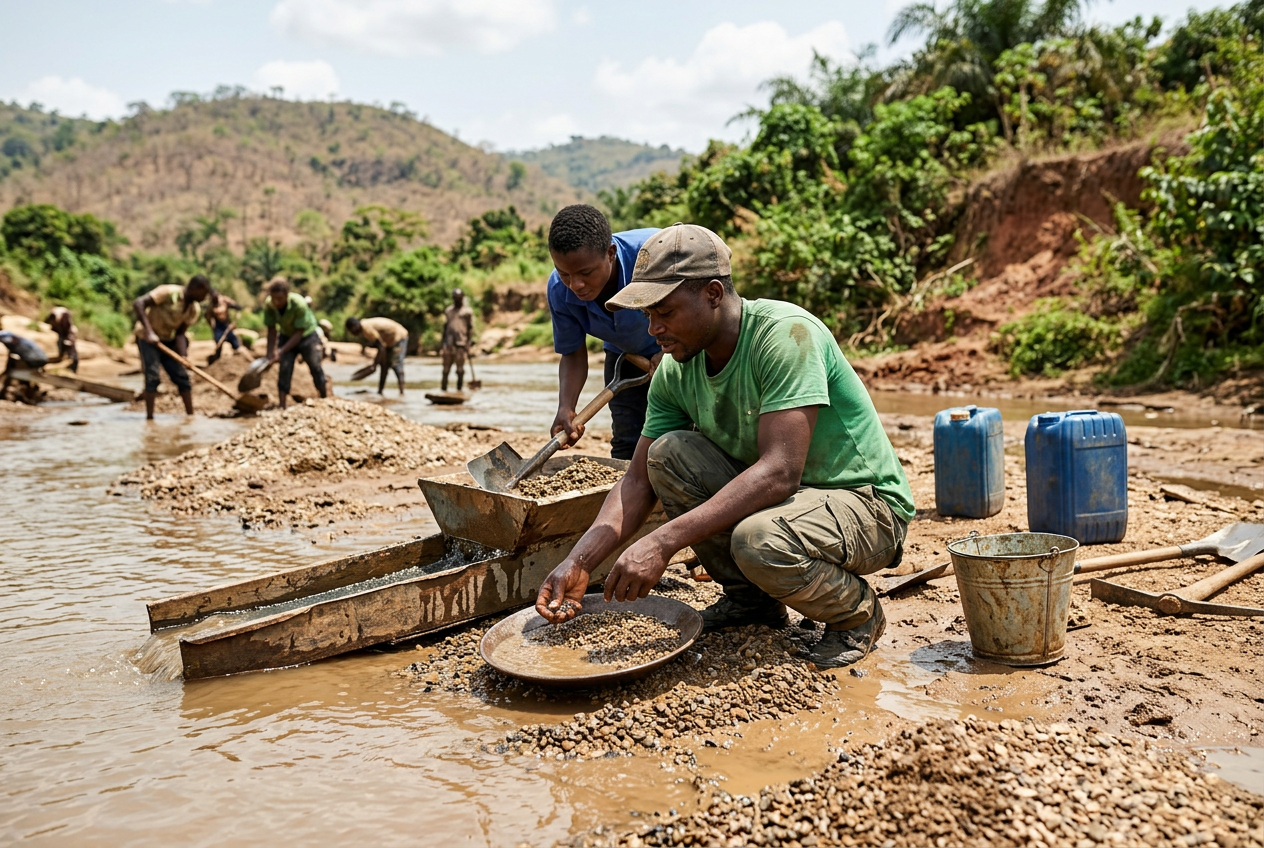
One mine, though, is not an industry. More than 90 per cent of Nigerian gold comes from artisanal and small-scale miners, often families working pits by hand with shovels, basins and mercury. It is dangerous, informal work, and in parts of the north-west it has been captured by armed groups. A thoughtful opinion piece arguing that mining reform could become a tool for peace points out that the sector supports an estimated 2 million livelihoods directly, and that blanket bans such as the one imposed on Zamfara in 2019 often push mining further into the shadows rather than stopping it.
The losses have been colossal. The Minister of Solid Minerals Development has cited estimates that 97 tonnes of gold were smuggled out of Nigeria between 2012 and 2018. At today’s prices, that is gold worth more than $13 billion, or roughly ₦17.7 trillion, gone.
So what is being done? The most interesting answer is the Central Bank’s domestic gold purchase programme. Gold bought from artisanal miners is aggregated by the Solid Minerals Development Fund, refined to London Bullion Market Association standards, then purchased by the CBN in naira at prices linked to the international benchmark. In March 2026 the bank said its gold holdings had reached about $3.5 billion. By my own rough arithmetic, that is somewhere around 25 tonnes at today’s price, a meaningful cushion bought without spending a single scarce dollar.
It is rather like a family that stops selling its farm produce to passing traders at a discount and starts storing it in its own barn. Slow, unglamorous, and exactly right.
What does gold cost in Nigeria today? At about ₦183,000 per gram for pure 24-karat gold, the melt value of common jewellery grades is roughly ₦168,000 per gram for 22-karat, ₦160,000 for 21-karat (the “Saudi gold” so beloved in northern markets) and ₦137,000 for 18-karat. Retail prices add workmanship on top, so expect to pay a premium over those figures, especially for intricate designs.
Gold hit a record near $5,600 an ounce in late January 2026 before easing back, so anyone quoting you a price should be doing so from today’s rate, not from last year’s memory.
How to Buy a Diamond or Gold Piece in Nigeria Without Regret
After years of watching friends, relatives and one very excited nephew make expensive mistakes, I have boiled my advice down to seven steps. Follow them in order and you will walk away from any jeweller’s counter in Lagos, Kano or Port Harcourt knowing exactly what you paid for.
- Decide whether you want a natural or lab-grown diamond before you set a budget, because a ₦1.5 million budget buys a fine one-carat lab-grown stone but only a small natural one, and mixing the two up is how people overpay.
- Insist on an independent grading report from a recognised laboratory such as GIA or IGI, then check the report number on the laboratory’s own website and confirm that the weight, measurements and grades match the stone in front of you.
- Measure the stone yourself with a small digital calliper (about ₦5,000 to ₦10,000 in most electronics markets), remembering that a one-carat round brilliant measures roughly 6.4 to 6.5 millimetres across, a half-carat about 5.1 millimetres and a two-carat about 8.1 millimetres.
- Get a second opinion from a different jeweller with a proper diamond tester, keeping in mind that ordinary testers cannot tell natural from lab-grown and some are fooled by moissanite, which is why the grading report in step two matters so much.
- Convert the asking price into dollars at the official rate and compare it with the international benchmark, which for a good one-carat natural stone is currently about ₦4.7 million to ₦8 million, and walk away politely from anything wildly outside that range.
- For gold, check the karat stamp, weigh the piece on the jeweller’s scale, then multiply the weight in grams by today’s price per gram for that purity (about ₦160,000 for 21-karat or ₦137,000 for 18-karat) so you know exactly how much of the price is metal and how much is workmanship.
- Refuse every offer of “raw Nigerian diamonds” from roadside sellers or social media, ask for a written receipt that lists weight, grade and price for anything you do buy, and add valuable pieces to your home insurance or keep them in a bank safe deposit box.
Now, a little styling advice, because buying well is only half the pleasure.
Gold suits Nigerian skin tones beautifully, and warm yellow gold in 18 or 21 karats sits particularly well against deep brown complexions. If you are pairing jewellery with traditional attire, let one element lead. A heavy gold choker with coral beads and a gele already makes a statement, so keep the rings simple. With a crisp white agbada or a fitted ankara dress, a single solitaire or a slim tennis bracelet says more than an armful of pieces.
For engagement rings, I tell everyone the same thing: prioritise cut over carat. A beautifully cut 0.7-carat stone will outshine a badly cut one-carat stone across a hall full of guests. And consider a Nigerian sapphire or tourmaline as a centre stone. It is locally mined, often a fraction of a diamond’s price, and it tells a story that no imported stone can.
Rather like good jollof, the best jewellery is about balance, not quantity.
Final Thoughts: Does Nigeria Have Diamonds After All?
So, does Nigeria have diamonds? Only in traces. Small alluvial finds have been reported across the central belt, but there is no proven deposit, no working mine, no official production and no place in the Kimberley Process, largely because our geology is built for other treasures. Botswana and Angola remain Africa’s true diamond powers, while Namibia and Lesotho earn the most per stone.
A diamond’s price in naira depends entirely on its size, quality and origin, from under ₦1 million for a one-carat lab-grown stone to ₦5 million and more for a natural one. A gram of diamond is five carats, and at every level, from rough to polished, it is worth far more than a gram of gold.
And gold is where Nigeria genuinely shines, from the industrial mine at Segilola to the millions of artisanal miners across the north-west and south-west, and a central bank now quietly turning their output into national reserves.
My nephew, by the way, still has his quartz pebble. He keeps it on his desk as a reminder to check before he celebrates. Not a bad lesson for any of us.
Here is where I would start:
- Treat any offer of “Nigerian diamonds” with suspicion, and ask for a laboratory grading report and a Kimberley Process certificate before any money changes hands.
- Before buying any diamond, convert the asking price into dollars at the official rate and compare it with the current benchmark of roughly $3,500 to $6,000 for a good natural one-carat stone.
- If you want a precious purchase with a genuinely Nigerian story, consider locally mined gold, sapphire or tourmaline, weighed and valued at today’s per-gram price.
Related Articles
If this piece has you thinking about where Nigeria’s real weight in Africa comes from, my earlier study of which country truly deserves to be called the giant of Africa weighs our population, oil, solid minerals and cultural reach against the rest of the continent, and it is a natural companion to the Botswana and Angola comparisons above.
And if the gap between what lies under our soil and what reaches ordinary households struck a nerve, my piece asking whether Nigeria should be considered a rich or poor country looks squarely at that paradox, tracing how enormous untapped mineral wealth sits alongside some of the highest poverty rates in the world.
Key Takeaways
- Nigeria has only scattered diamond occurrences, with no commercial deposit, no diamond mine, no official production and no Kimberley Process membership, while Botswana and Angola lead Africa with around 15 million carats each in 2025.
- A good one-carat natural diamond costs roughly ₦4.7 million to ₦8 million at today’s rates against about ₦900,000 to ₦2 million for lab-grown, and one gram of diamond equals five carats.
- Nigeria’s real precious-metal wealth is gold, mined industrially at Segilola in Osun and by artisanal miners across the north-west, with the Central Bank now buying local gold in naira for the national reserves.
Frequently Asked Questions: Does Nigeria Have Diamonds?
Does Nigeria have diamonds?
Nigeria has only small, scattered diamond occurrences, mostly reported as alluvial finds in stream gravels across Plateau, Nasarawa, Kaduna, Kwara and parts of the Benue Trough. There is no proven commercial deposit, no operating diamond mine and no official diamond production in the country.
Where have diamonds been reported in Nigeria?
Reported occurrences cluster in the central belt, particularly Plateau, Nasarawa, Kaduna and Kwara, with further alluvial finds described in parts of the Benue Trough. None of these sites has been proven to hold diamonds in quantities that would support a commercial mine.
Is Nigeria a member of the Kimberley Process?
Nigeria is not a participant in the Kimberley Process Certification Scheme, and it does not appear in the scheme’s production statistics. This means rough diamonds from Nigeria cannot legally be traded with the scheme’s member countries, which account for almost all global production.
Which African country is rich in diamonds?
Botswana is Africa’s richest diamond country, having mined about 15.5 million carats worth roughly $1.98 billion in 2025. Angola is a very close second with about 15.2 million carats worth $1.81 billion, and it briefly overtook Botswana on value in 2024.
Which country produces the most diamonds in the world?
Russia is the world’s largest diamond producer, mining about 31.5 million carats worth $2.72 billion in 2025. Botswana and Angola follow, and together the three countries account for close to two thirds of global production value.
How much is 1 diamond in Nigerian currency?
A good-quality natural one-carat diamond costs roughly ₦4.7 million to ₦8 million at the official exchange rate of about ₦1,330 to the dollar. A lab-grown one-carat diamond of similar appearance costs roughly ₦900,000 to ₦2 million.
How much is 1 gram of diamond in Nigeria today?
One gram of rough diamond at the 2025 world average is worth about ₦621,000, although Namibian rough averages around ₦2.3 million per gram. One gram of polished diamond, which is a single five-carat stone, can cost about ₦17 million if lab-grown and well over ₦100 million if natural.
How many carats are in 1 gram of diamond?
One gram of diamond equals exactly five carats, because a single carat weighs 0.2 grams. A five-carat round brilliant diamond measures roughly 11 millimetres across.
What precious stones does Nigeria actually produce?
Nigeria produces commercial quantities of coloured gemstones, including sapphire, tourmaline, aquamarine, emerald, garnet, topaz and zircon. Plateau, Kaduna, Nasarawa and Oyo are among the most important gemstone-producing states.
Does Nigeria have any gold?
Nigeria has significant gold deposits in schist belts across Zamfara, Kebbi, Niger, Kogi, Kwara, Kaduna and Osun. The Segilola mine in Osun produced 91,910 ounces in 2025, while artisanal miners produce more than 90 per cent of the country’s gold.
Is the Central Bank of Nigeria buying local gold?
The Central Bank buys locally mined gold in naira through its domestic gold purchase programme, after the metal is aggregated and refined to international bullion standards. The bank said in March 2026 that its gold holdings had reached about $3.5 billion.
How much is 1 gram of gold in Nigeria today?
Pure 24-karat gold is worth roughly ₦183,000 per gram at today’s international price and official exchange rate. The metal value of 21-karat gold is about ₦160,000 per gram, while 18-karat is about ₦137,000 per gram before any workmanship charges.

