 Follow Us on Google News


 Follow Us on Google Discover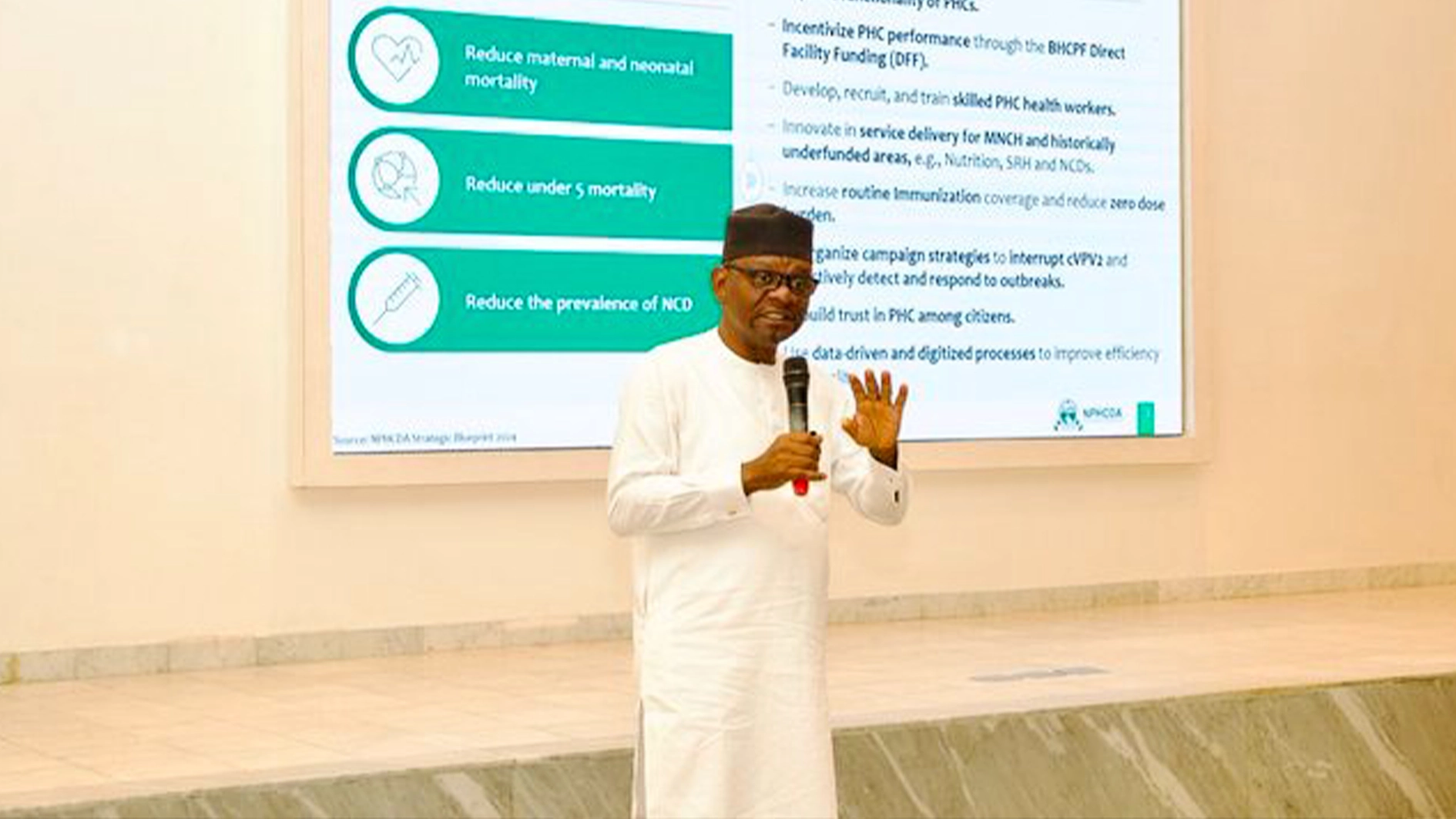
…As health insurance enrollment hits 23 million
The Federal Government has renovated and commissioned 3,526 primary healthcare centres across the country, while work is nearing completion on additional 91 facilities, as part of efforts to expand access to quality and affordable healthcare for Nigerians.
The Executive Director of the National Primary Health Care Development Agency (NPHCDA), Dr Muyi Aina, disclosed this at the agency’s quarterly media briefing, where he outlined the progress recorded under the ongoing primary healthcare revitalisation programme and other interventions aimed at strengthening Nigeria’s health system.
Providing details of the primary healthcare revitalisation programme, Aina said the government had made substantial progress in addressing the poor state of many public health centres inherited at the beginning of the administration’s reform efforts.
According to him, 4,434 facilities have either been completed or are nearing completion, with 3,526 fully renovated, commissioned and handed over to the relevant state governments and local government authorities.
He noted that the agency is working towards expanding the number of functional primary healthcare facilities across wards to bring services closer to communities adding that the programme was designed to ensure that Nigerians could access essential healthcare services without travelling long distances or depending entirely on private providers.

“We are continuing to make very good progress towards our promise to make high-quality facilities more accessible,” Aina said, while cautioning that the country was still some distance from achieving its overall objective.
Aina the explained that the distribution of the facilities was guided by considerations such as existing access to healthcare, the presence of alternative providers, geographical distance and the availability of other service options.
He disclosed that more than half of the approximately 27,000 active primary healthcare centres nationwide were functioning at Level One or Level Two standards.
The NPHCDA boss emphasized that the revitalisation programme placed particular emphasis on reliable electricity, water supply and sanitation, noting that solar power was a critical component of efforts to ensure uninterrupted service delivery, especially in rural and remote communities.
He noted that the agency has also established a live, geocoded dashboard through which Nigerians can identify nearby primary healthcare centres and check the services available at each facility, stressing that it is intended to improve transparency, public access to information and accountability in the delivery of primary healthcare.
Beyond infrastructure, Aina said the government was investing in the capacity of frontline health workers to ensure that refurbished facilities could provide safe, reliable and effective services.
He disclosed that more than 78,000 frontline health workers had been retrained under the programme, against the presidential target of 120,000.
According to him, the agency was also commencing the retraining of another 23,000 community-based health workers to strengthen service delivery in underserved areas.
He explained that some communities were too remote to be reached quickly through conventional facility-based healthcare, making community-based health workers essential to expanding access and preventing avoidable deaths.
The NPHCDA chief said the government was establishing a structured community health workforce programme across the country to complement services delivered at primary healthcare centres.
He added that the Federal Government, through the Maternal, Newborn and Child Health-related interventions under its healthcare financing programmes, had equipped more than 500 primary healthcare centres with the essential equipment required for service delivery, with state governments also contributing to the effort.
Aina said the combination of improved infrastructure, better-equipped facilities and a strengthened workforce was beginning to translate into increased utilisation of public healthcare services.
The NPHCDA executive director said attendance at primary healthcare facilities had increased significantly since the beginning of the revitalisation efforts.
According to him, quarterly service attendance, which previously stood at about 33 million to 34 million, now fluctuates between 43 million and 45 million, with a peak of approximately 46 million recorded at some point in 2025.
He said the upward trend was also reflected in antenatal care attendance, immunisation and other essential health services.
Aina described the development as an indication that more Nigerians were beginning to engage with the public primary healthcare system.
However, he maintained that the government would need to sustain its investments and improve service quality to ensure that increased attendance translated into better health outcomes.
In a major intervention targeting maternal and newborn deaths, Aina said the NPHCDA was expanding its Maternal and Newborn Mortality Reduction Initiative, known as MAMI, to improve the continuity of care for pregnant women and their babies.
He explained that the programme was designed to support women throughout pregnancy, childbirth and the immediate postnatal period, while identifying those at risk and linking them to facilities capable of providing appropriate care.
The initiative, which began in 172 local government areas, connects pregnant women to primary healthcare centres, caseworkers, investigations and comprehensive emergency obstetric and newborn care services where necessary.
Aina disclosed that more than 773,200 pregnant women had been linked to primary healthcare centres and were being tracked across 10 states, with additional beneficiaries in other participating states.
He also reported that more than 20,000 deliveries had been attended by skilled birth attendants between January and August 2026, representing an increase of about 17 per cent compared with the corresponding period in 2025.
The agency, he said, was working with other health institutions to upgrade secondary and tertiary facilities to provide comprehensive emergency obstetric and newborn care.
He added that emergency transportation arrangements were also being strengthened in collaboration with the National Emergency Medical Services and Ambulance System to ensure that pregnant women and other patients could be moved quickly when complications arose.
Food banks support vulnerable households
Aina further disclosed that the NPHCDA was collaborating with the First Lady-led National Comorbidity Food Bank initiative to support vulnerable households whose health conditions could be worsened by food insecurity.
According to him, the programme had been launched across six geopolitical zones, with 23 food banks operating in 23 local government areas.
He said the food banks had distributed about 9,500 food packages to 2,488 beneficiaries, some of whom had received multiple packages.
The NPHCDA chief said state governments were increasingly taking ownership of the initiative, disclosing that 13 governors had participated in its launches and at least seven states were actively working to expand the programme.
He described the initiative as an important intervention for vulnerable people whose ability to maintain good health was affected by inadequate access to nutritious food.
18.3 million girls receive HPV vaccine
On immunisation, Aina said more than 18.3 million girls had received the human papillomavirus (HPV) vaccine, which protects against HPV infections that can lead to cervical cancer.
He said the programme would continue to cover eligible girls entering the target age group of nine to 14 years, while further partnerships were being explored to extend access to older girls.
He also disclosed that the measles-rubella vaccine campaign had reached more than 102 million children aged nine months to 14 years.
Under the malaria vaccine programme, he said approximately 182,000 children in Kebbi, Bayelsa, Ondo and Bauchi states had received the vaccine, with many progressing through subsequent doses.
Aina said the agency was also intensifying routine immunisation and targeted interventions to identify and vaccinate children who had not received any vaccine or had missed essential doses.
He expressed concern, however, over outbreaks of diphtheria in parts of the country, attributing the persistence of the disease in affected communities partly to gaps in routine immunisation coverage.
According to him, analysis of cases from different outbreaks showed that approximately 93 per cent of affected children.
Aina said the facilities were being revitalised across all states of the federation and almost every local government area, with the government adopting an equity-based approach to ensure that underserved communities and people living far from existing health facilities were not left behind.
He, however, acknowledged that significant challenges remained, stressing that the government was yet to reach the desired level of access to quality primary healthcare nationwide.
Aina said the ultimate objective was to build a system in which Nigerians could trust public health facilities, obtain essential services close to their homes and receive appropriate care when they needed it.
Also speaking at the briefing, NHIA Director-General Ohiri said health insurance coverage had grown from about 16 million Nigerians in January 2024 to approximately 23 million, representing an increase of 42 per cent.
He said at least 3.18 million of those covered were poor and vulnerable Nigerians whose insurance premiums were financed through the Basic Health Care Provision Fund.
Ohiri explained that the administration’s health insurance reforms were built around expanding coverage, prioritising vulnerable populations and improving the quality of services available to enrollees.
He said the government was pursuing a whole-of-government approach to enforcing health insurance requirements, while working with relevant agencies and stakeholders to ensure that more Nigerians were enrolled.
According to him, public awareness was equally important, as many Nigerians still needed to understand the benefits of health insurance and the financial risks associated with paying for treatment out of pocket.
He urged the media and civil society organisations to intensify public education and help citizens understand their entitlements under the scheme.
Ohiri said insurance remained a more sustainable approach to healthcare financing because it enabled people to contribute through prepayment rather than having to raise large sums of money when illness occurred.
The NHIA boss disclosed that approximately 80,000 women had benefited from government-funded comprehensive emergency maternal care over the preceding two years.
Ohiri observed that the programme covered services delivered through more than 270 accredited secondary and tertiary health facilities nationwide, with the cost of eligible care reimbursed through the scheme.
The initiative, he explained, was intended to remove financial barriers that prevent pregnant women from accessing emergency treatment during childbirth.
He added that about 6,000 women suffering from obstetric fistula had received life-restoring surgeries funded by the government.
The programme had also extended support to newborns, with more than 67,000 babies receiving life-saving interventions financed through the initiative.
Ohiri said the interventions were aimed at addressing preventable maternal and newborn deaths by ensuring that women and babies could obtain essential treatment regardless of their financial circumstances.
He further disclosed that approximately 60,000 people living with HIV or tuberculosis were benefiting from arrangements integrating them into health insurance programmes in partnership with participating states and the Global Fund.
The NHIA director-general also announced that the Ministerial Oversight Committee had approved arrangements to extend health insurance coverage to inmates in partnership with the Nigerian Correctional Service, recognising prisoners as another vulnerable population requiring access to healthcare.
NHIA increases provider payments
Addressing complaints about poor service delivery under health insurance, Ohiri said the authority had reviewed provider payment rates that had remained unchanged for about a decade.
He disclosed that the review resulted in a doubling of capitation payments and a 373 per cent increase in fee-for-service reimbursements, with revised tariffs introduced on April 1, 2025.
According to him, the changes were designed to reflect prevailing market costs and ensure that healthcare providers received more adequate payments for services rendered.
He said inadequate reimbursement had contributed to situations in which patients were denied medicines or services covered by their insurance policies.
Ohiri added that the authority had introduced measures to empower enrollees to understand their benefit packages and exercise their rights when seeking treatment.
Under the policy, he said, hospitals should not delay treatment while awaiting an authorisation code beyond one hour, after which they are empowered to commence treatment under the prescribed arrangements.
The NHIA, he added, had strengthened its complaints-handling and enforcement systems, with approximately 87 per cent of complaints received in the preceding year resolved within 48 hours.
He said the authority had also imposed appropriate sanctions in cases involving wrongful charges for covered services, while refunding affected enrollees where necessary.
In the Federal Capital Territory and other locations, the NHIA had deployed personnel to major health facilities to help insured patients resolve challenges directly at the point of care.
Ohiri maintained that the objective was to ensure that Nigerians who paid premiums or were covered by government-funded insurance received the services to which they were entitled.
Ohiri, on his part, emphasised the need for stronger enforcement of health insurance requirements, improved public awareness and accountability among healthcare providers and insurance administrators.
The officials called on journalists and civil society organisations to help educate Nigerians about available healthcare services, promote immunisation, expose service delivery failures and hold relevant institutions accountable.
They maintained that infrastructure investments and increased insurance coverage would only produce lasting results if healthcare workers were adequately trained, facilities remained functional and patients received the services promised to them.

