 Follow Us on Google News



 Follow Us on Google Discover
• APC says 12-state itinerary balances electioneering with governance
• Stakeholders urge President to prioritise health, reconsider second term
• Tinubu defends subsidy removal, urges youths to sustain reform support
• Russian analyst warns opposition disunity could favour Tinubu
President Bola Tinubu’s decision to limit his re-election campaign rallies to 12 state capitals has drawn mixed reactions, with opposition figures questioning his capacity to campaign nationwide.
This came as Tinubu reached out to Nigerian youths yesterday, urging them to defend his administration’s economic reforms, while the City Boy Movement (CBM) pledged to mobilise at least 10 million youth votes for his re-election, citing its nationwide grassroots structures and 4.6 million registered members.
The All Progressives Congress Presidential Campaign Committee (APC PCC) recently disclosed that Tinubu would physically attend and address campaign rallies in 12 state capitals as part of efforts to secure re-election.
The move comes on the heels of the Independent National Electoral Commission’s (INEC) recent disclosure that 103 million Nigerians are eligible to vote in next year’s general election. The figure suggests that the President’s campaign strategy may have been influenced by voter distribution and other electoral calculations.
Stakeholders who spoke to The Guardian, including the Chancellor of the International Society of Social Justice, Dr Omenazu Jackson; the Secretary of the Coalition of United Political Parties (CUPP), Peter Ameh; and Fouad Oki, were divided over the wisdom of the President’s decision to campaign in fewer than 25 per cent of the states.

Describing the APC’s selective campaign itinerary as a tacit admission that its leader was too frail to campaign nationwide, Ameh said the strategy created the impression that some states were considered less important by the President.
The CUPP scribe said: “The decision by the APC Presidential Campaign Council to cherry-pick states where President Bola Ahmed Tinubu will personally attend and address rallies for the 2027 poll is not just troubling; it is insulting and a deliberate declaration of some states as second-class and unimportant.
“In a presidential contest, every state, every citizen, and every vote is supposed to matter. To openly categorise states into those worthy of a presidential visit and those to be ignored is to institutionalise discrimination and to tell millions of Nigerians that they do not count in the Renewed Hope agenda, which has driven many into renewed hopelessness.
“But, what worries me even more than this brazen political segregation is what it reveals about the President himself. This selective itinerary strongly suggests an inability on the part of the President, due to ill-health or lack of physical strength, to undertake the vigorous, demanding, nationwide campaigning that a presidential race requires.”
Ameh argued that if the President were fit and healthy, he would campaign across the country to defend his record and sell his manifesto.
He said: “You cannot lead a nation of over 200 million people with energy you do not have. You cannot inspire a youthful population when you cannot stand before them in all 36 states. Nigerians deserve to know the true state of the President’s health. Nigerians deserve a President who sees every state as important, not a President whose party has to shield him from the rigours of campaigning.”
However, Jackson urged Tinubu to visit all 36 states, saying such visits would give the President firsthand knowledge of the hardship Nigerians were experiencing under his administration.
He also urged the President to reconsider his reported second-term ambition if his health would not permit him to meet the demands of the office. Jackson advised him to bow out honourably rather than succumb to pressure from political associates seeking power.
“Nigeria,” he noted, “is facing multiple challenges, including insecurity, hunger and environmental problems, which require the President’s direct attention. Relying on reports from surrogates and political associates is insufficient.
“The President needs to engage directly with citizens across the country to understand their concerns. There is nothing like first-hand information. The nation is passing through difficult times, including insecurity, hunger and ecological problems.”
Jackson suggested that the President use a helicopter to visit communities and observe conditions on the ground. He added that direct interaction with citizens would help Tinubu better understand their needs and develop appropriate responses.
Insisting that Nigerians in every state deserved the opportunity to meet the President, express their concerns and hear directly from him about how his administration intended to address their challenges, Jackson said Tinubu should be held accountable for his first-term mandate.
He said: “We need a President who will be free to interact with the people, hear from them and feel their pain. We need a President who can look at Nigerians in various states and say, ‘This I can do, and this I cannot do.’
“He needs to be held accountable for his pronouncements. He is not just a presidential candidate; he is the current President and Commander-in-Chief of the Federal Republic of Nigeria. His attention is needed all over the country.”
Jackson warned that political associates seeking to advance their own ambitions should not pressure the President into decisions that could undermine his health and reputation. He also urged Tinubu to protect his family’s dignity and the legacy he would leave behind.
“The President should not overextend himself after years in public service,” he said.
Similarly, a female politician in Rivers State, Mrs Agnes Okwe, advised the President to prioritise his health and consider stepping aside if he could no longer cope with the demands of the presidency.
Okwe said Tinubu should honestly assess his physical capacity to travel across the country, engage with Nigerians and respond to their concerns. She argued that if his health would not permit him to fulfil these responsibilities, taking a rest would be the more appropriate decision.
For political expert Fouad Oki, a former director-general of campaign organisations in Lagos, the campaign itinerary should be considered alongside the negotiations and alliances that influence electoral outcomes.
“Campaign is not about physical presence alone. It involves a lot of negotiations behind closed doors,” he said.
Citing Tinubu’s political engagements ahead of the 2023 election, including his interaction with Oyo State Governor Seyi Makinde, Oki said candidates needed to manage competing interests and identify states whose voting strength and political dynamics could influence their overall performance.
He identified Lagos, Rivers, Kaduna, Kano and Katsina as states deserving close attention because of their voter populations and political influence. He also questioned the implications of overlooking states with large voter registers, noting that the value of a physical visit depended on the circumstances in each state.
Oki cautioned against using social media reactions as a reliable measure of electoral support. He stressed that although economic hardship and public dissatisfaction were important considerations, online opinions alone could not determine how the wider electorate would vote.
APC defends Tinubu’s 12-state campaign plan
THE ruling party has pushed back against criticism of the President’s campaign travel plan, saying Tinubu must balance electioneering with his responsibilities as President.
The APC National Chairman, Nentawe Yilwatda, who spoke through his aide, Abimbola Tooki, maintained that an incumbent seeking re-election could not abandon governance for campaign activities.
Tooki said campaign effectiveness should not be measured solely by the number of states a candidate visits or the time spent addressing rallies, adding that consultations with political stakeholders were equally important.
He explained that the selection of the 12 states was strategic, particularly as the APC seeks to strengthen its position in states where Tinubu lost in 2023. According to him, the campaign team also plans to hold meetings in 19 other states to engage stakeholders and canvass support.
The party maintained that the rallies formed part of a broader mobilisation strategy that combines public appearances with political consultations while allowing Tinubu to continue discharging his presidential duties.
Tinubu urges youths to defend reforms, as City Boy targets 10m votes
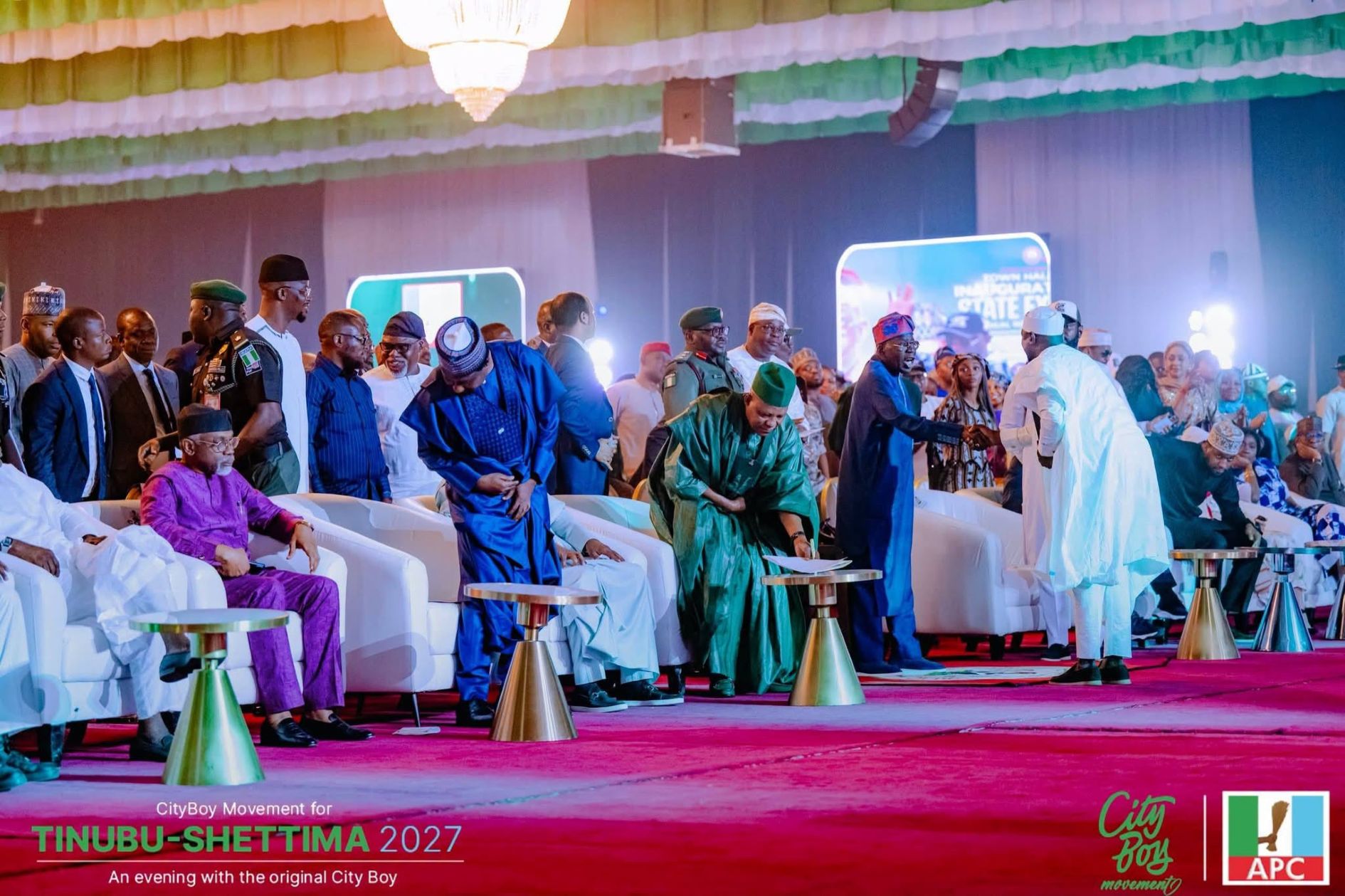
MEANWHILE, the City Boy Movement (CBM) has pledged to mobilise at least 10 million youth votes for President Bola Ahmed Tinubu in the January 2027 presidential election, saying its nationwide grassroots structures are ready to campaign for his re-election.
The Director-General of the movement, Francis Shoga, pledged yesterday during a meeting between the movement’s national leadership and President Tinubu at the State House, Abuja.
Shoga disclosed that the organisation had registered 4.6 million members in its national database and engaged more than 50,000 young Nigerians through its Renewed Hope Youth Tour across the six geopolitical zones.
He also appealed to the President to expand youth participation in governance by considering competent and qualified members of the movement for appointments to public offices.
Speaking on the theme, “Youth, Unity, Action: Building a Stronger and More Prosperous Nigeria”, Shoga said the movement was determined to translate its growing membership and grassroots presence into electoral support for Tinubu.
Addressing members of the City Boy Movement at the Banquet Hall of the Presidential Villa, Abuja, yesterday, Tinubu urged Nigerian youths to defend his administration’s economic reforms ahead of the 2027 general elections, describing his re-election bid as a contest over their future and the country’s economic direction.
He insisted that Nigeria could not afford to reverse the removal of petrol subsidy, arguing that the country must sustain its reforms despite the difficulties they have imposed on citizens.
Joined by Vice President Kashim Shettima and members of the National Assembly, the President urged the youth-led political mobilisation group to take his administration’s message to campuses, markets and communities.
“You are not campaigning for me. You are campaigning for your own future, and that future is Renewed Hope,” he told the gathering.
Tinubu said his administration had taken difficult decisions since assuming office in 2023, citing mounting financial obligations, pressure on foreign reserves and difficulties in meeting some payment commitments as part of the economic challenges confronting the country.
He explained that petrol subsidy removal was part of broader efforts to address structural weaknesses in the economy and prevent the country from continuing along what he described as an unsustainable fiscal path.
The President maintained that Nigeria could not achieve lasting prosperity by relying on borrowing while postponing difficult economic decisions.
“We understood that a nation cannot borrow its way to greatness,” he said.
He cautioned against proposals to restore the subsidy regime, insisting that Nigeria must sustain its new economic direction rather than return to the previous arrangement.
Tinubu’s remarks came amid continuing public debate over the effects of subsidy removal, including rising living and transport costs, and concerns over how the benefits of economic reforms could translate into improved living conditions.
Acknowledging the difficulties associated with the reforms, the President commended young Nigerians who, he said, had defended his administration and its policies on campuses, in motor parks and on social media, even when doing so was unpopular.
“I saw it. I noticed, and I will never forget it,” he said.
Tinubu also praised the organisers of the City Boy Movement for establishing a political structure with a presence across states, local governments and wards, describing its activities as more than public rallies and demonstrations.
“That is not noise. That is organisation,” he said.
He urged the group to sustain its engagement with young people and communicate his administration’s record and plans, expressing confidence that its grassroots network would help promote his message ahead of the 2027 election.
The President also promised to give young Nigerians a greater role in governance, citing the student loan programme and initiatives aimed at developing technical skills as examples of efforts to expand opportunities.
“I have trusted those people with real responsibility in this government. I have watched them deliver. I intend to do more,” he said.
Tinubu said young people had the greatest stake in the decisions being taken today because they would live longest with their consequences.
“The future of this country does not belong to me. It does not belong to my generation. It belongs to you,” he said.
He assured members of the movement that they would remain part of his political project and the country’s development.
“You will not be left behind. Not in this campaign. Not in this government, not in Nigeria,” he said.
Opposition disunity could boost Tinubu’s re-election chances, Russian analyst warns
A Russian political analyst, Valentin Bianki, has warned that opposition disunity and competing political ambitions could give President Bola Tinubu an advantage in the 2027 general elections.
Bianki said public dissatisfaction with the government would not automatically translate into an opposition victory without effective organisation, a credible electoral platform and strong voter mobilisation.
He spoke yesterday in Abuja while presenting his book, Politics in Nigeria: Elites and Voters, at the Shehu Musa Yar’Adua Centre.
Drawing lessons from the 2023 general elections, the political psychologist and campaign strategist examined how political alliances, voter behaviour and opposition fragmentation could shape the next presidential contest.
“From ancient Rome till now, you have to split the opposition. And they succeeded; or rather, the opposition failed to unite,” he said.
Bianki argued that opposition parties needed to overcome their differences and establish a credible coalition if they hoped to challenge the ruling All Progressives Congress (APC).
He also identified Tinubu’s expanding political base as a significant factor ahead of the election, saying the APC had increased its number of governors from 20 in 2023 to 31, thereby strengthening the President’s network of political allies.
“Tinubu has succeeded in building a strong elite coalition,” he said.
However, Bianki cautioned that the President’s political advantage did not guarantee re-election, noting that incumbents faced pressure from voters who expected tangible improvements in their living conditions.
“Re-election is always very difficult for an incumbent. People still expect a miracle. Government should rapidly address the country’s many problems,” he emphasised.
He said the opposition also faced the challenge of reconciling the ambitions of prominent politicians, particularly over who should lead a coalition and which region should produce its presidential candidate.
Bianki warned that low voter turnout could further influence the outcome, citing the 26.7 per cent turnout recorded in the 2023 presidential election. He argued that opposition parties could not rely on public dissatisfaction alone but needed to persuade their supporters to vote.
His research examined 5.9 million Twitter accounts and 2.3 million tweets during the 2023 campaign. According to him, although Labour Party presidential candidate Peter Obi dominated online political conversations, he finished third in the election.
Bianki also said nine of the 12 opinion polls published during the campaign predicted an Obi victory, highlighting the gap between online engagement, polling projections and actual voting patterns.
He maintained that online popularity could not replace grassroots organisation and effective voter mobilisation.
The analyst identified young voters as a potential force in the 2027 election, estimating that up to 10 million additional young people could become eligible to vote. He said parties that organised and mobilised them effectively could influence the outcome.
He, however, warned that young people’s frustration with established political leaders could trigger wider protests if public confidence in the political system deteriorated.
Bianki stressed that his analysis was independent and did not represent the official position of Russia.
“I hope your country will preserve stability without sacrificing democracy, and the other way round: preserve democracy without sacrificing stability,” he said.

