
 Get Guardian on Google
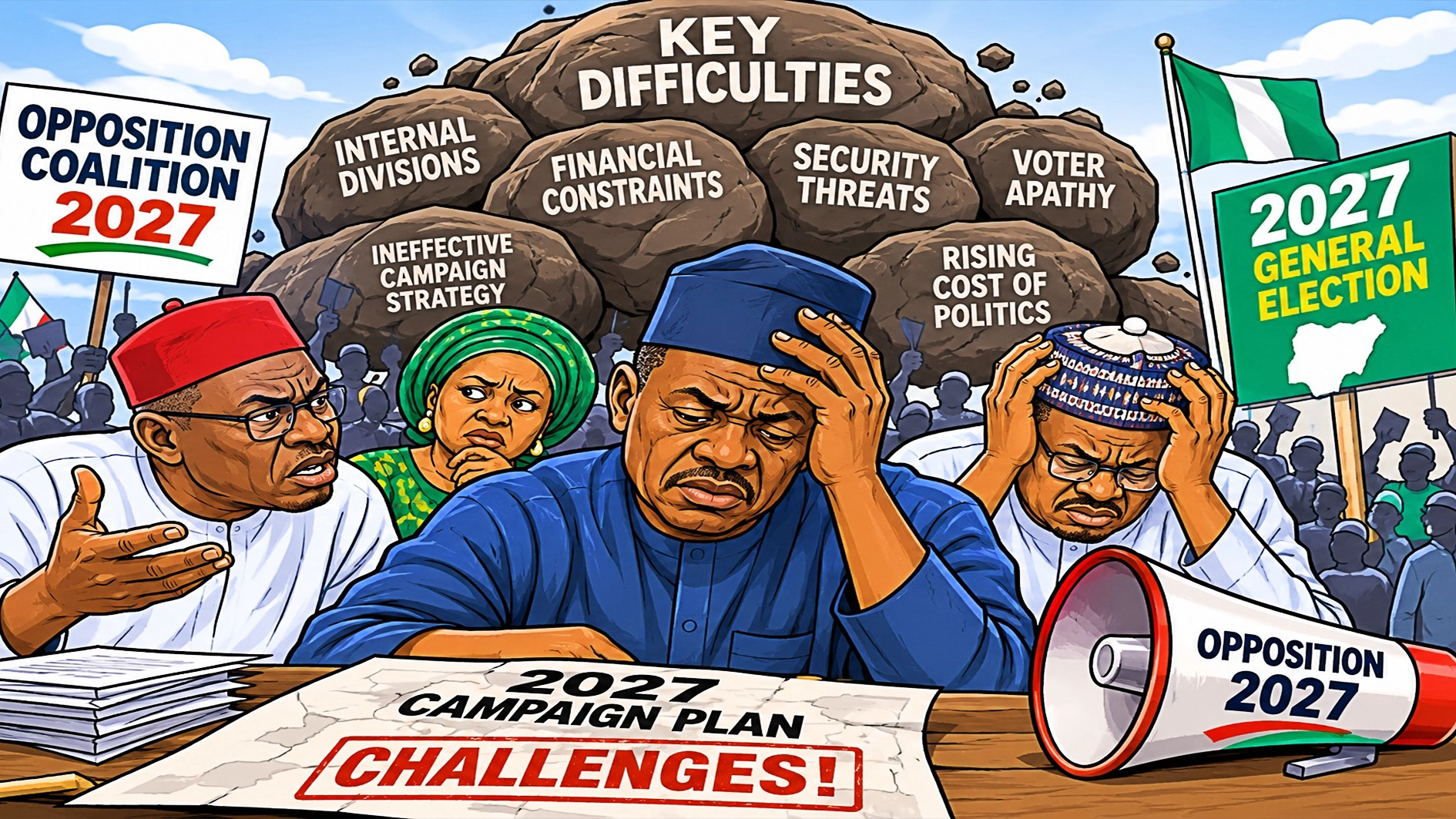
Despite immense advantages at its disposal, the ruling All Progressives Congress (APC), is not making pretenses that it is haunted by fear of the same opposition it had disarrayed. The government and the party have continued to deploy efforts, obvious and remote, to continue to frustrate opposition campaigns in several locations across the country.
For a party that has governed for nearly 12 years, and is very boastful of its far-fetched macro achievements, what else would make it so insecure, to resort to jankara tactics: bulldoze opposition offices, set thugs against peaceful gatherings, shut down hotels, stadiums and public event centres, just to deny the opposition a free and fair environment to reach voters? What else, apart from the desperation to deny impoverished and disrespected Nigerians the opportunity for a payback.
In Kebbi State, residents woke up last Tuesday; to find earth-moving equipment mowing down a building located along Sanni Abacha Bypass, in a manner that betrayed crude justice and vengeance. Ordinary folks who were moved to record the demolition, which they shared on social media, questioned the motive. Some alleged the building had been designated to serve as youth office for the major opposition political party in the state.
Former Attorney General of the Federation and governorship candidate of the African Democratic Congress (ADC), in Kebbi State, Abubakar Malami, accused the state government of being behind the demolition, to intimidate and provoke his supporters. But the government denied involvement and claimed the action was the result of a private dispute between individuals. Malami has asked his lawyers to go to court to ask whether private individuals can pull down structures.
That was not the first time the ADC in Kebbi would suffer what is apparently state sponsored aggression. Not the last either.
In Sokoto State, it was crass high-handedness last week, when the state government did everything to suffocate the opposition. The ADC was billed to flag off its presidential campaign on Saturday, October 31, 2026, in Sokoto, but the event had to be shifted to Wednesday, November 4, when the state government reportedly embargoed bookings into major hotels in the state capital.

As the story was reported in traditionally credible media, the absence of hospitality places to lodge party leaders and guests arriving to witness the campaign flag-off became a logistic hurdle. To overcome that, members of the party who had accommodation in Sokoto had to open them to the guests.
That settled, the next challenge for the party was how to secure a venue for the event. As reported, there were the options of hosting it at the Trade Fair Complex, for which the party had been charged N20 million by the government. The party agreed to pay the fee, but the account for payment was not disclosed on the eve of the event. The other option was the state ecretariat of the party situated at No. 1 Ilorin Road, Sokoto. Even here, there had been uncertainty, as prior to the event, the government had sealed the Secretariat over purported dispute.
In the absence of another venue, the party resolved to stay put at its Secretariat. Apparently, the government had relaxed its position for renovation work to be carried out on the premises by Monday, November 2. However, a detachment of security personnel in five Hilux vehicles had been stationed there. While members of the party feared the state government may have resumed the sealing of the place, the State Police Command interpreted the deployment as part of measures to prevent breakdown of law and order.
The Police Public Relations Officer, DSP Ahmad Rufai told newsmen: “We have done our deployment and gathered intelligence to ensure there is no breakdown of law and order. All hands are on deck to ensure that flag-off takes place without violence, God willing.” God could not have willed otherwise.
In the face oppression, the party was compelled to drag Governor Ahmad Aliyu, for refusing to approve a venue, and also interfering in the party’s campaign activities. In a statement by Mallam Bolaji Abudullahi, national publicity secretary of the party, the party condemned what it noted as political obstruction and attempt to intimidate the party.
The statement reads in part: “The Sokoto State Government must understand that governing a state does not confer ownership. Public office is a temporary mandate from the people, not a license to suppress political competition. No governor has the power to decide which party can campaign, which candidate can speak, or which political choices the people of Sokoto are allowed to consider…”
The party managed to flag-off the campaigns in Sokoto despite the restrictions. The campaign in Kebbi, the following day, was not different with regards to state-sponsored restrictions. The event was limited to the party secretariat in the state capital.
At the end of the Kebbi campaign, Amnesty International (AI), condemned the violence that was unleashed on the convoy. Amnesty International commented on footages that it analysed, showing armed gangs carrying weapons, and attacking vehicles and party faithful. Apart from the direct attacks, AI said hoodlums suspected to be sponsored, pelted vehicles with bottles, stones and also attacked media crews, destroying cameras and other gadgets.
mnesty International said: “Clearly, a brutal campaign of repression against the opposition and its supporters is increasingly making it extremely difficult for them to exercise their rights to freedom of association and peaceful political activities. So far, Nigerian authorities have failed to ensure accountability for such atrocities that happened in many states, including Niger, Kaduna, Edo and Enugu. In all the cases investigated by Amnesty International, security agencies failed to do their job of preventing or stopping the attacks to protect the right to freedom of association…”
On November 4, the convoy of the presidential candidate of Nigeria Democratic Congress (NDC), Peter Obi, along with his wife, Margaret and running mate, Rabiu Kwankwaso, was attacked by suspected thugs around Watt Market Roundabout, Calabar. Obi was said to be returning from a courtesy visit to the Obong of Calabar’s palace, on his way to the Metropolitan Hotel, where an event was to be hosted.
The thugs were reported to be armed with machetes, sticks, stones and bottles. They attacked vehicles and smashed windscreens. One arrest was made. For Obi, that was not the first time he will be waylaid in the course of the campaigns. The Independent National Electoral Commission (INEC) opened the space for parties and candidates to reach out to voters on August 22, 2026. It is a statutory part of the electioneering system and is covered by laws.
The Presidential candidate of Africa Action Congress (AAC), Omoyele Sowore, and members of his team were violently attacked in Ado Ekiti on October 30, at Tawakalitu Restaurant, Damilore area, after he had finished an interview at MIDAS FM. According to Sowore, armed men stormed the restaurant and descended on them with sticks and machetes. They robbed them of telecom devices, slashed vehicle tyres and destroyed other items. Sowore presented video evidence of the Police Cottage hospital in Okesha, Ado Ekiti, where they were given treatment and discharged.
They left with injuries to the knee, hands, lacerations on the head, swollen eyes and bleeding nose. Sowore said it was an assassination attempt on his life. But the Police described the attack as an altercation, with Sowore and his group sustaining minor injuries. The Police later arraigned 11 suspects before Chief Magistrate Abayomi Adeosun, in Ado Ekiti, for conspiracy and assault occasioning harm. They were charged under Sections 421, 186, 363, 181(1)(d) Criminal Law of Ekiti 2021, and granted bail in the sum of N100,000 each. The case was adjourned to December 4, 2026.
But Sowore has a different story from what the Police have declared. He named 12 suspects based on video evidence and intelligence gathered at the scene of attacks and a GPS tracking of stolen devices. These are government and APC related individuals with some participating in the physical assault. Sowore has called for an independent investigation of the matter because he does not trust the Police.
Sowore was among the presidential candidates who physically signed the peace accord on August 18,2026. Even though he said it was a ritual, he signed because he “wanted to bring faith” into the system. Those who attacked him and their sponsors are the ones who do not believe in this democracy. They go about using force to intimidate opponents. It is high time the organisers of the Peace Accord and their sponsors changed tactics.
You cannot supervise signing a peace accord and then go to sleep in the face intimidation, violence and open threat to peaceful campaigns, only to return in four years to sign another peace accord. What the organisers should do is, follow the process, document violators of the accord and call them out. Let it be on record that those who perpetrate violence do not go scot-free, and that their activities do not go unnoticed. Perhaps, that could challenge law enforcers to be neutral and do the needful.
The NDC also decried what it called the desperate attempt by the APC to muzzle opposition. In a statement signed by the party’s national publicity secretary, Osa Director, last Friday, the party reported the desperate attempt to constrict the democratic space through violent attacks and using soft targets. The party said that on two occasions, a popular hotel in Abuja denied it use of their space after payment. Another hotel in Wuse, Abuja, bluntly refused to allow the party unveil its national campaign council. The flimsy reasons are always “orders from above.” NDC believes APC is responsible for issuing such anti-democratic orders just to frustrate the opposition.
The party said: “This is not democracy. The APC should allow all parties to campaign without let or hindrance, and give Nigerians the opportunity to make their choices on who governs them.”
If it is democracy we want, we must play by the rules. Let those in power today not forget history.