
 Get Guardian on Google
… Offers ₦10m prize pool
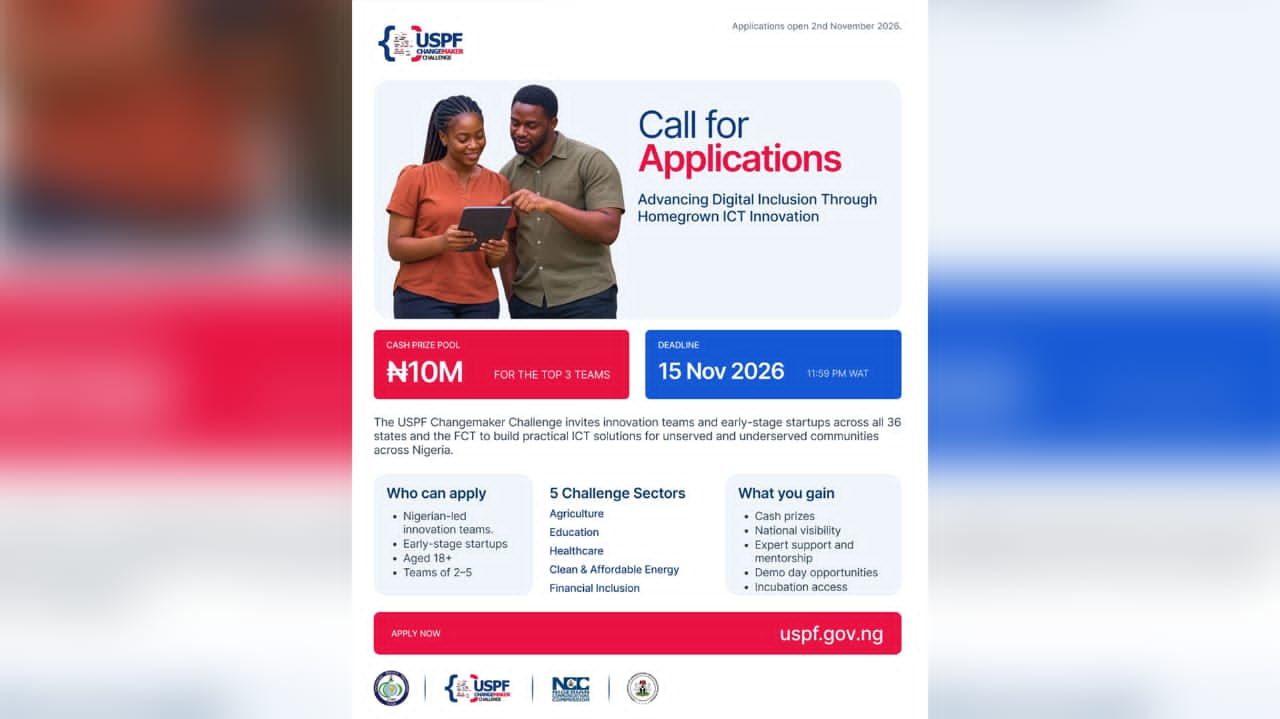
The Universal Service Provision Fund (USPF) has opened applications for its 2026 Changemaker Challenge, a nationwide innovation competition seeking technology-driven solutions to challenges facing underserved communities across Nigeria.
The competition, which opened on November 2, is designed to identify and support Nigerian innovators and early-stage startups developing practical information and communications technology (ICT) solutions in critical sectors, including agriculture, education, healthcare, financial inclusion, and clean and affordable energy.
The initiative comes amid concerns over Nigeria’s digital access gap, with about 23 million people still living in areas with little or no access to telecommunications services, according to the USPF.
The fund said the challenge would provide an opportunity for local innovators, particularly those outside major cities, to develop solutions addressing problems within their communities.
Applications are open to Nigerian-led innovation teams and early-stage startups comprising between two and five members. All team members must be at least 18 years old.

Interested applicants are required to submit solutions with a clear ICT component that address at least one of the published problem statements under the five focus sectors. Entries will also be assessed based on their relevance to the identified challenges and credible evidence of their potential to work.
The five sectors covered by the competition are agriculture, education, healthcare, financial inclusion, and clean and affordable energy.
In agriculture, the challenge seeks technology-based solutions that can address problems affecting farmers and agricultural productivity. Under education, innovators are expected to explore digital approaches to improving access to learning and educational opportunities.
The healthcare category focuses on technology solutions that can improve healthcare access and service delivery, while the financial inclusion sector targets innovations capable of expanding access to financial services.
For clean and affordable energy, the competition seeks practical solutions that can help address energy access challenges, particularly in communities with limited electricity supply.
According to the organisers, applying for the competition is free, and applications are open to eligible teams across all 36 states and the Federal Capital Territory (FCT).
Interested teams can submit their applications through the USPF website at https://uspf.gov.ng. The application portal closes on November 15, 2026, at 11:59 p.m. West Africa Time.
As part of the application process, the organisers will also host free online information sessions to guide prospective participants through the different challenge areas.
The sessions will hold between 5 p.m. and 6 p.m. WAT, with healthcare scheduled for November 9, education on November 10, and financial inclusion on November 11.
Following the application period, 50 teams will be selected to participate in six virtual Regional Demo Days scheduled for November 25 to 27. The selection will include at least one team from each state and the FCT, alongside 13 additional teams selected on merit.
Six teams, representing Nigeria’s six geopolitical zones, will subsequently advance to the National Demo Day scheduled to hold in Lagos on December 11, 2026.
The top three teams will share a ₦10 million prize pool, while all six finalists will participate in a four-week incubation programme beginning in January 2027. The programme will include a five-day residency designed to help the selected innovators further develop their solutions.
The Changemaker Challenge is organised by the Universal Service Provision Fund in collaboration with the Nigerian Communications Commission (NCC) and the Federal Ministry of Communications, Innovation and Digital Economy, with Ubulu Africa serving as the programme delivery partner.
The initiative is part of efforts to promote digital inclusion by identifying homegrown innovations capable of improving access to essential services and opportunities in communities that remain underserved.