

 Get Guardian on Google
Across commercial streets in Lagos, Abeokuta and Onitsha, millions of young people sustain themselves through trading, small retail and localised services in what is widely known as the hustle. Peters Jaaziah Bakare, a digital growth strategist who has worked with software platforms, small businesses and digital academies, has observed that this model, while resilient, faces structural limits that prevent broader wealth creation. He argues that African youth and entrepreneurs must shift from physical merchant models to software-led enterprises and platform-driven architectures if they are to move beyond survival-level economics.
Bakare points to the mathematics of linear commerce as a core constraint. Physical retail requires continuous reinvestment in inventory, warehousing and logistics to increase sales, keeping cash flow constrained. Businesses remain bound by geography, able to serve only those who can physically reach them. Revenue is also tied directly to time and presence. “When you stop working, revenue stops,” he noted. In contrast, software-led businesses operate on zero marginal cost once a digital product, automated funnel or platform is built, allowing the same infrastructure to serve far larger numbers of users across borders.
He has contended that educational frameworks, from community youth centres to secondary schools and digital skills academies, currently train many young people as passive consumers of foreign software rather than architects of local solutions.
Practical competencies he identifies as necessary include digital growth and performance marketing through acquisition funnels and automated customer-relationship workflows, product-led growth principles that deliver immediate value with minimal friction, and the use of open-source tools and cloud environments to reach international clients.

“When a young tailor, baker or retail vendor learns how to deploy targeted digital ads, manage automated customer databases and build a web-first brand presence, they instantly transcend the physical boundaries of their local neighbourhood,” Bakare said.
Through community mentorship programmes and youth empowerment initiatives under the Vehgo Foundation, including digital skills workshops for young people and underserved communities, he has sought to democratise access to such knowledge. Teaching graphic design tools, customer-acquisition engines and direct-to-chat sales funnels is presented as more than marketing instruction.

“We are planting the seed of scalable enterprise. We are showing them that their smartphones and laptops are not just consumption devices, but global export terminals,” he stated.
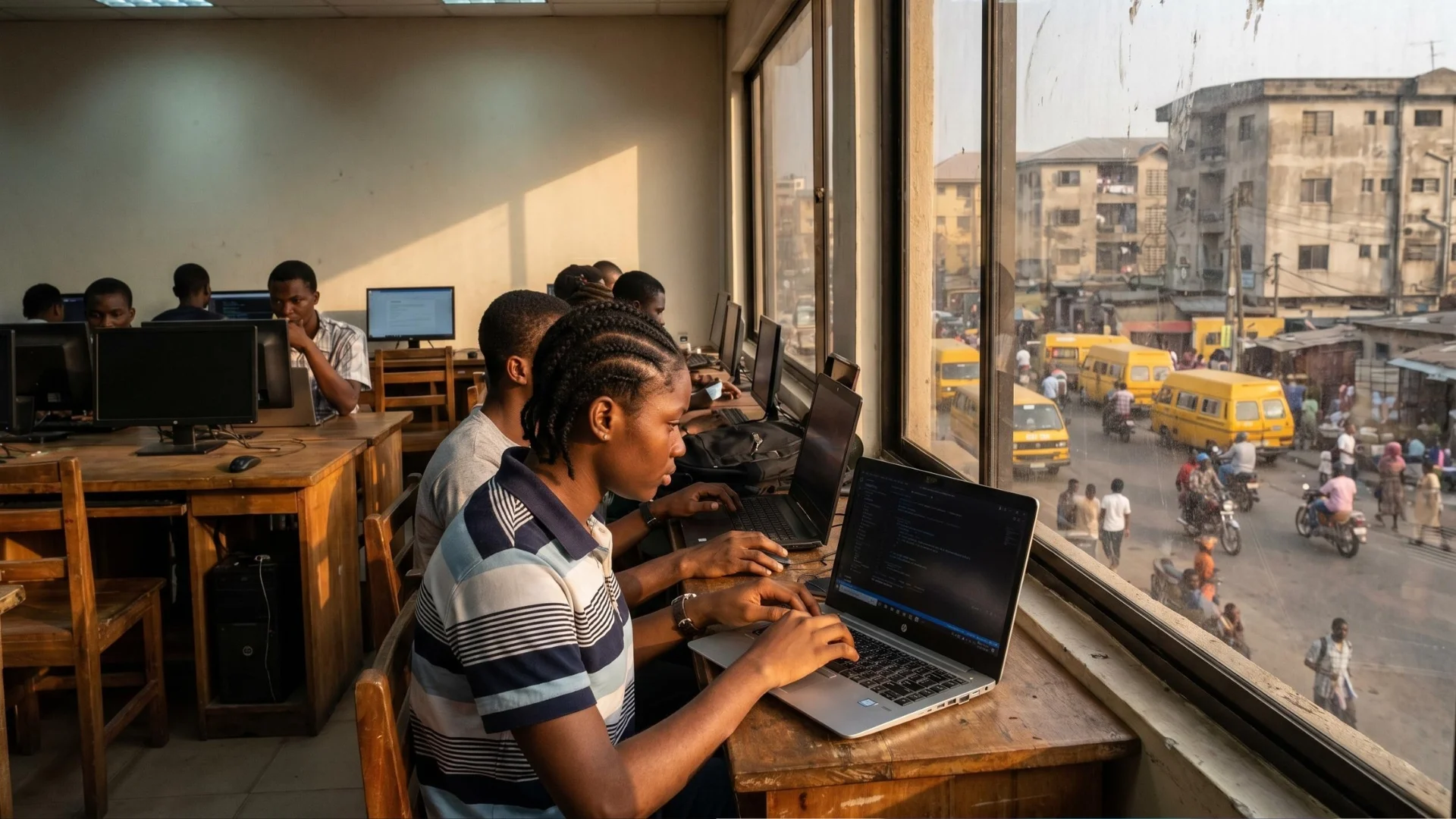
Africa’s young population, Bakare has argued, represents either a prolonged risk of underemployment within a linear economy or an asset in the global digital technology sector.
“If we want African businesses to move past survival and into sustainable global dominance, we must stop glorifying structural inefficiency,” he said. “We must embrace platform-led architectures, automate our growth engines, and systematically equip our youth with the digital skills required to build the future.”
He has concluded that while the hustle has sustained communities to this point, software-led scale offers the path to wider participation in international markets.