 Get Guardian on Google
The German Government and the Small and Medium Enterprises Development Agency of Nigeria (SMEDAN) have urged Nigerian entrepreneurs to innovate, become more competitive, access larger markets and contribute meaningfully to the nation’s economic growth.
Thankfully, the German Government has declared that it remains committed to working with Nigeria and all its partners to ensure that entrepreneurship contributes to inclusive economic growth, productive employment and shared prosperity.
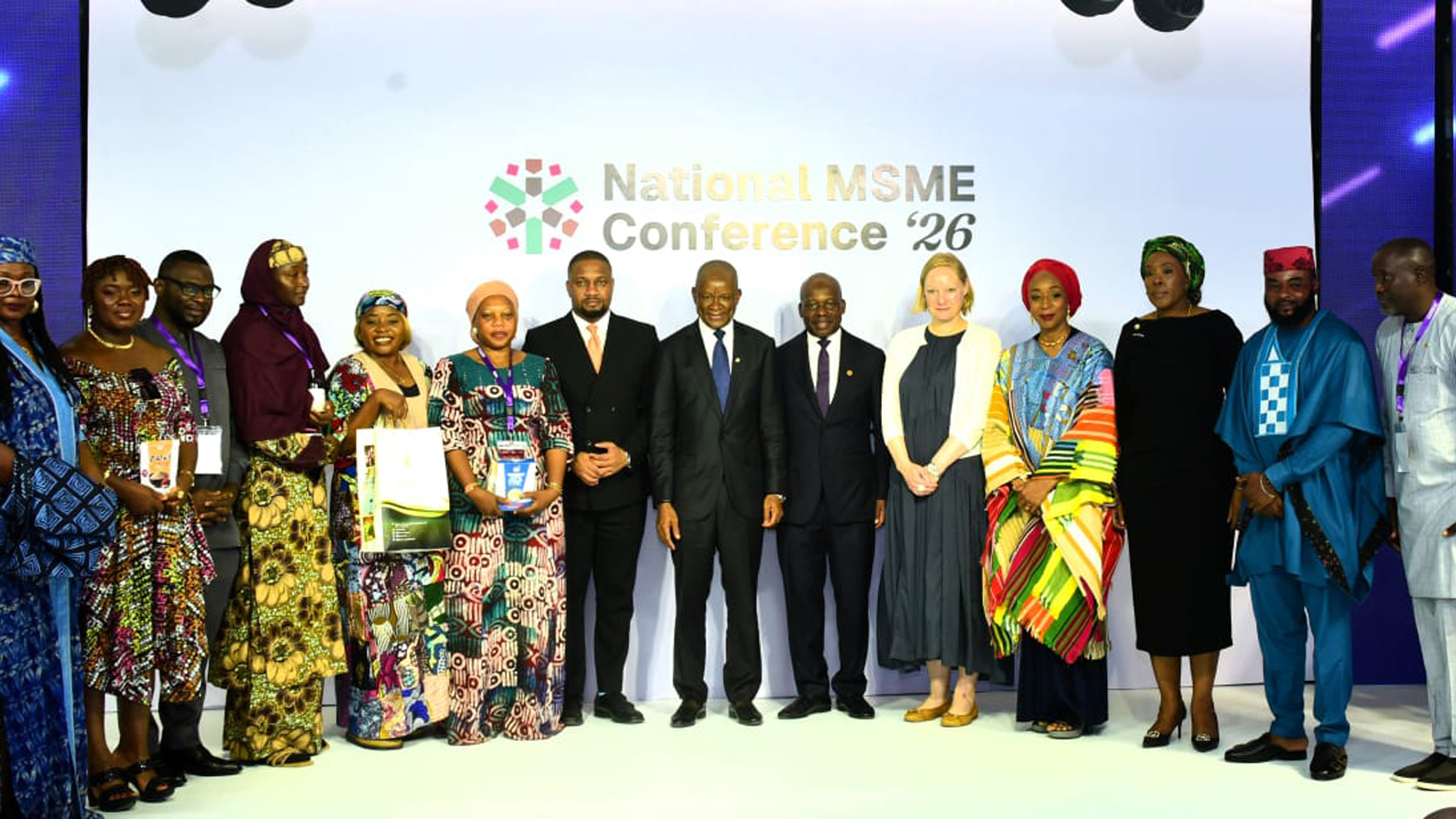
Speaking at the three-day National MSME Conference 2026, which was held in Lagos with the theme ‘The Next Frontier for Innovation, Policy and Market Access,’ Deputy Consul General, German Consulate Lagos, Katharina Ziegler, said the theme of the conference speaks to opportunities Germany and Nigeria want to advance together: “the growth of Nigerian enterprises, stronger commercial ties between our countries and increased investment in Nigeria.”
The conference was delivered by the SMEDAN in partnership with Deutsche Gesellschaft für Internationale Zusammenarbeit (GIZ) GmbH, commissioned by the German Government, alongside co-funding from the Governments of Denmark and Switzerland, and the European Union.
It brought together entrepreneurs, policymakers, financial institutions and development partners to explore opportunities for business growth. It also featured the Nigeria First Fair, exhibitions, masterclasses and the Zero to 100 pitch competition, with 230 businesses showcasing their products and services.
Ziegler said GIZ, on behalf of the German Government and in cooperation with the European Union, Switzerland and Denmark, has supported the conference since 2023, noting that its continued growth reflects the shared commitment of Nigeria and Germany to a stronger and more competitive Nigerian economy.
She said: “Our economic relationship has deep roots. Germany established its embassy in Lagos just three days after Nigeria gained independence in 1960. Since then, our bilateral development cooperation has exceeded one billion euros.
Today, Nigeria is Germany’s second-largest trading partner in sub-Saharan Africa, with bilateral trade worth approximately three billion euros a year.
“In May 2026, the Nigerian and German governments agreed on 65 million euros in new funding for 2026 and 2027. Of this amount, 34 million euros is dedicated to economic development, vocational training and employment. This reflects a clear priority: creating opportunities for businesses to grow and people to prosper.”
She stated that innovation, policy and market access are closely interconnected, adding that for Nigerian MSMEs to innovate, they need more than technology.
“They need the skills to use it, the resources to invest in it and a business environment that encourages enterprise and investment. Equally, businesses need effective institutions, accessible business development services and opportunities to connect with markets beyond their immediate surroundings.
“These priorities guide Germany’s development cooperation with Nigeria. Through GIZ, we work with Nigerian institutions and private sector partners to strengthen enterprises, improve access to finance, develop vocational skills and promote business-enabling reforms and digitalisation. In collaboration with SMEDAN, our Digitalisation Service Points have supported over 1,200 MSMEs to adopt digital solutions and improve their competitiveness.”
Ziegler disclosed that between 2018 and 2023, German cooperation through the Inspire, Create, Start and Scale (ICSS) programme trained over 40,000 entrepreneurs, while more than 30,000 Nigerians acquired vocational skills and over 7,000 secured employments.
“We remain committed to expanding these opportunities, particularly for young people, women and persons with disabilities.
“Ultimately, the next frontier is not simply about helping more businesses emerge. It is about creating the conditions in which Nigerian enterprises can innovate, become more competitive, access larger markets and contribute meaningfully to economic growth.
“Our approach is clear: Nigerian institutions and businesses must lead, with German cooperation providing expertise and partnership opportunities. Stronger Nigerian enterprises also create opportunities for German businesses through local partnerships, suppliers and customers, benefiting both countries through increased investment, trade and employment,” she said.
Also speaking, the Lagos State Governor, Babajide Sanwo-Olu, described MSMEs as the real engine of economic growth, saying small businesses employing even four or five people play a critical role in sustaining the Nigerian economy.
Sanwo-Olu said government support must go beyond financial interventions to addressing infrastructure challenges, particularly transportation, electricity and regulatory costs, which continue to make business operations difficult.
He disclosed that Lagos State had supported nearly 39,000 businesses through the Lagos State Employment Trust Fund, providing tens of billions of naira in single-digit loans, grants and other financing interventions.
The governor also disclosed that the state had introduced grants of between N10 million and N50 million for technology startups through its innovation and research initiatives, alongside interventions in the creative and movie industries.
He urged business owners not to abandon their enterprises despite prevailing economic difficulties, assuring them that his administration would continue to listen to their concerns and create an enabling environment for businesses to thrive.
Earlier, the Director-General and Chief Executive Officer of SMEDAN, Charles Odii, disclosed that the Federal Government had approved a N6 billion waiver to formalise 250,000 informal businesses across the country.
Odii, who put the number of MSMEs in Nigeria at approximately 39.6 million, explained that the waiver would ease the cost of business registration and help more informal enterprises become formal.
He also disclosed that the Federal Government had committed N200 billion to business support packages for nano businesses, while SMEDAN had mobilised an additional N12 billion in single-digit interest loans for small businesses.
Odii said the agency had trained 1,765,000 businesses in the last 12 months, expanded access to shared production facilities and work tools, and strengthened business advisory and capacity-building support.
According to him, SMEDAN had secured approval from the Federal Ministry of Education to establish its own polytechnic to provide training for entrepreneurs, while a $12 million investment had been secured for its Abuja Centre for Entrepreneurship through KUIPER.