
 Get Guardian on Google
‘Mene, Mene, Tekel, Upharsin – ‘The Biblical image that won’t go away’
In Daniel Chapter 5, King Belshazzar was feasting in his palace, drinking from gold vessels looted from the Temple, praising gods of gold and silver, while his kingdom was collapsing outside. Then a hand appeared and wrote on the wall: MENE, MENE, TEKEL, UPHARSIN. Daniel interpreted it: You have been weighed on the scales and found wanting. Your kingdom is divided and given away. That is the image that haunts the 2027 campaign of President Bola Ahmed Tinubu. Not because anyone is claiming divine prophecy. But because from Kaduna through Abuja to Port Harcourt and Calabar, the walls of his campaign are writing their own message. And the question is: Are his strategists reading it right? Or are they reading endorsements in Abuja conference halls and mistaking them for votes in the streets? The President has deployed massive resources to the campaign fields. Billboards everywhere. Jingle everywhere. Endorsement after endorsement. Governors endorsing. Senators endorsing. Traditional rulers endorsing. Ministers endorsing. Birthday big boys endorsing. But on the ground, people are saying: We don’t want you. That is the writing on the wall.
Kaduna –The Flag-off That Flagged Off Rejection’
On October 24, 2026, the APC chose Kaduna for its presidential campaign flag-off. Kaduna is strategic. It is the political capital of the North West, the most populous zone. It is the place where you prove you still have the North.
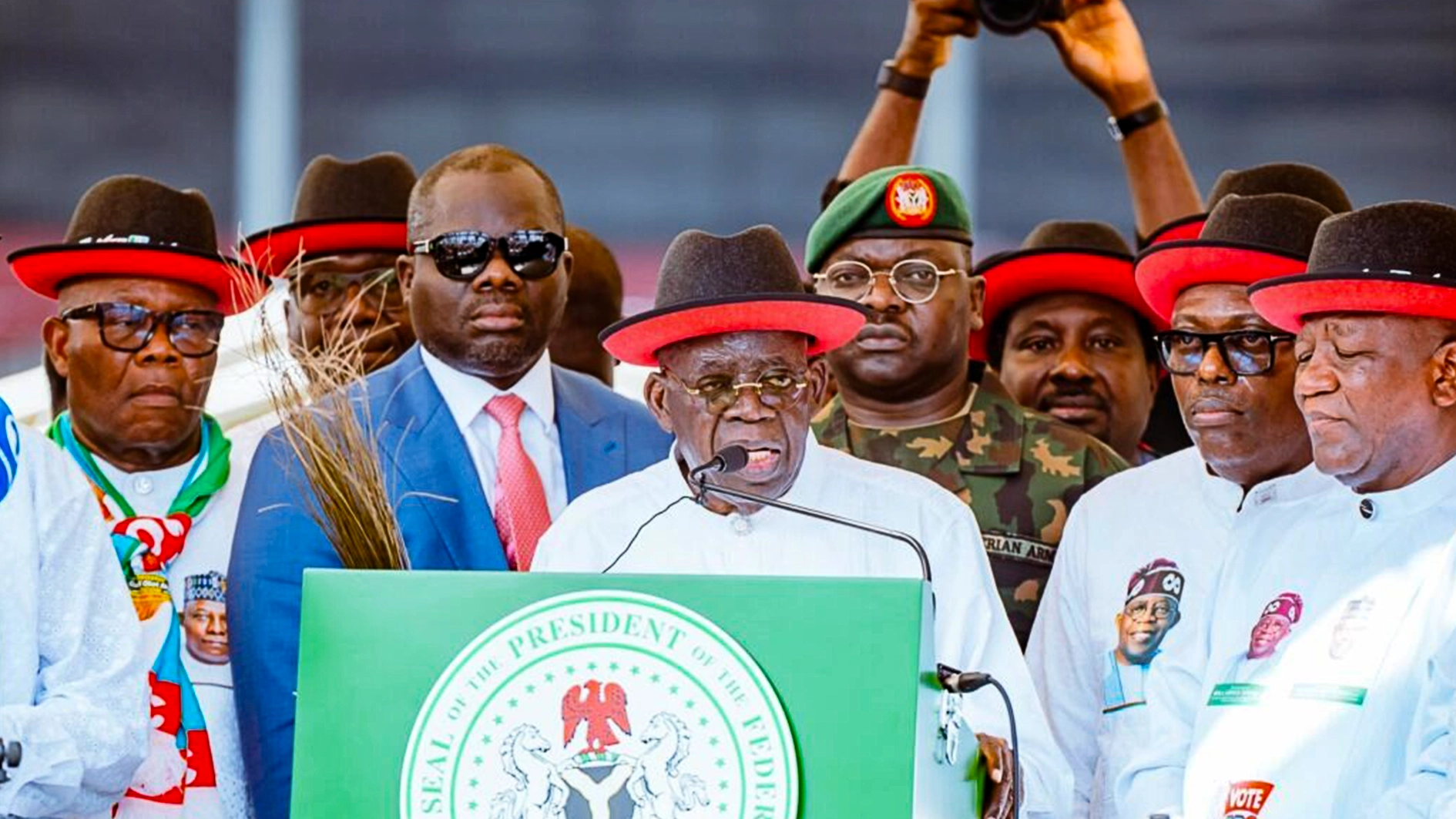
President Tinubu arrived at Ranchers Bees Stadium, also known as Kaduna Township Stadium, to launch his 2027 re-election bid. According to Daily Trust, as reported widely, when Tinubu mounted the podium and shouted “Nigeria!” – a section of the crowd responded: “Ba Ma Yi!” – Hausa for “We don’t want you” / “We won’t support you”. When he shouted “Kaduna!” – the same response. He had to invoke Governor Uba Sani’s name – “Sai Uba Sani” – before he could continue his speech. Some attendees who spoke to Daily Trust said their actions were motivated by concerns over insecurity and the effects of the government’s economic policies. President Tinubu acknowledged hardship and hunger in his speech. But he blamed the opposition for it. That is the first misreading of the wall: When people tell you they are hungry, you don’t tell them the opposition made them hungry. You tell them what you did with the three-year budgets you implemented.
Kaduna was not just a rally. It was a referendum in miniature. His strategists told Nigerians: “It was a huge success.
The crowd was massive.” The wall said: “Ba Ma Yi.” Which one will they believe?
‘Abuja –The Mosque That Turned To Protest’ If Kaduna was embarrassing, Abuja was symbolic. On Friday, November 13, 2026, President Tinubu went to observe Juma’at prayers at the Shehu Shagari Central Mosque in Area 1, Garki, Abuja. This is significant because in 2023, when he campaigned on a Muslim-Muslim ticket, he was warmly received in mosques across the North. The Muslim-Muslim ticket was presented as a masterstroke. Muslims were told: “This is your turn. This is our ticket.” Three years later, the same constituency was saying something else. Videos also showed youths outside the Area 1 axis tearing down APC campaign posters and banners while chanting against the administration.
Eyewitnesses attributed the anger partly to excessive security restrictions. But the deeper anger was not about security. It was about the Muslim-Muslim ticket itself. The ticket promised: “Muslims will benefit.” What did ordinary Muslims in Abuja get? The same hunger, the same ‘Band A tariff’, the same insecurity, the same out-of-pocket health care as everyone else. The ticket delivered power to elites, not bread to the masses.
It was also in Jalingo, Taraba State, on October 30, 2026, that worshippers reportedly walked out of the mosque when the Chief Imam Sheikh Ibrahim Jalo Jalingo called on them to back Tinubu’s re-election. In Madina Quarters in Bauchi, an Imam identified as Dahiru Abubakar was reportedly removed by the mosque committee for using his sermons to campaign for Tinubu. These are not opposition rallies. These are mosques. The most sacred spaces. When prayer turns to protest, the writing is not only on the wall – it is on the prayer mat. The presidency, of course, disputed the narrative.
‘Port Harcourt and Calabar –The South is not safe either’
The strategists might say: “The North is difficult, but the South-South is ours. Wike is there.” But Port Harcourt has its own writing on the wall. In Rivers State, the APC campaign has been dogged by the Wike-Fubara war. The state that should be a fortress is a battlefield. The President’s own minister, Wike, has turned Rivers into a permanent crisis zone. People in Port Harcourt are not asking about 2027. They are asking: “Who is governor? Who controls the Assembly? Who controls the local governments?” When you go to campaign in a state where your own party is in two factions, where your minister is fighting your governor, the crowd does not hear “Renewed Hope.” They hear “Renewed Confusion.”
In Calabar, Cross River State, the writing was even more violent. The other day, according to reports, the convoy of Peter Obi, presidential candidate of the Nigeria Democratic Congress, was attacked by miscreants around Watt Market Roundabout after a courtesy visit to the Obong of Calabar. Windscreens were smashed. Supporters panicked. That attack was rightly condemned. But it also showed that Calabar, which should be a peaceful APC state under Governor Bassey Otu, is now a place where campaign convoys get attacked. If opposition convoys are attacked in Calabar, what does that say about the security the ruling party promised? The South-South writing is: “You promised us peace, you gave us factional war.”
“Heaven won’t fall” – The correct context and why some commentators are right. Minister of Aviation and Aerospace Development, Festus Keyamo, SAN, said: “Heaven won’t fall if Atiku isn’t on the ballot.” On November 5, 2026, Justice Peter Lifu of the Federal High Court, Abuja, in Suit No. FHC/ABJ/CS/1819/2025 – Nafiu Bala Gombe vs ADC – nullified the David Mark-led leadership of the African Democratic Congress (ADC), under which Atiku Abubakar emerged as the party’s presidential candidate for January 16, 2027. The ADC has appealed. But INEC Chairman, Prof. Joash Amupitan, told Chatham House in London on November 13: If Atiku fails to overturn the judgment, “I’m obligated to obey every court order, especially if it’s from the Supreme Court” and Atiku will not be on the ballot. It was in that charged atmosphere that Keyamo said: “Heavens WILL NOT FALL IF A CERTAIN ATIKU ABUBAKAR IS NOT ON THE BALLOT IN 2027.” Heaven did not fall when the same court sacked all our candidates in Zamfara a few years ago. Not just candidates who had won elections. The governor, the deputy governor, all members of the House of Assembly, all the senators and all members of the House of Representatives. I’m talking from top to bottom.
They were all sacked.” He added the Bayelsa precedent: On February 13, 2020, when the Supreme Court nullified the victory of APC governorship candidate David Lyon a day to his swearing-in, APC took it on the chin. His legal point was precise: The ADC as a party would remain on the ballot, but Atiku might not be its candidate, because the process that produced his nomination was conducted by a leadership the courts had refused to recognise. In other words, Keyamo was dismissing the opposition’s threat that heaven would fall. But here is why his dismissal is itself a misreading of the writings on the wall – and why two recent commentators are more prophetic than the Minister.
Commentator 1: “Heaven doesn’t fall in one day.” Keyamo is technically right: On November 6, 2026, heaven did not fall. On November 13, heaven did not fall. Markets opened. Banks opened. Flights flew from Lagos to Abuja. But heaven does not fall in one day. It recedes. It leaks. It cracks. In Zamfara in 2019, heaven did not fall on the day the Supreme Court sacked all APC candidates. But what happened after? Zamfara became the epicentre of banditry in Nigeria. A state whose democratic legitimacy was decided by court, not by ballot, lost the moral authority to govern. People stopped believing in elections. They started believing in guns.
Commentator 2: “Heaven may not fall but the skies can recede.” This is even more poetic, and even more accurate. The skies receding means: The space for democracy shrinks. Not with a bang, but with a slow closing. Heaven may not fall. But the skies can recede until there is no sky left – until Nigeria becomes a democracy in name, a one-party state in practice, where elections are held but outcomes are decided in courtrooms in Abuja before votes are cast in Kaduna. Keyamo is using a legal truth to hide a political danger.
Legally, INEC must obey court orders. But politically, when you remove the most experienced opposition candidate – a former VP contesting for the seventh time, the anchor of ADC coalition about 60 days to election, through a lower court judgment in a case filed by a party member, not by INEC, not by APC, you create a perception that cannot be erased by legal correctness: The perception that the ruling party is using courts to clear the ballot. And perception is the writing on the wall.
What should they be doing instead? If Tinubu’s strategists were reading the writings on the wall right, they would do five things:
1. Campaign on record, not on attacks. Tell Nigerians: “Here is what we borrowed, here is what we spent, here is what we built, here is the audit.” Apologise where they failed. Apologise for electricity failure. Apologise for food inflation. Apologise for insecurity. Nigerians forgive a leader who apologises. They don’t forgive a leader who blames opposition for hunger he created by removing subsidy without palliatives.
2. Fix existing roads, not promise new superhighways. Go to Abuja-Lokoja road and fix it. Go to East-West Road and fix it. Nigerians will believe a repaired road more than a billboard of a coastal road.
3. Stop the dismissive messaging. Stop “Heaven won’t fall.” Stop N10 million for wards. That is not mobilisation. That is vote-buying and judicial triumphalism. It insults voters and scares democrats.
4. Stop attacking opposition and start listening. When youths chant “Ba Ma Yi” in Kaduna, don’t call them opposition thugs. Ask: “Why are they angry?” When worshippers walk out in Jalingo, don’t call them sponsored. Ask: “What did we promise them in 2023 that we didn’t deliver?”
5. Show, don’t tell, on electricity. If you cannot give 20 hours light before election, don’t promise 24 hours after election. Give people 12 hours for one month and they will believe you.
Conclusion: MENE, MENE, TEKEL…
The writings on the wall are not mystical. They are practical. The strategists are reading endorsements. The people are writing rejection. The biblical king ignored Daniel and lost his kingdom that night. Tinubu’s strategists should not ignore Daniel. Hope Tinubu is reading ‘The Writings On The Wall’! Because if he is not, 2027 will read it for him. And the interpretation will be the same as Babylon: You have been weighed on the scales of electricity, food, security, education, health – and found wanting. Tinubu’s strategists think that because heaven didn’t fall on November 5, it won’t fall on January 16, 2027. They are wrong. “Heaven doesn’t fall in one day”. It falls when a nation stops believing that its courts are neutral, its elections are free, and its ballot can change its leaders.“ And heaven may not fall, but the skies can recede. 2027-2031 is still a bridge too far – unless he crosses it by apologising, accounting, and actually delivering, not by buying wards and dismissing the opposition.