 Get Guardian on Google
As the All Progressives Congress (APC)’ rallies attract influential political leaders and large crowds across the North, Tinubu’s second-term ambition faces a crucial test of whether campaign promises will be sufficient to secure the support of a northern electorate increasingly concerned about economic hardship, insecurity, unemployment and the cost of living, ADAMU ABUH reports.
President Bola Ahmed Tinubu’s campaign for a second term in 2027 is placing the North at the centre of his political calculations, with his recent rallies in Kaduna, Jigawa, Plateau and Kebbi states offering an insight into the opportunities and challenges confronting his re-election bid.
From Kaduna, where he defended his economic reforms and promised prosperity, to Dutse, where he unveiled an agricultural development agenda and pledged support for smallholder farmers; Jos, where he promised to rebuild communities devastated by violence and Kebbi, where he approved an inland dry port and promised further infrastructure interventions, the President has tailored his campaign messages to address some of the pressing concerns across the region.
The rallies also provided an opportunity for the APC to showcase its political organisation, mobilise influential northern politicians and demonstrate that Tinubu retains the backing of important sections of the region’s political establishment.
The participation of Vice President Kashim Shettima, governors, senators, members of the National Assembly, former governors and other party leaders was particularly significant.
However, beyond the impressive gatherings and endorsements, the central question is whether the President’s promises and his administration’s record will be sufficient to secure the support of a northern electorate increasingly concerned about economic hardship, insecurity, unemployment and the cost of living.
The four campaign appearances suggest that the APC recognises that the North cannot be approached as a politically homogeneous constituency. While infrastructure and economic development featured prominently across the rallies, Tinubu’s messages reflected the peculiar concerns of each location.
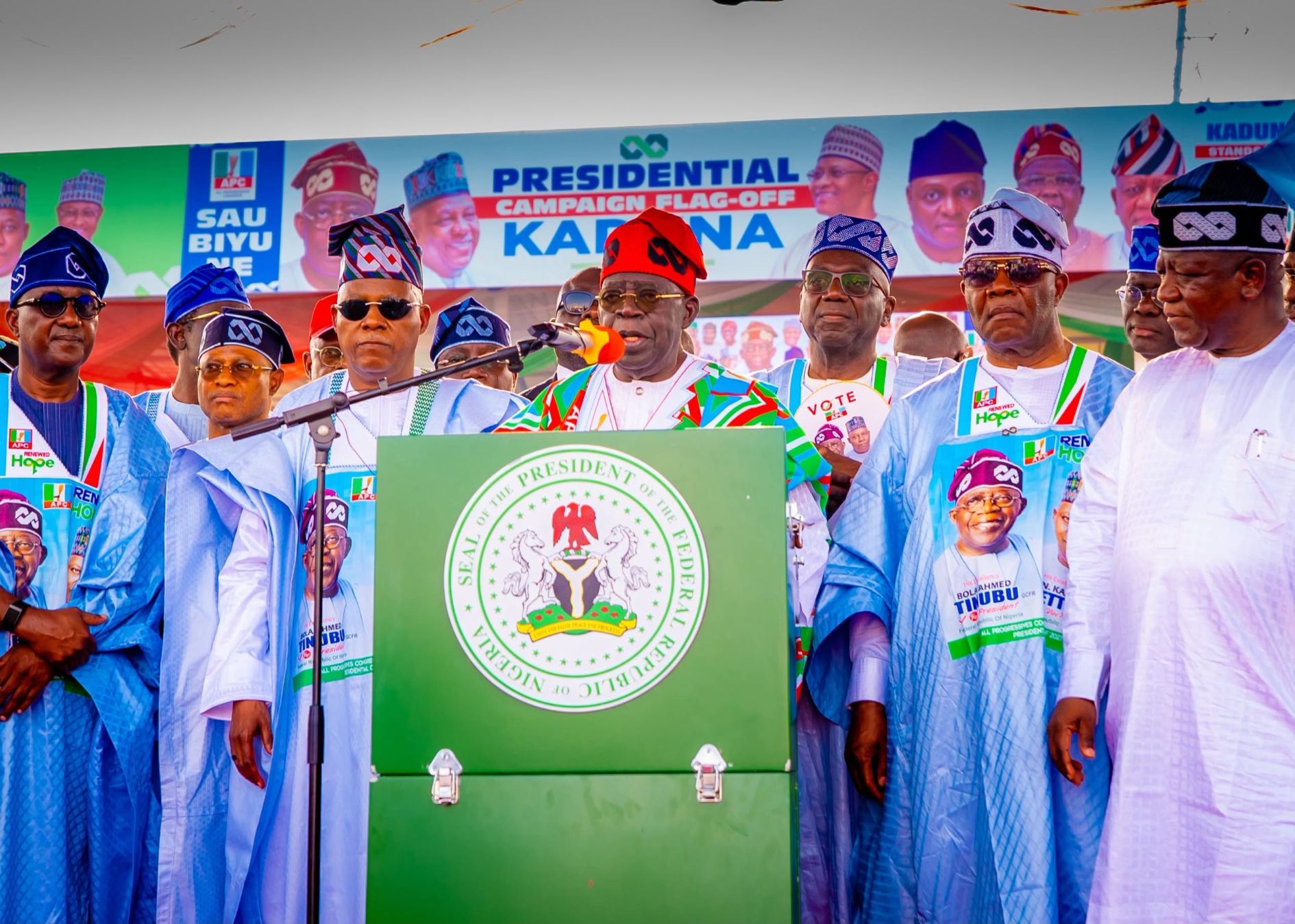
Tinubu’s October 24 campaign flag-off in Kaduna was particularly important because it marked the formal commencement of his presidential re-election campaign.
The rally attracted a large crowd of supporters and an impressive gathering of political heavyweights, including Shettima, APC National Chairman, Nentawe Yilwatda; Director-General of the Presidential Campaign Council, Abdulaziz Yari; Senate President Godswill Akpabio, governors and other party leaders.
The participation of 32 governors, according to the Presidency, was intended to demonstrate the ruling party’s organisational strength and determination to secure another mandate for the President.
Unlike his subsequent appearances in the other states, Tinubu’s central message in Kaduna was largely a defence of his economic policies and an attempt to counter opposition criticism of the hardship experienced by Nigerians.
Responding to complaints about hunger and poverty, the President blamed previous administrations and opposition politicians for the country’s economic difficulties, insisting that his government was working to eradicate the problems. He defended the removal of the petrol subsidy, arguing that the policy had ended corruption, falsification of invoices and fuel smuggling associated with the previous subsidy regime.
His promise was that a second term would bring prosperity, continuity and progress. The message reflected the administration’s determination to persuade Nigerians to look beyond the immediate difficulties associated with its reforms and consider their anticipated long-term benefits.
The removal of the petrol subsidy and foreign exchange reforms have improved government revenues and some macroeconomic indicators, but they have also contributed to increased transportation costs, food prices and pressure on household incomes. For northern households dependent on farming, trading and informal employment, the consequences are particularly significant. The President’s economic argument will therefore be tested against the daily experiences of citizens who want to know whether the reforms have made food more affordable, created jobs and improved their purchasing power.
Kaduna also provided an opportunity for the administration to showcase its infrastructure investments. Tinubu inaugurated the 81-kilometre section of the Abuja-Kaduna highway during the campaign flag-off, while Shettima highlighted Federal Government interventions in education, vocational training and railway development.
He cited the establishment of the Federal University of Applied Sciences, the transition of the Federal University of Education, Zaria, and vocational training institutions in Rigachikun, Soba and Samaru. He also highlighted the Kaduna-Kano railway, the Ajaokuta-Kaduna-Kano gas pipeline and other major infrastructure projects across the North-West.
These projects were presented as evidence that the administration was addressing the region’s development needs.
The Kaduna rally also had a political dimension. Shettima reminded northern voters of Tinubu’s previous support for northern presidential aspirants, including Atiku Abubakar in 2007, Nuhu Ribadu in 2011 and Muhammadu Buhari in 2015 and 2019. His argument was that the North should reciprocate the political support Tinubu had extended to its leaders over the years.
Nevertheless, the political loyalty argument may not be sufficient to override economic concerns among voters.
A different dimension emerged at the November 10 campaign rally in Dutse, Jigawa State, where Tinubu placed agriculture, food security, electricity, employment and human capital development at the centre of his re-election appeal.
Unlike Kaduna, where he concentrated on defending his economic reforms, the Jigawa appearance provided an opportunity to demonstrate how the administration intended to translate those reforms into increased agricultural production and improved household welfare.
Tinubu presented the APC manifesto, titled ‘From Reforms to Prosperity,’ and promised interest-free loans for smallholder farmers, mechanised farming service centres across the six geopolitical zones and improved irrigation facilities.
He argued that Nigeria had sufficient arable land and human resources to feed itself, insisting that increased agricultural production would help bring down food prices.
The agricultural proposals were particularly relevant to Jigawa, where farming remains a major source of livelihood. The President also promised reliable electricity, functional education, job creation and a more effective security architecture. He ruled out any return of petrol subsidy, arguing that resources saved from its removal were necessary to finance roads, agriculture, education and other development programmes.
The significance of the Jigawa visit, however, extended beyond campaign promises. Tinubu inaugurated 400 tractors and 60 combine harvesters, alongside projects executed by the Governor Umar Namadi administration. The agricultural equipment included 300 tractors provided by the state government and 100 supported through Federal Government intervention.
He also commissioned the Bola Ahmed Tinubu Multi-Purpose Skills Acquisition Centre, the Renewed Hope Technical Services Centre and a three-kilometre dualised road in Dutse. These interventions were presented as investments in agricultural productivity, vocational skills and infrastructure.
Namadi used the occasion to highlight the Greater Dutse Water Supply Project, which he said was more than 60 per cent complete. The project was particularly significant because Tinubu had promised to address Dutse’s water shortage during the 2023 campaign.
Namadi also cited the Kano-Katsina-Maradi railway, Federal Government interventions in agriculture and education, and the establishment of federal educational institutions in the state. He appealed for the acceleration of the water project and Federal Government intervention in ecological challenges affecting Dutse and Hadejia.
The Jigawa rally therefore offered Tinubu an opportunity to connect his national economic agenda with practical interventions in a predominantly agrarian state. The inauguration of agricultural machinery was especially important in projecting the administration’s commitment to mechanisation.
However, the provision of tractors and harvesters alone cannot transform agricultural productivity without affordable inputs, irrigation, accessible financing, storage facilities, rural roads and reliable markets.
Similarly, the proposed interest-free loans and mechanised farming centres will have to move beyond campaign announcements to become accessible interventions that reach smallholder farmers.
The political dimension was equally important. Namadi declared Jigawa’s readiness to deliver victory for the APC across elective offices, while Shettima urged residents to support the President and the governor. Shettima also invoked Tinubu’s historical political alliances with northern leaders, urging the region to reciprocate his support.
The presence of Deputy Senate President, Barau Jibrin; Speaker of the House of Representatives, Tajudeen Abbas; Yari, APC governors and other influential politicians reinforced the party’s mobilisation efforts. Yet, the extent to which these endorsements translate into votes remain to be seen..
If Kaduna was largely about defending economic reforms and showcasing infrastructure, and Jigawa about agricultural productivity and food security, Tinubu’s November 14 visit to Jos placed security, reconciliation and reconstruction at the centre of his campaign.
The APC North-Central rally at Zaria Road Stadium attracted the President, Shettima, Akpabio, Abbas, Yilwatda, Yari and several serving and former governors.
The presence of influential Plateau political figures, including former governors Joshua Dariye and Simon Lalong, alongside Governor Caleb Mutfwang, was significant in projecting political cooperation behind the President.
However, the most consequential aspect of Tinubu’s message was his acknowledgement of the security and humanitarian challenges confronting Plateau. He promised Federal Government assistance to rebuild communities affected by violence and facilitate the return of displaced residents to their ancestral homes.
The President also announced that surveillance cameras promised for the state had arrived in Nigeria and would soon be installed. He disclosed that 1,000 forest guards recruited by the Federal Government were undergoing training and would be deployed upon completion to support security agencies in monitoring forests and vulnerable communities.
These commitments addressed longstanding concerns in Plateau, where communal violence and attacks have disrupted livelihoods, displaced residents and affected economic activities.
Tinubu also announced plans to convert Plateau’s airport into a cargo facility to facilitate the export of agricultural produce, particularly vegetables and potatoes. The proposal is significant because Plateau has considerable agricultural potential.