Half a century after his passing, the rhythms of Oba (Dr.) John Adetoyese Laoye still pulse through Ede, Osun State like a living memory. Hence, in December 2025, the ancient town of Ede stood still as the drum of its 22nd monarch beat again, not in flesh, but in spirit, memory and culture continuity.
Oba Laoye, who reigned as Timi of Ede from 1946 to 1975, was no ordinary king. He was a drummer-scholar, a cultural philosopher, a bridge between tradition and modernity, and one of the most influential cultural ambassadors Yoruba land has produced.
Fifty years after he joined his ancestors, Ede gathered to honour a monarch whose hands once shaped the heartbeat of his people and whose rhythms carried Yoruba culture beyond Nigeria’s borders and into global consciousness.
In Yoruba cosmology, kingship is not merely political authority; it is spiritual stewardship. Oba Laoye embodied this ideal in uncommon ways.
While many monarchs ruled by edict, lineage or ritual, he ruled also through sound, through the talking drum (Dùndún), an instrument capable of speech, metaphor and history.
Born into royalty but shaped by Western education, Oba Laoye became the first Western-educated Timi of Ede. However, rather than distance himself from tradition, education sharpened his cultural consciousness. He understood early that modernity needed not erase identity; rather, it could be a tool to preserve and project it.
Under his reign, drumming ceased to be a background art. It became language, archive and diplomacy. His mastery of rhythm allowed him to “speak” across communities, ceremonies and continents, translating Yoruba history and philosophy into beats that resonated far beyond Ede.
Hence, 50 years after, his town remembered him. The golden jubilee memorial of Oba Laoye was organised by the Laoye Royal Dynasty. The event brought together royal fathers, scholars, clerics, politicians, artists and culture enthusiasts from across Nigeria, and beyond.
More than a remembrance, the event became a cultural statement, a reaffirmation of the place of tradition, memory and creativity in a dynamic world.
The celebrations began on December 12, 2025, with a vibrant cultural carnival at the Sports Pavilion of the Federal Polytechnic, Ede. The arena came alive with drums, chants, dances and dramatic performances that transformed remembrance into spectacle.
One of the most symbolic moments of the day came when children between the ages of four and seven performed on talking drums, articulating phrases and messages through rhythm. Their small hands, confidently commanding ancient instruments, offered a quiet assurance that Oba Laoye’s legacy is not frozen in the past but actively inherited by younger generations.
Cultural troupes, Sango devotees, poets and dancers followed in succession, each performance layering history upon memory. The carnival was less a performance and more a communal dialogue between generations, a reminder that culture survives only when lived.
The following day, December 13, the memorial shifted into a more solemn register with a service at the First Baptist Church, Apaso, Ede. The venue was symbolic. Oba Laoye was not only a custodian of Yoruba tradition but also a committed Christian, embodying a rare synthesis of faith and culture.
In his sermon, Rev. Dr. Nathaniel Oyewole of the Baptist Church drew parallels between Oba Laoye and the biblical King David, saying both rulers, both musicians, both men whose devotion to God shaped their leadership.
“Legacy is not what you leave for people, but what you leave in them,” the cleric declared. He described Oba Laoye as a disciplined monarch, a man of faith and a leader whose impact endured because it was rooted in service, integrity and moral clarity. The sermon resonated deeply with congregants, many of whom saw in Oba Laoye a reminder that leadership need not be divorced from humility, nor power from responsibility.
The cleric said: ‘’David was a skilful musician. Oba Laoye was also a skilful drummer. His signature drumming is still being played at Radio Nigeria. He used the skill to promote Ede, Yoruba, Nigeria and Africa. Oba Laoye used his drumming to preach unity, promote culture and morality.
“In the global map, Oba Laoye was one of those that made Yoruba to be on the global map. He used his influence and wealth to promote society; it was not like the modern-day leaders who are using their influence to amass wealth for themselves.”
He called on Nigerians to learn from the conduct of Kings David and Laoye, adding: ‘’We need to learn lessons from the lives of the two kings. They left a lasting legacy, because they were devoted to God. They lived a life of integrity. Our conduct must align with our words. Kings David and Laoye were exemplars of good conduct.”
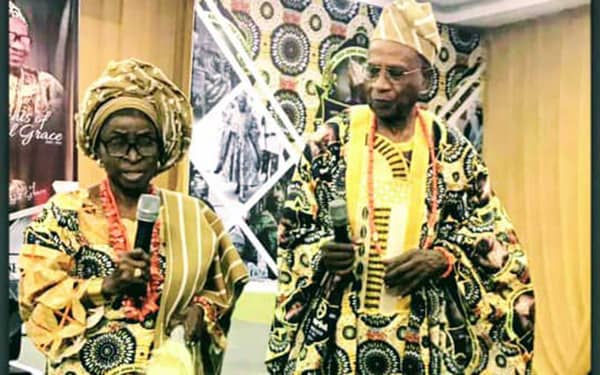
From the church, the celebrations moved to the Admus Hotel Banquet Hall for a grand royal reception. The gathering brought together a cross-section of Nigerian society: traditional rulers, political leaders, captains of industry, scholars, clerics and family members.
Notable guests at the event included President Bola Tinubu, represented by Chairman of the Governing Council, Federal Polytechnic, Ede, Prof. Taiwo Akanbi Olaiya; the Timi of Ede, Oba Munirudeen Adesola Lawal, Laminisa II, and the Ooni of Ife, Oba Adeyeye Enitan Ogunwusi, represented by the Asoya of Ile Isoya, Oba Muraina Adebanjo Adedini.
Others were the Orangun of Oke-Ila, Oba Adedokun Abolarin; the Asa Ooni of Ora-Igbomina, Oba Johnson Adekanmi Abikoye; Senator Lere Oyewunmi representing Osun West; Governor Ademola Adeleke’s sister, Yeye Modupe Adeleke-Sanni; a renowned cleric Prophet Timothy Funsho Akande, and a host of others.
There were a torrent of tributes for the monarch, many described as an cultural ambassador, drummer-king, devoted community leader, lover of education, love of God, and others.
The speakers and guests stated that under his leadership, Ede witnessed improvements in infrastructure, access to electricity and water, and the revival of traditional arts. His approach to leadership was inclusive, marked by religious tolerance and social harmony at a time when such values were neither fashionable nor politically expedient.
According to them, Oba Laoye’s reign was marked by tangible development. He was instrumental in expanding education in Ede, donating personal property for schools and supporting access to information by distributing radio sets to the community. His creation of the iconic Radio Nigeria signature tune using the talking drum remains one of the most recognisable symbols of Nigerian broadcasting history.
Leading the pack , the Timi of Ede, Oba Munirudeen Adesola Lawal, Laminisa II, described Oba Laoye as a monarch whose influence transcended Ede, impacting the nation and beyond. The Orangun of Oke-Ila, Oba Adedokun Abolarin, praised him as a visionary leader committed to societal development.
Yeye Modupe Adeleke-Sanni recalled the late monarch as a fatherly figure who ensured her welfare and education while she was in Osogbo. A popular cleric, Prophet Timothy Funsho Akande recounted the deep friendship between Oba Laoye and his late father, Prophet Samson Akande, noting the profound impact of the monarch’s passing on his family. He said his father, Prophet Samson Akande could not eat for 14 days because of Oba Laoye’s transition.
Princess Dorcas Monilola Laoye-Adewopo, eldest daughter of the late Timi, described her father as accommodating yet disciplined, urging young mothers to instill values in their children. Her brother, Dr. Anjola Laoye, expressed gratitude to all who attended the event. Prof. Adebambo Adewopo (SAN) hailed Oba Laoye as a rare royal father whose influence endures.
In his remarks, chairman of the event planning committee, Prince Steve Laoye, described the late monarch as a unifying force whose imprints remain indelible.
The event also featured the launch of a commemorative book, Timi Adetoyese Laoye: Footprints of Royal Grace,and presentations of awards to prominent Nigerians, including the late Prophet Samson Akande, a close confidant of the late monarch; the mother of Yeye Modupe Adeleke-Sanni, and others.
One of the intellectual highlights of the memorial was a lecture by Prof. Jeleel Olasunkanmi Ojuade, Vice-Chancellor of Ojaja University, Kwara State, and a scholar of performance and cultural studies. His address, titled: “Drumming Through Life,” reframed Oba Laoye not simply as a traditional ruler but as a cultural theorist in practice.
Ojuade said Oba Laoye belonged to an exceptional class of African monarchs who combined royal authority with intellectual depth, noting that his mastery of the Yoruba talking drum (Dùndún) transformed drumming into a sophisticated medium of communication, education and historical documentation.
According to him, Oba Laoye used drumming not merely for entertainment but as a language system, capable of transmitting messages, preserving history and reinforcing social order. He explained that under the late monarch, the Dùndún became a symbol of identity, diplomacy and cultural pride.
Ojuade noted that even 50 years after his passing, Oba Laoye’s legacy continues to inspire scholars, artists and traditional rulers, stressing that culture remains a vital tool for peace, development and identity.
The professor said: “Oba (Dr.) John Adetoyese Laoye I, the Timi of Ede from 1946 to 1975, stands out in Yoruba history as a rare drummer-king, scholar and cultural ambassador whose reign fused royalty with intellect and artistic mastery. He belonged to an exceptional class of monarchs whose authority extended beyond governance into the preservation and global promotion of Yoruba culture.
“Central to Oba Laoye’s legacy was his profound engagement with Yoruba music, especially the talking drum (Dùndún). In Yoruba society, music and dance are inseparable from daily life, serving as tools for education, communication.
.