 Follow Us on Google News


 Follow Us on Google Discover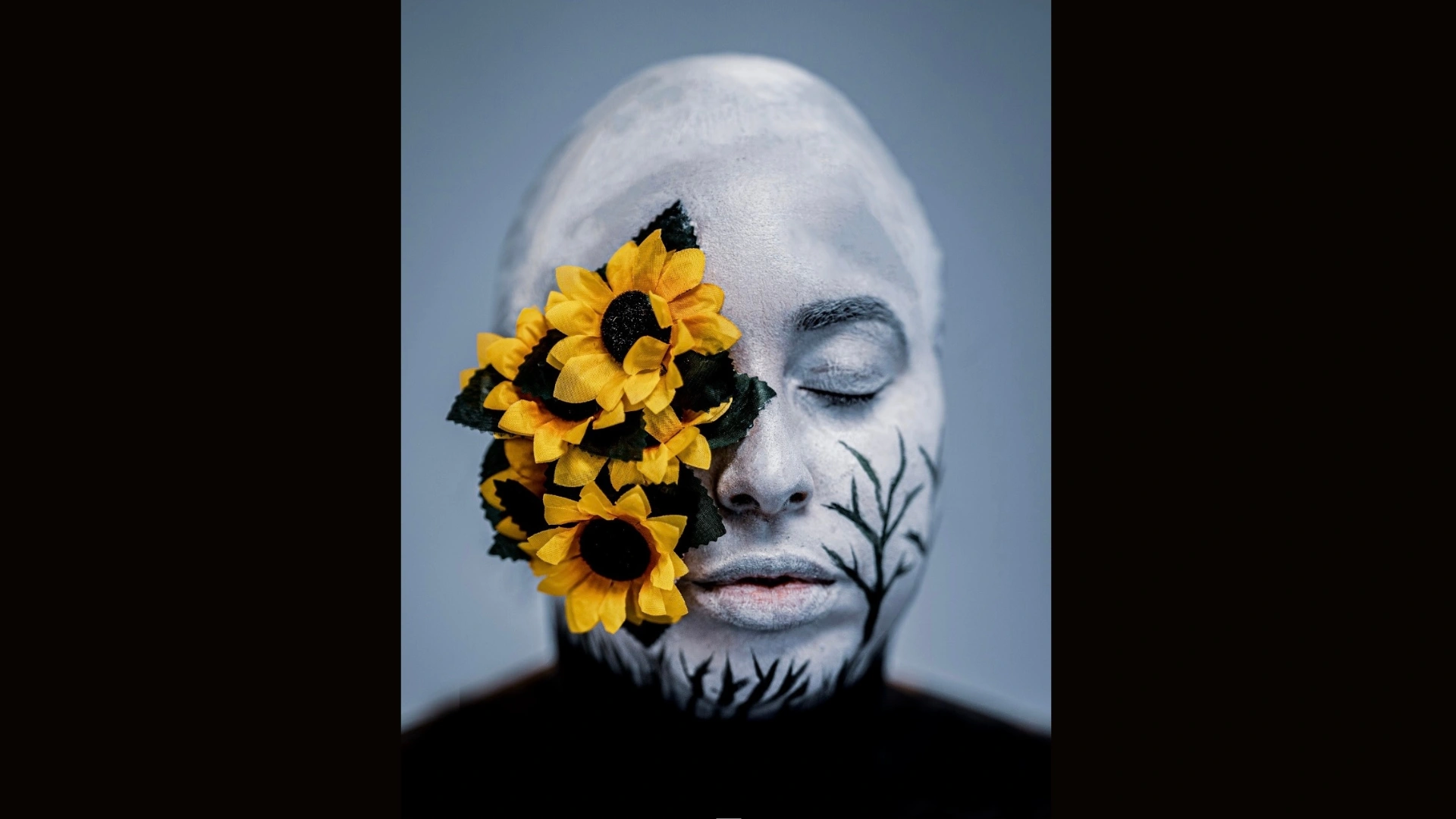
Grant Elvis’ Half Bloom is a photograph that initially appears to be about contrast: flowers against bare skin, yellow against grey, life against darkness. But the longer one looks at the portrait, the less convincing that simple opposition becomes.
The photograph is ultimately about coexistence.
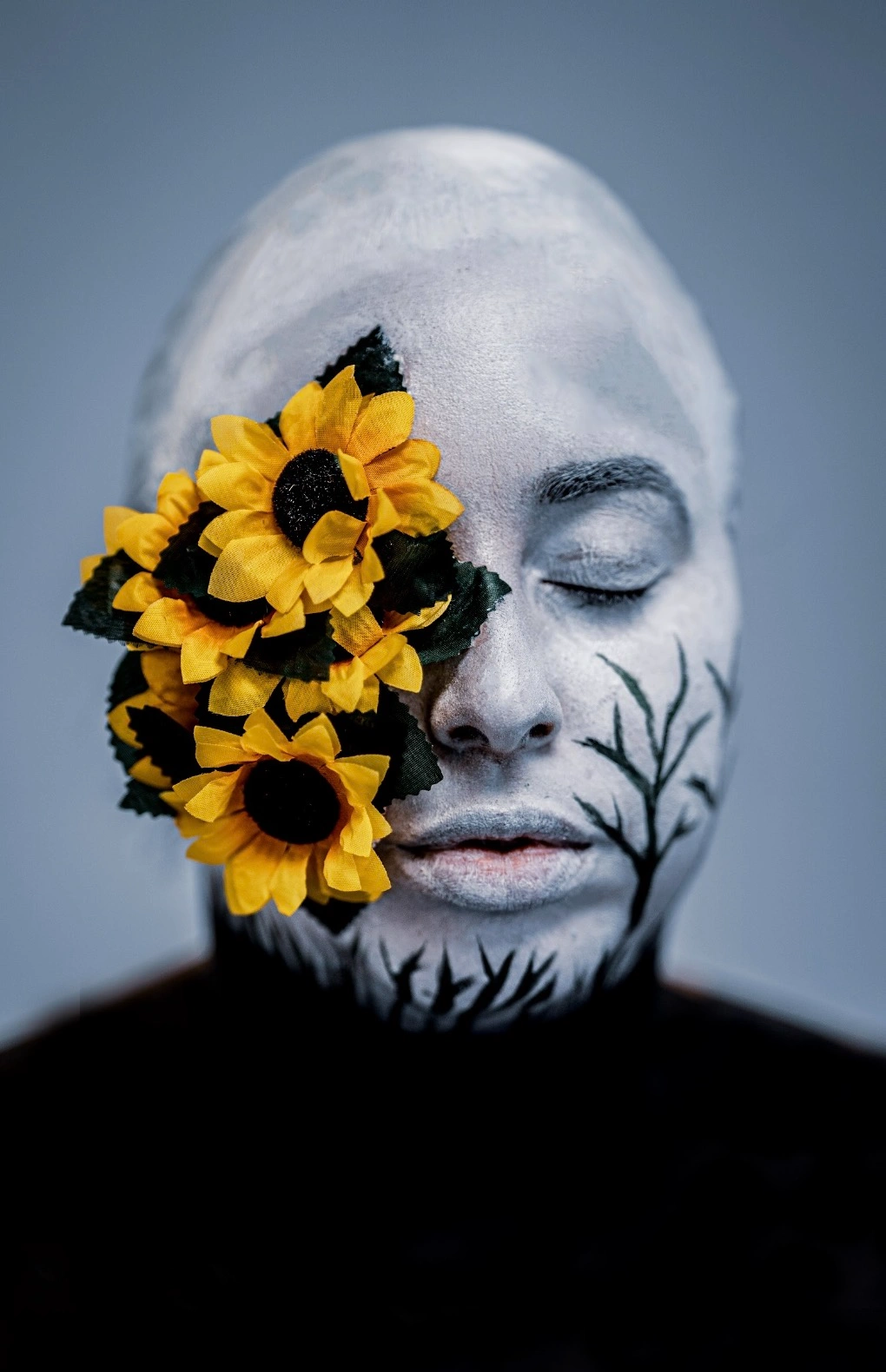
On one side of the subject’s face, sunflowers emerge in abundance, covering the eye and extending toward the cheek. On the other, the face is almost entirely stripped of colour, marked only by dark branches that resemble the remnants of a tree in winter. The effect is striking, but Elvis’ strongest decision is not the visual contrast itself. It is his refusal to suggest that one side is healthy while the other is broken.
Both exist on the same face.
Both belong to the same person.
And both, the photograph suggests, are part of becoming.

A Portrait Divided by Seasons
The title, Half-Bloom, provides an immediate entry point into the work. Blooming is commonly associated with completion, flourishing and arrival. Yet Elvis deliberately gives us only half of that image.
The other half is waiting.
The sunflower-covered side is visually exuberant. The flowers introduce texture, volume and an almost tactile physicality to the portrait. Their yellow petals become the dominant visual punctuation against the muted grey of the face.
But the bare side is equally important.
The dark branches painted across the skin create a visual vocabulary of dormancy. They evoke a tree stripped of leaves, a landscape between seasons. Rather than representing death, however, the branches can be read as a state of suspension a period in which visible growth has temporarily stopped.
This is where the work becomes psychologically compelling.
Elvis asks the viewer to reconsider what progress is supposed to look like.
The Face as a Landscape
One of the photograph’s most effective qualities is the transformation of the human face into something resembling a landscape.
The flowers suggest vegetation. The painted branches suggest roots, stems or winter trees. The grey skin becomes almost atmospheric, like an overcast sky or a landscape waiting for sunlight.
The portrait consequently moves beyond conventional representation. We are not simply looking at a face decorated with flowers; we are looking at a visual metaphor for an internal landscape.
The person becomes a season.
And importantly, there are two seasons occurring simultaneously.
That is perhaps the central idea of the photograph.
Human beings rarely experience growth uniformly. One area of life may be flourishing while another remains uncertain. Someone may be professionally successful while privately struggling. A person may have found confidence in one aspect of themselves while still waiting for another part to emerge.
Half-Bloom understands this contradiction without attempting to resolve it.
The Closed Eye and the Question of Waiting
The closed eyes introduce another important layer.
The subject is not looking at the viewer, and neither expression nor posture communicates urgency. There is a sense of withdrawal, but not necessarily sadness. That distinction matters.
The image does not portray waiting as helplessness. Instead, waiting becomes an active psychological state.
The subject appears to be allowing time to pass.
This interpretation is reinforced by the flowers. Their presence tells us that something is already happening, even if the entire face has not yet “bloomed.” The work therefore rejects the idea that growth must be visible everywhere to be real.
Sometimes development is uneven.
Sometimes one part of life moves ahead while another remains dormant.
And sometimes dormancy is necessary.
The Power of Yellow Against Grey
From a photographic perspective, Elvis demonstrates a strong understanding of colour as emotional language.
The saturated yellow of the sunflowers immediately attracts the eye. It communicates warmth, vitality and energy without needing to become sentimental. Against this, the cool grey treatment of the face creates distance and restraint.
The black clothing and dark branches then anchor the composition, preventing the flowers from turning the portrait into a purely celebratory image.
This balance is important.
Had the entire photograph been vibrant, the conceptual tension would have weakened. Had the image been entirely monochromatic, the sense of possibility would have disappeared.
Instead, Elvis gives us both.
Colour and absence. Growth and waiting. Bloom and dormancy.
An Unfinished Self
There is also something quietly radical about the photograph’s refusal to offer a complete transformation.
Contemporary visual culture often celebrates the “before and after”—the idea that personal development should eventually produce a perfected version of the self. Half-Bloom challenges that narrative.
There is no “after” here.
There is only the present moment.
The subject is simultaneously blooming and unfinished.
That makes the photograph particularly resonant as a work about identity. Elvis’ wider practice explores identity, memory and the quieter forms of progress within African and diasporic life, and this photograph fits comfortably within that inquiry. Rather than presenting identity as fixed or fully resolved, the work presents it as something seasonal and continually evolving.
What Makes “Half-Bloom” Successful
The greatest strength of Half-Bloom is its simplicity of concept.
The metaphor is immediately accessible, yet the image does not exhaust itself after the first reading. The longer one looks, the more possibilities emerge.
The flowers could represent healing.
The branches could represent memory.
The grey could suggest uncertainty.
The closed eyes could suggest introspection.
Or the entire composition can simply be understood as a reminder that different parts of our lives move at different speeds.
Elvis wisely leaves that interpretation open.
Final Verdict
Half-Bloom is an emotionally restrained but visually assertive piece of fine-art portraiture. Grant Elvis takes a familiar symbol the flower and avoids using it merely as an emblem of beauty. Instead, he places it beside its apparent opposite: the bare branch.
The result is not a portrait of someone who has fully bloomed.
It is a portrait of someone in the middle of becoming.
Its most profound suggestion is that standing still does not necessarily mean going nowhere. There are seasons when nothing appears to be happening, yet beneath the surface, something may be preparing to emerge.
In this sense, Half-Bloom offers a gentler definition of progress:
You do not have to bloom everywhere at once. Sometimes, half-bloom is still growth.

