 Follow Us on Google News
 Follow Us on Google Discover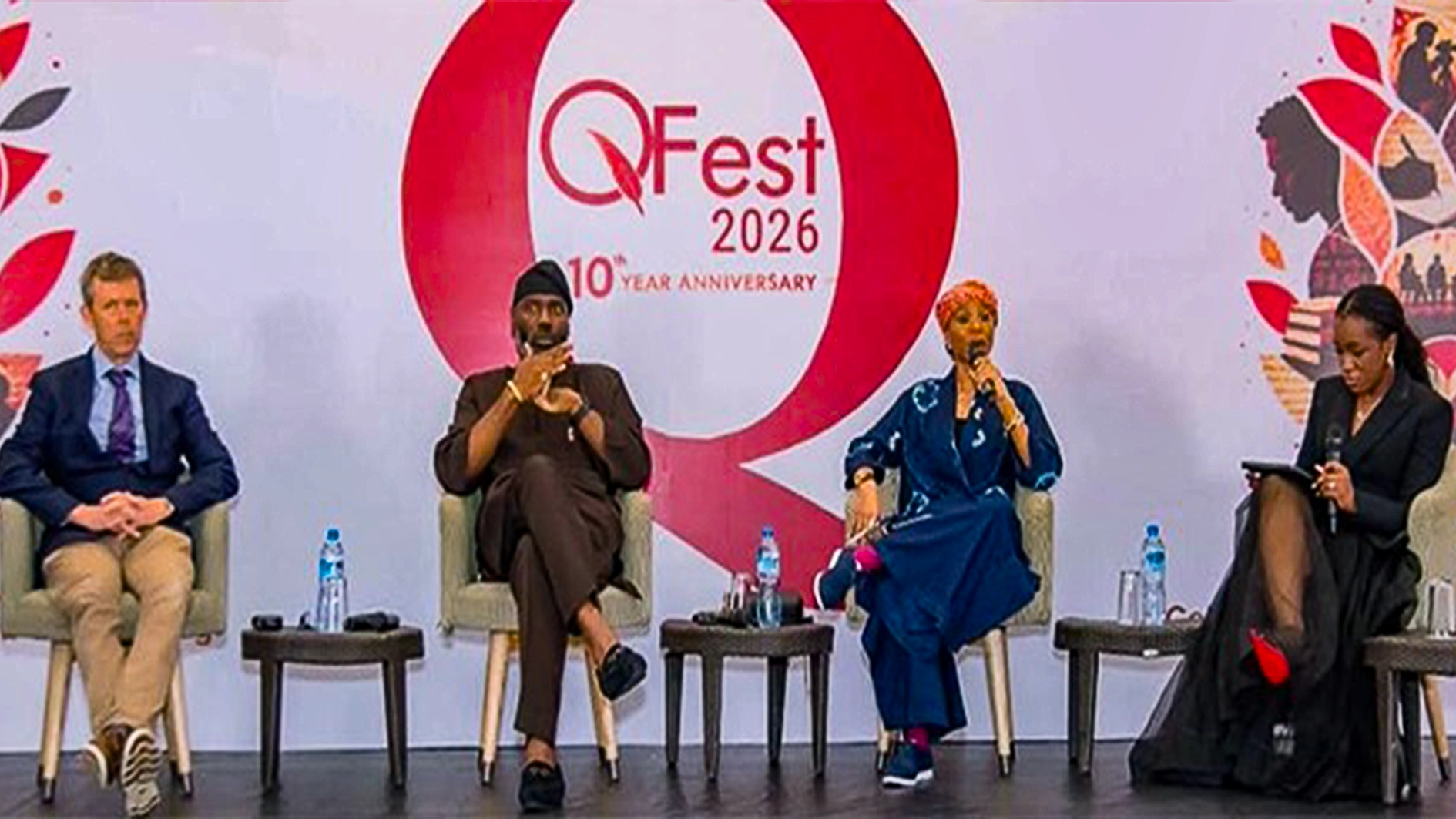
The Director General of the National Commission for Museums and Monuments (NCMM), Olugbile Holloway and Director General of the Centre for Black and African Arts and Civilisation (CBAAC), Aisha Adamu Augie, have described proposals by the British Museum to loan the Benin Bronzes back to Nigeria as unacceptable, insisting that Nigeria should not be expected to borrow artefacts that were looted from the country.
The government functionaries spoke during a session, titled, ‘Loot, Restitution and African Heritage’ at the 2026 Quramo Festival, held at Eko Hotels and Suites, Lagos. The session was moderated by Ore Ogunbiyi, African Correspondent for The Economist. The award-winning journalist and author of Loot- Britain and the Benin Bronzes, Barnaby Phillips was part of the conversation.
Phillips, who spent 27 years reporting for the BBC and Al Jazeera, said his interest in the Benin Bronzes and Britain’s colonial legacy in Nigeria began during his first visit to Benin City in 1999.
Benin Bronzes have been the subjects of intense conflict. While Nigerians, especially Benin descendants clamour for the return of their cultural heritage, curators of Western museums believe sending them back to Africa will be a total stripping them out of their heritage.
It is hardly surprising that as many as 160 museums and institutions around the world hold artefacts looted from Benin Empire in their collections.
As at when the former Minister of Information and Culture, Alhaji Lai Mohammed, announced the launch of a campaign for return and restitution of Nigeria’s looted artefacts in 2019, there had been long queues of protests and demands, which snaked out of the country.

The campaign further emboldened agitators such that in less than two years, there had been a gale of restitution of looted artefacts.
In November 2022, the newly launched Digital Benin, a German-curated and financed online database, listed 5,246 Bronzes
in 131 institutions around the world, including 27 British ones.
Recall that after decades of campaign, Germany led the biggest détente in restitution history by signing off over 1,130 artefacts. This decision, no doubt, is considered as the most significant by a member state Benin Dialogue Group (BDG) at this parlous juncture of moral struggle.
In 2022, the German government announced the transfer of ownership of some. In fact, Germany’s decision reduced BDG’s influence and wiped off its decade-and-a half long hankering to become a lender of last resort for the artefacts.
Phillips explained that the events of 1897 occurred at the height of the European “Scramble for Africa”, when Britain and other European powers were increasingly seeking territorial and commercial influence on the continent.
Phillips said the British soldiers who entered the palace were not art historians or anthropologists but nevertheless discovered the extensive collection of objects now commonly referred to as the Benin Bronzes, including bronze plaques, sculptures and ivory tusks: A recurring caveat in the narrative. “These are trophies of war that were taken back in 1897 to Britain,” he said, adding that many of the objects subsequently found their way into institutions such as the British Museum.”
Augie said the loss went beyond the physical removal of artefacts, arguing that the objects represented a repository of history, language, culture and storytelling. “Imagine having all your books stolen and you have no way to access them,” she said.
She noted that the bronzes, sculptures and ivory objects contained stories and historical meanings, meaning that their removal also deprived generations of Nigerians and Africans of access to aspects of their own heritage.
“For us at the centre, we tend to see a lot of conversations happening, depending on which country it’s coming from. You have people looking at the financial aspect of it, and others are looking at education and history,” Augie said.
The CBAAC boss said the restitution debate must therefore go beyond the question of physical ownership to address the loss of languages, history and traditional storytelling, adding that the ongoing conversations should eventually translate into policies that provide clearer frameworks for restitution.
The question of whether Nigeria has the capacity to properly house returned artefacts also featured prominently during the discussion.
Holloway challenged the assumption that the Western concept of a museum should determine how African societies preserve their heritage. “The concept of a museum itself is foreign, so you don’t get to take everything a white man does and force it on a black man,” he said.
On the question of who should own the returned Benin artefacts, Holloway said the issue had been complicated by the fact that modern Nigeria did not exist as a political entity in 1897. He noted that the Oba of Benin was the sovereign authority with whom the British had entered into a treaty.
He explained, however, that the NCMM had entered into a management agreement with the Oba of Benin because the monarch does not have the museum professionals and institutional apparatus required to manage the artefacts.
“All the museums that are returning the bronzes, the agreement we signed, it has the National Commission for Museums and Monuments and an agreement with the Oba of Benin,” he said.
A government Notice No. 25 in the Federal Republic of Nigeria Official Gazette No. 57, Volume 110, which is dated March 28, 2023 titled: ‘Notice of Presidential Declaration – on the Recognition of Ownership, and an order vesting custody and Management of Repatriated looted Benin Artefacts in the Oba of Benin Kingdom’
The document instructed that the repatriated artefacts should be kept within the palace, other locations within Benin City, or other places that the Oba and the government consider safe. It further ordered that the “Oba shall be responsible for the management of all places where the repatriated artefacts are domiciled or located.”
He argued that African societies had their own systems of preserving cultural memory long before the modern museum emerged, citing shrines and festivals as examples. “We have to imagine what a museum means in the African context,” he said.
Holloway pointed to the National Museum’s renovated gallery and its new exhibition, “Echoes of the Past”, as evidence that Nigeria possesses the capacity to care for returned artefacts.
Augie similarly argued that the definition of a museum should not be limited to a building where objects are physically stored.
She recalled visiting a museum where many culturally significant objects were kept away in storage and were only made accessible to her through the intervention of a curator.
“We tend to project that we do a lot of rituals in Africa. We do have the spaces to store these artefacts,” she said.
According to her, the more important question is whether museums are being used to preserve the stories and connections between African people and their cultural objects.
She also pointed to the emergence of digital museums as a potential way of reconnecting Africans with heritage that remains physically outside the continent. “How do we use these items that are ours, even if they are not with us, to reconnect that power back to say who we were?” she asked.
Holloway, however, said Nigeria should reject the idea of borrowing its own heritage. “We are constantly in communication with the British Museum, and in one of our meetings, I clearly told them that insinuating you want to loan us our artefacts, I find it quite insulting, so let’s not entertain the thought,” he said. “I’d rather you keep them till the end of time, than for you to loan something that was looted.”
He also distinguished between the physical return of an artefact and the transfer of legal ownership, arguing that restitution could begin with a transfer of ownership even where the physical object remained temporarily outside Nigeria. “The loans should be us agreeing to loan you, not loaning us what you looted,” he said.
Augie disclosed that the CBAAC itself had experienced the consequences of the continued absence of the Benin artefacts.
She said the centre was inspired by an ivory mask from Benin that is currently held by the British, but when CBAAC sought to borrow the original for its activities, it was denied permission and had to create a replica instead.
Augie said the issue demonstrated why African countries needed to strengthen their collective policy advocacy. She rejected the idea that existing laws in Britain should be treated as permanently immutable, noting that laws could be changed through political will and sustained public pressure.
For Holloway, however, the restitution question is ultimately bigger than the physical return of the Benin Bronzes. He described the objects as symbols of African civilisations and periods when African societies demonstrated confidence in their own institutions, cultures and identities. “When the chains of the colonial masters fell, those chains moved from physical to mental chains,” he said.
He said the restitution campaign should therefore be understood as part of a broader effort to redefine Africa’s image and the way Africans present themselves to the world.

