 Get Guardian on Google
There is something almost archaeological in Kelani Abass’s approach to the family archive. In his current exhibition, he appears uninterested in leaving the contents of the archive undisturbed. He removes photographs from their settings and handwritten documents. He excavates private fragments of memory and knowledge. Abass brings to the foreground information that has been buried in family documents and photographs and gives it a new life. In the process, he compels the viewer to interrogate what it means to inherit a past.
What it means to inherit a past is interrogated in Abass’s solo show, Becoming Immortal, at Tiwani Contemporary, Lagos. The show is billed for December 15, 2026 to February 20, 2027. This show is the second outing of Tiwani Contemporary Lagos having closed its doors in May 2026 as part of a wider restructuring that also included the closure of its London outpost in Mayfair where it had been for 15 years.
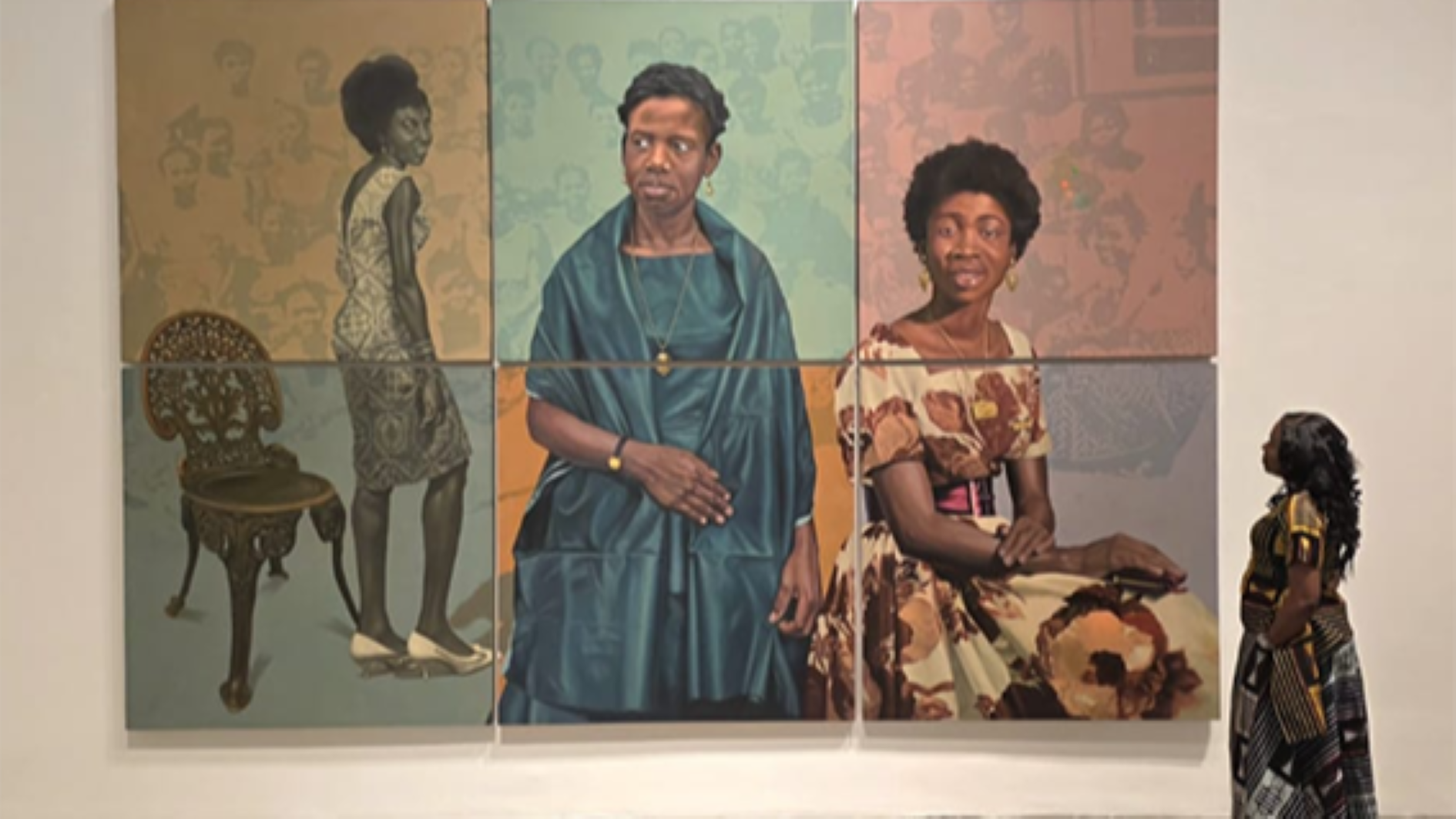
One of the artist’s imposing six-panel compositions, the title of which is the name of the exhibition, examines the role of women, memory and lineage in contemporary Nigerian art using three figures: a seated profile of a young woman; an empty, ornate chair; and a central matron (a deceased aunt of the artist) in teal, both seated, with the latter bearing a warm and knowing smile, against a backdrop of muted, archival photos that maintain a haunting presence in the background like echoes.
The artist makes up for empty space, which could have been filled with a large crowd, through the use of tactile representations of women, bearing the weight of history of family and community, that inform and support the presence of women in the work. It is a work that testifies to the dignity and respect of women.
One of the exhibition’s strongest statements is Translucent History. This features a display of 11 small paintings with associated materials and documents. A centerpiece of the exhibit is a scroll with handwritten Yoruba text with the heading, ‘For Running’ (spelt ‘For Runing’ in the document). This family document is referenced in the paintings.
With the scroll is a copy of a painting from the series, ‘Farmers’ Ritual’. ‘For Running’ has a strong element of ancient manuscript. Like a hidden cache of important documents, it also has the element of a secret or private archive.
This describes traditional wisdom or knowledge about herbs and other rural or folk remedies and practices, and potential allusions to social customs, practices and rituals.
Other random documents and ephemera are part of the installation. These documents are certainly archival materials, but they won’t easily conform to the typical classifications and orderly arrangements of most archival materials.
They are randomly arranged, and it seems there is no immediate way of establishing a hierarchy or a structure. It could be that the artist deliberately arranged them randomly to allude to the fact that traditional and inherited knowledge may not always be systematic and in an ordered fashion, but may be in random fragments which may only make sense with the passing of time.
The canvas pieces appear all the more colourful and intimate when placed against this background. Fragments of a family document written in Yoruba by Abass’s father, mother and grandfather are woven into the canvas pieces. The document has suffered irreparable loss over the years. There are clues that remain, however.
Abass is preoccupied with documentation in the pictorial representation he gives in the collages. It seems he combines multiple sources in his pictorial representation. This may be to allude to photography or printed documents. The artist’s family ran a letterpress printing business and Abass may have been sensitised to layers, impression and other processes involved in the creation of images. It is quite possible that this background explains Abass’s interest in shifts and the combination of the three mediums.
This also accounts for the reconstruction and documentation nature of his paintings. His interest in reconstruction gives the photographic image a renewed significance and interpretation and goes beyond the frame of its original documentary role.
The family photographs found in Translucent History can also be found in Space in Between (2022-2025), Becoming Immortal (2025), Awake (2023) and elsewhere. They may not always be easy to identify. In some of the paintings they barely appear, if at all, like faint watermarks, underneath the painted surfaces. Their role should not be undermined by their subtle presence. These photographs constitute the essential building blocks of the artist’s narratives.
The photographs in more recent works by Abass document family members in Abeokuta and other Yoruba settlements. Abass moves beyond the traditional function of the family album to document family occurrences and record ancestors. He takes relatives out of the contexts that they are documented in, and places them with relatives who are not related to them, in reality, in the same photograph. Abass, in the process, constructs new scenes and situations that invite the audience to contemplate different ways of seeing relationships, especially kinship, and other linkages people in society have to one another in the various levels and dimensions of their existence.
This he successfully does in the large-scale, multi-panel paintings. The various panels serve as freestanding compositions. The audience has the liberty to make connections between them. Often, members of the same family, or of different generations or social backgrounds, may occupy the same pictorial space.
Since the individuals in the photographs are actual persons, the audience is free to imagine and construct relationships that may not exist between them, which demonstrates the creative nature of the photography as opposed to painting.
Brilliant colours represent the shapes and structures of the 1980s and 1990s in new and exciting ways. The different sitters against painted backdrops almost give the photos a movie-like quality. The subject repetition creates a meditative effect. The people in the pictures seem to belong to a larger gathering, spanning many years, that has been edited and aligned to a long, continuous wall to illustrate history.
Abass is interested in life after death, thus his depiction of time is cyclical. In his opinion, the past, present and future do not flow one after the other. The future begins where the past left off. His interest in time and death is best represented in his photography. His photographs extend beyond taking photos of the dead. His photographs illustrate how one life touches another, and how one life can continue to live on through another, giving others the assurance that they will never completely lose their loved ones. This is the reason Abass holds a personal handwritten document by his grandfather in high regard. He believes that in the future, even writing will fade away, and like oral tradition, memory will also be lost. Out of all things that can illustrate or assist humankind to relive the past, Abass prefers the written word.
The fragility of Abass’ family document shows that even if one documents his family history, that documentation too will not be exempt from the passing of time.
The exhibition includes an artist’s book in a limited edition of 150 copies. Each volume has the same content, but is numbered, and has a handcrafted cover. The book was designed by Jennifer Bajorek in collaboration with Mariama Attah and Robin Riskin, with writings by Emmanuel Iduma. The handcrafted cover of each book introduces another aspect of the exhibition’s consideration of reproduction. What role does the cover play in the identity of the book? Especially in this digital age, where reproducing an image or a text is as easy as the click of a button, a handcrafted object takes on special meaning.
Abass has shown at the MoMA (Museum of Modern Art), New York; the Tate Modern, London; C/O Berlin and elsewhere. His work is in collections of MoMA, the Art Gallery of Ontario, the Princeton University Art Museum, Kadist Art Foundation and Fondation H, Antananarivo, Madagascar.
Ultimately, Becoming Immortal explores the past and what endures beyond the test of time. It considers the claim of the past on the present and future.
Abass rescues old images and documents not to dwell in the past, but rather to give them a second life. In doing so, he reinterprets their meanings. It is possible that he inherited old documents not from the past, but from the future. The future may send messages to the present, convey useful materials to help reinterpret and create new beginnings.