 Get Guardian on Google
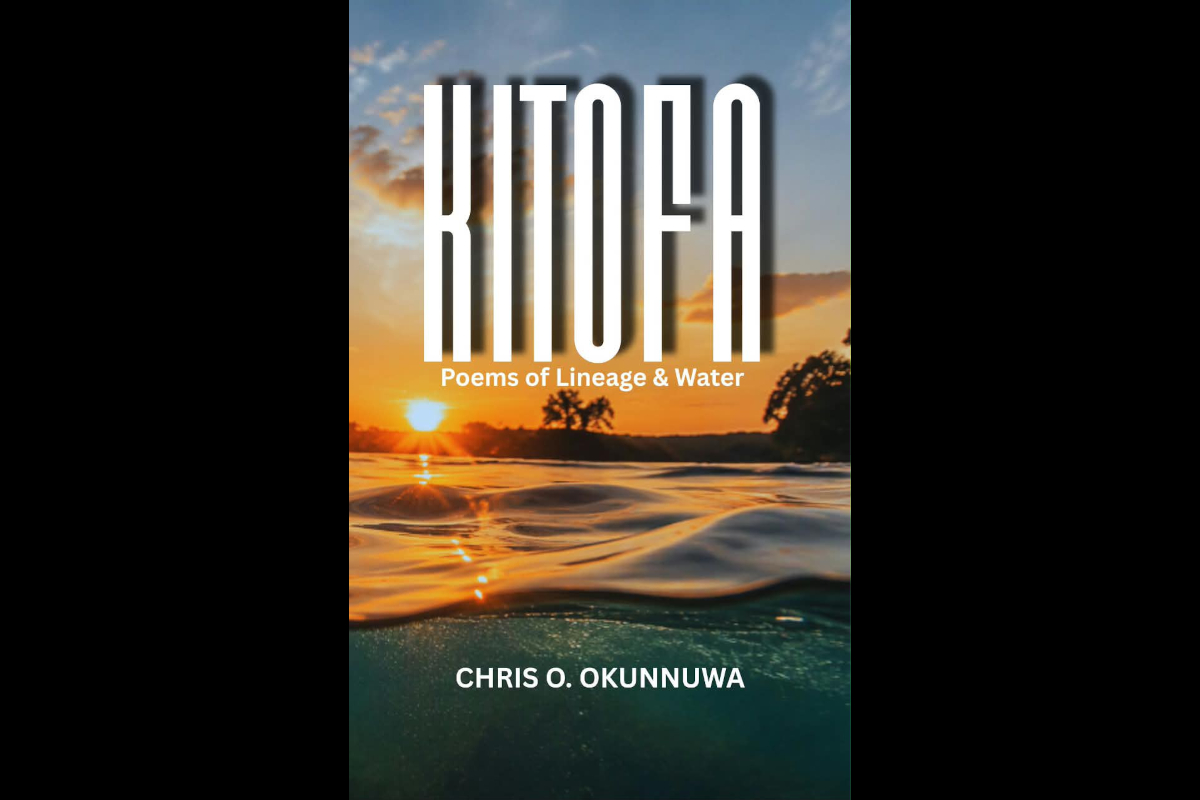
Christopher was born at the dawn of the British treaty with the Mahin coastal region. The name was foreign to the Ilaje tongue; hence the contorted version, Kitofa. Named after the central character, this poet digs into the family archive to understand a collective heritage. Thi collection, divided into six sections, blends political history with intimate memories across twenty-one poems and a coda.
Water is the dominant metaphor in Kitofa. Beyond being an essential physical feature of the book’s setting, it defines the characters’ nature. Water embodies strength, loyalty, and steadfastness, but it can also be cruel. In ‘The Man Who Didn’t Take Off His Agbada’, Kilord, an angel in a flowing robe, thwarts the river’s attempt to snatch a child. “Brown water shot over my head, /heavy as iron… /the river closed over me.”
In ‘The Same Current’, the author recounts water’s paradox. It serves as witness and conduit, cold and generous, offering escape and scission at the same time. It doubles as grave and salvation.
“It swallowed my mother
In the war
And spat her back…”
Water signifies continuity, a fundamental subject in the book. The poems span four generations, beginning with the author’s grandfather. A persistent tide of migration begins with Kitofa’s move to Ikorigho, his mother’s village, and culminates with Christopher II’s move to the United Kingdom. Kitofa flees to the creeks of Itsekiri after fighting the colonial tax men, where he remained with his son until the nation’s independence guaranteed his freedom.
Felix’s journey to independence started with a return to Grammar School, away from the shores of Ikorigho. Felix is strong-willed and rebellious, like his father. He is industrious, too, building a lifetime with a two-pound capital from his reluctant father and a fishing net. “No letter ever went home asking for coin”.
Each of Okunnuwa’s poems tells multiple stories, albeit subtly layered. He compresses the years into short lines and stanzas. The verses run out of breath, but the reader never really catches up. Chris’ diction is direct; his images are concrete and literal. The poems’ clear narratives make them accessible, but can sometimes constrain linguistic and formal experimentation. The documentary voice is insistent on easy comprehension. But memorable images resist elaboration; a little ambiguity makes recurring metaphors less predictable. For instance, the creek, everywhere it appears, symbolises escape, kinship, spirituality and bionomic trauma, almost stripping it of its material relevance.
The collection explores the central characters’ emotional conflicts, moral make-up, ambitions, and grief. They are not just individuals with private lives; they embody family and cultural memories, political history, and the effect of environmental changes over the years. Likewise, geography shapes how identities form and pass down through generations. But readers don’t get enough of a feel for these places beyond their symbolism for the writer. This deprives us of experiencing the scenes, sounds, and tension of the personas’ journeys. We also only get to meet certain personalities briefly.
‘Kitofa’ explores naming as a family inheritance. Beyond identity, a name preserves culture and holds history. A name is a house of memories. In ‘Oriyomi’, a father recalls the events surrounding his son’s birth and the circumstances that influenced his choice of name.
“The sky of Ikorigho had been dry,
the withheld rain broke above the roof,
meeting my first cry.”
But who does a name belong to? The clan, desperate to carry on its lineage; a father, marking a moment in time; the bearer, never consulted; or the people who will interact with them in the future? Felix forbids foreign names in the family. Ironically, he names his first son after his father to immortalise him.
Christopher completes the migration cycle. This singular event conflates home, exile, and naming. Home is not always conducive. Exile can be fruitful. A name is sometimes a scar.
“My grandfather fled by canoe into (the) dark,
staying one step ahead of the colonial authority.
I flew willingly toward their capital.”
[Across The Ocean]
In Theresa Lola’s poem ‘My Name is My Home’ from her book, ‘Ceremony for the Nameless’, she laments the mispronunciation of her name. “Every time someone mispronounces my name, they disrupt its foundations”. By adhering to his father’s ban on foreign names, Christopher risks having his children’s names distorted in foreign mouths as he relocates across the ocean.
The book doesn’t tell us what led Christopher to move to Manchester, but this line from ‘Christopher II’ shows a man who reveres his grandfather and is so deeply inspired by him that he carries him everywhere:
“When my children ask what I carried across the sea,
I begin with you.”
Jide Badmus
Author, Obaluaye
Jide Badmus is a poet, literary critic, and author of five poetry collections, including Obaluaye (FlowerSong Press, 2022), and eight pamphlets. He is the poetry editor for Con-scio Magazine, a mentor in the SprinNG Writers fellowship, and a member of the Board of Advisors for Libretto Magazine.
Jide draws inspiration from the nuances of beauty and destruction. He believes that things in ruins were once beautiful. His works explore themes of sensuality and healing.
Badmus has been nominated for prestigious honours, including Best of the Net and the Pushcart Prizes. His works have appeared in Black Bough Poetry, The Nigeria Review, Agbowo, and elsewhere. Arts Council England endorsed him as a Global Talent. He writes from Nottingham, United Kingdom.