 Follow Us on Google News


 Follow Us on Google Discover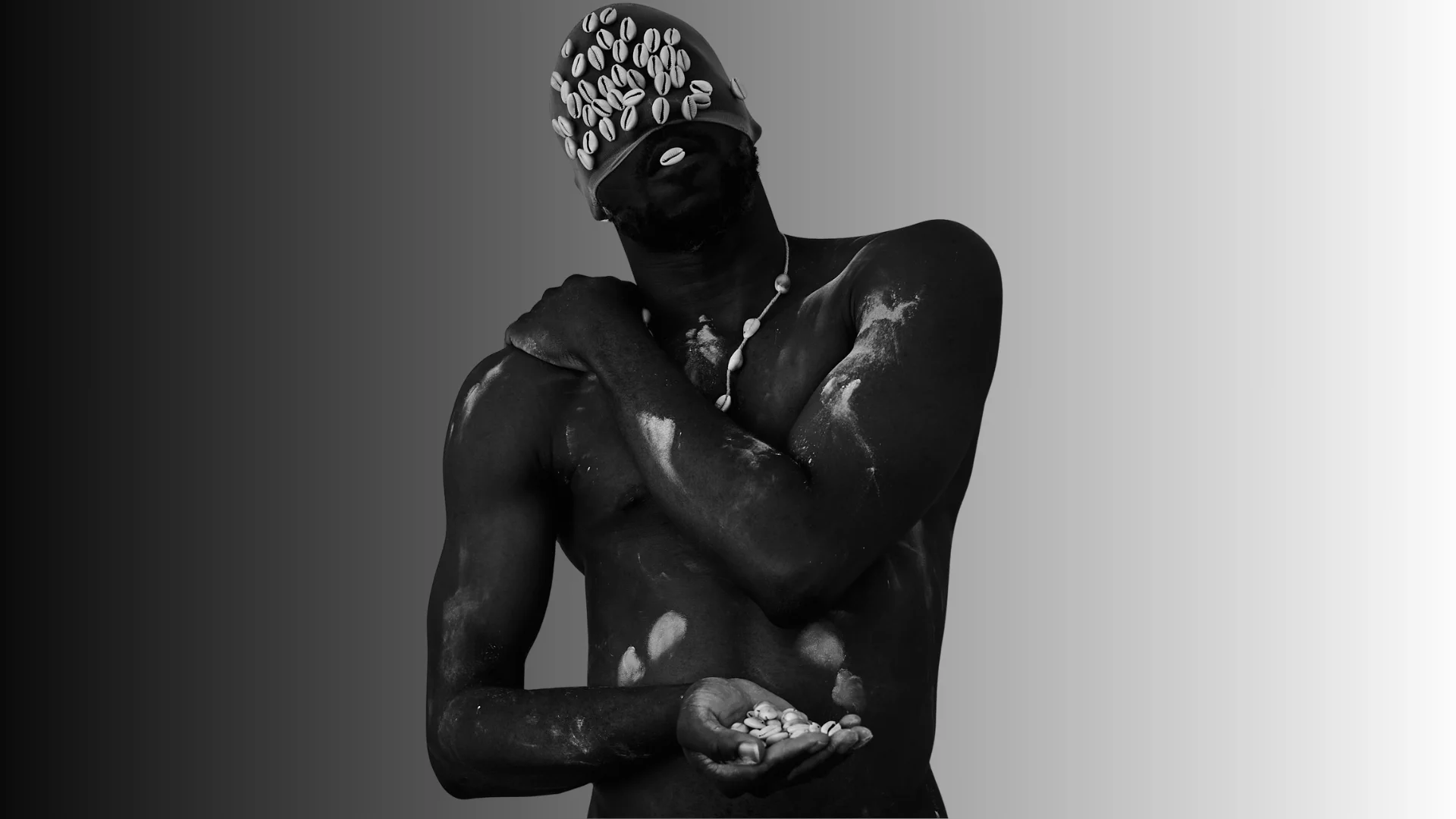
By Professor Chuu Krydz Ikwuemesi, Dean, Faculty of Arts, University of Nigeria, Nsukka
There are objects whose meanings exceed their material presence. They survive history by accumulating histories. They migrate from utility into metaphor, from commerce into ritual, from the marketplace into memory. The cowrie shell is one such object. In Segun Emmanuel Akinremi’s Ajé Olókun, the cowrie becomes the conceptual and visual fulcrum for a photographic meditation on wealth, value, responsibility, inheritance and human continuity. Once a medium of economic exchange and subsequently an enduring sign of prosperity within West African cultural imaginaries, the cowrie is recovered, imaged and revisited here not as ethnographic residuum or decorative motif, but as a living, symbolic continuum, a vocabulary through which the artist asks a deceptively simple question: what does it mean to be wealthy?
The question is historically loaded. Cowries circulated extensively as currency in parts of West Africa and became embedded in complex systems of trade and economic exchange (Johnson 1970; Hogendorn and Johnson 1986). Yet their significance was never exhausted by monetary use. As Toyin Falola and Olatunde Bayo Lawuyi (1990) have demonstrated, the cowrie in Nigerian cultural experience acquired meanings extending beyond currency into ritual, spirituality, creativity, productivity and social value. Thus, before Akinremi photographs the cowrie, the object already possesses a biography. It arrives in his contemporary photographs carrying commerce, spirituality, history and memory.
Akinremi is a Nigerian-born photographer based in the United Kingdom whose practice has increasingly explored human connection, memory and place through the double consciousness produced by Nigerian cultural inheritance and British lived experience. His biography describes this as looking through a “dual lens,” inhabiting the atmospheric space between origin and present location. Ajé Olókun intensifies this concern by turning towards the cultural archive. Here, however, return is not nostalgia. The past becomes a resource for interrogating the present. The title itself establishes the exhibition’s philosophical terrain. In the artist’s account, Ajé invokes wealth, commerce and economic prosperity within Yoruba thought, while the cowrie carries histories of currency, value and exchange. Yet Akinremi deliberately stretches wealth beyond monetary possession. He understands it as something capable of moving through people, communities and memory: something received, created, transformed and transmitted. Thus, the photographs begin with economics but refuse to remain there.
This refusal is important. We inhabit an age in which wealth has become increasingly numerical and abstract: bank balances, market valuations, stocks, assets, digital currencies and data. Against such dematerialisation, Akinremi returns wealth to the body. Cowries are held by hands, placed upon skin, carried upon the head and traced across the back. Value becomes tactile again. It acquires weight, texture and vulnerability. The body itself becomes both carrier and archive—a repository of memory through which culture is embodied and transmitted, recalling Paul Connerton’s (1989) proposition that societies remember not only through texts and monuments but also through bodily practices and activities that define our humanity.

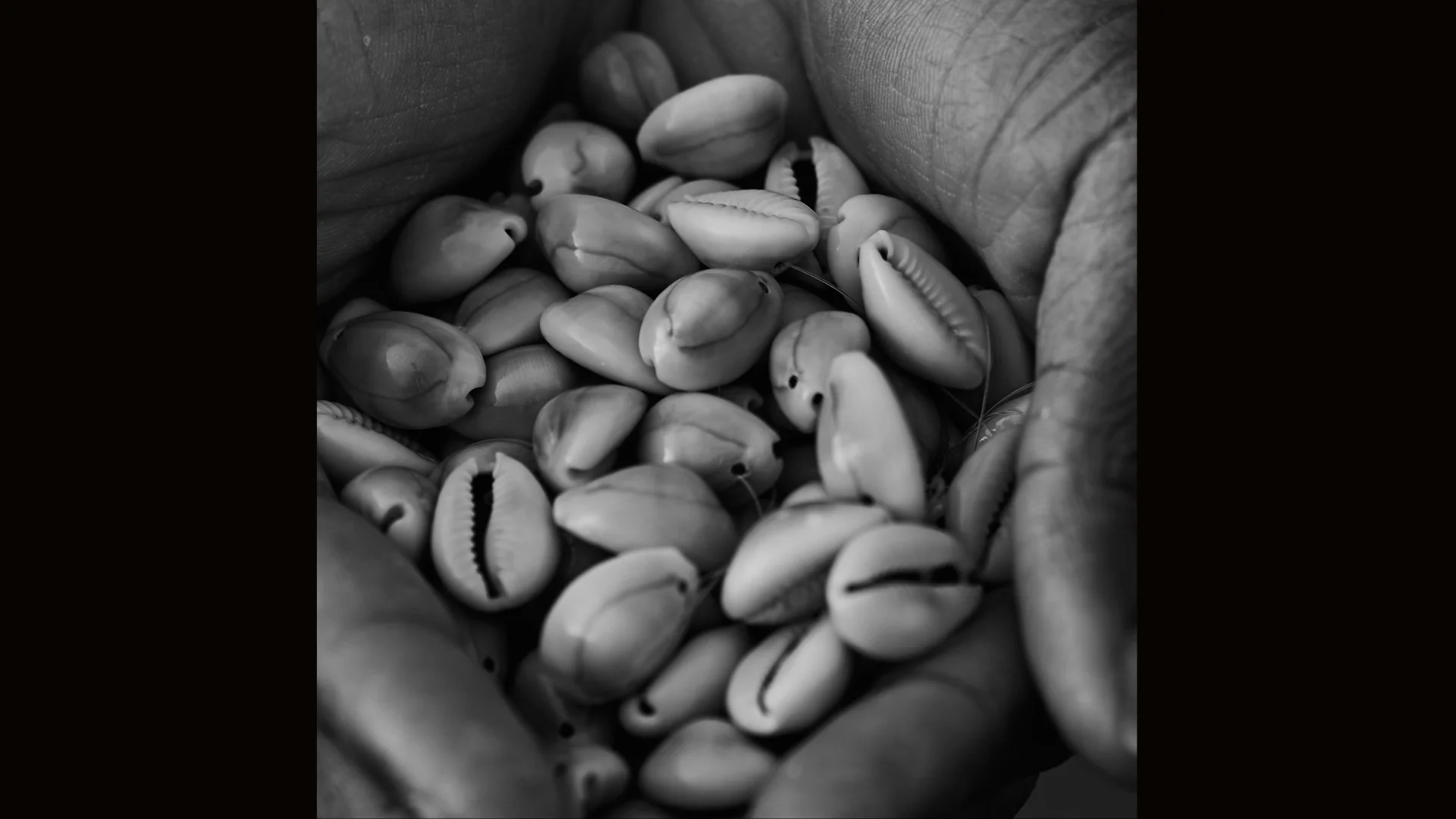
In The Weight of Wealth, this corporeality is particularly pronounced and proclaimed. A mass of cowries rests within cupped hands. The photograph is intimate, almost claustrophobic: flesh encloses shells, while shells occupy the vulnerable and symbolic hollow created by the hands. The artist’s accompanying text proposes accumulation as one of the image’s meanings, in the sense that the small becomes substantial through gathering. Yet hermeneutically, the image permits another question. If wealth has weight, then possession is never entirely innocent. To hold is also to bear. Accumulation produces not merely privilege but burden, expectation and responsibility.
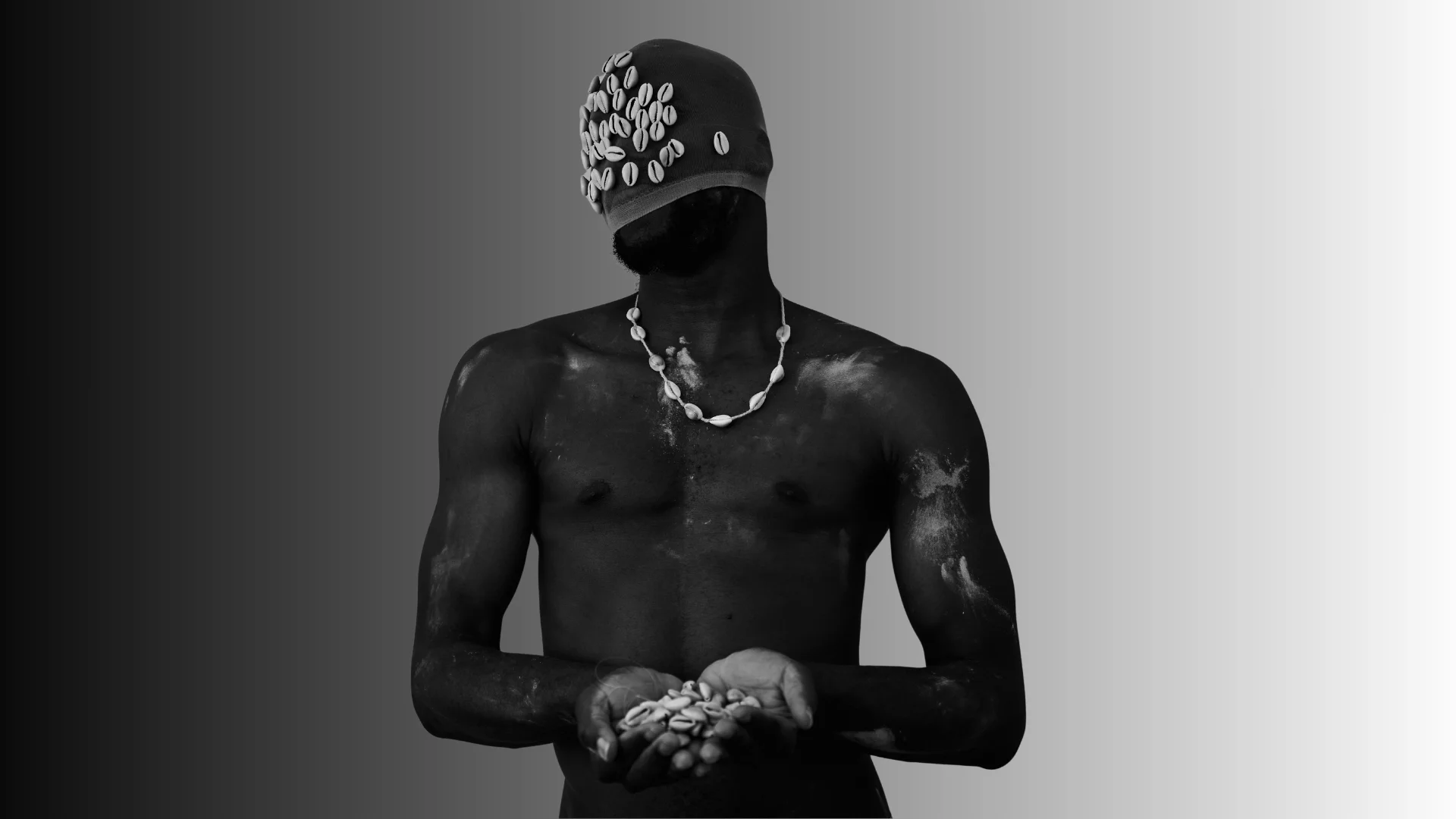
The hands are crucial throughout Ajé Olókun. They are among humanity’s oldest instruments of labour: we make, gather, exchange, protect, give and receive with them. Consequently, Akinremi quietly returns wealth to labour and human agency, in the sense of the Igbo proverb that insists that “‘a soilly’ hands begets an oily mouth” – a metaphoric allusion to the promise and dignity of labour. This becomes explicit in The Hands That Create. A frontal male figure extends cupped hands containing cowries, while more shells gather around his head and neck. White markings interrupt the darkness of the body. According to the artist, the hands suggest that wealth begins before material possession – as “an idea, a decision, a skill, a relationship or an opportunity.”
But the photograph also establishes a compelling triangle between head, hand and wealth. The head suggests conception, imagination and vision; the hand, labour and making; the cowrie, realised value. Wealth consequently ceases to be miraculous acquisition and becomes creative process. Within contemporary African societies, where conspicuous consumption can sometimes obscure the labour and productive processes behind prosperity, especially as adumbrated by dashing fire-eating “end-time” pastors, such imagery carries an understated social and political charge. It redirects attention from consumption towards creation, from possession towards productivity.
Yet Akinremi does not romanticise wealth. What We Choose to Carry complicates the proposition. One arm crosses the body protectively while another hand remains open, holding cowries. More unsettlingly, a shell occupies the area of the eye. The artist recognises the ambiguity himself: the pursuit of wealth may alter how we see ourselves and the world. Here the cowrie undergoes a semiotic reversal. What elsewhere signifies possibility becomes an obstruction to sight.
This may be one of the exhibition’s most socially and politically suggestive images. Wealth provides agency, but wealth can also distort vision. The desire to possess may itself possess the possessor. Read against contemporary societies marked by widening inequalities between abundance and deprivation, the covered eye becomes available as an image of moral blindness: the possibility of becoming unable or unwilling to see beyond the world secured by one’s own possessions. The crossed arm intensifies the ambiguity. Is the figure protecting value, protecting himself, or withholding what he possesses? The open hand and guarded body coexist, establishing a tension between generosity and accumulation that no simple interpretation can resolve.
Such ambiguity gives Ajé Olókun its critical vitality. The cowrie is never permitted a single stable meaning. It is money and memory, possession and responsibility, material object and spiritual sign. Historically associated with exchange, its presence also recalls African economic systems that long preceded the consolidation of European colonial currencies. Johnson’s (1970) history of cowrie currencies and Hogendorn and Johnson’s (1986) study of shell money demonstrate the complexity and geographical reach of these systems. The cowrie therefore becomes an archive: a small material witness to African histories of exchange and value as well as a witness to the injustice and violence approximated by both slavery and colonisation.
But that archive is not innocent. Cowries were also entangled with wider commercial systems that included the Atlantic slave trade (Hogendorn and Johnson 1986). Their history therefore contains both prosperity and violence, circulation and human commodification. This historical underside complicates any purely celebratory reading of the shell. The same object capable of signifying abundance can carry memories of economies in which human beings themselves became objects of exchange. Without explicitly narrating this history, Akinremi’s photographs reopen the cowrie sufficiently for such suppressed histories to enter the interpretive field.
There is consequently something culturally recuperative in Akinremi’s reclamation of the cowrie. An object rendered economically obsolete by modern monetary systems is reactivated as an instrument for thinking about value itself. Its disappearance from everyday economic exchange becomes precisely the condition of its reappearance within the symbolic economy of art. Photography converts currency into memory and memory into critical reflection.
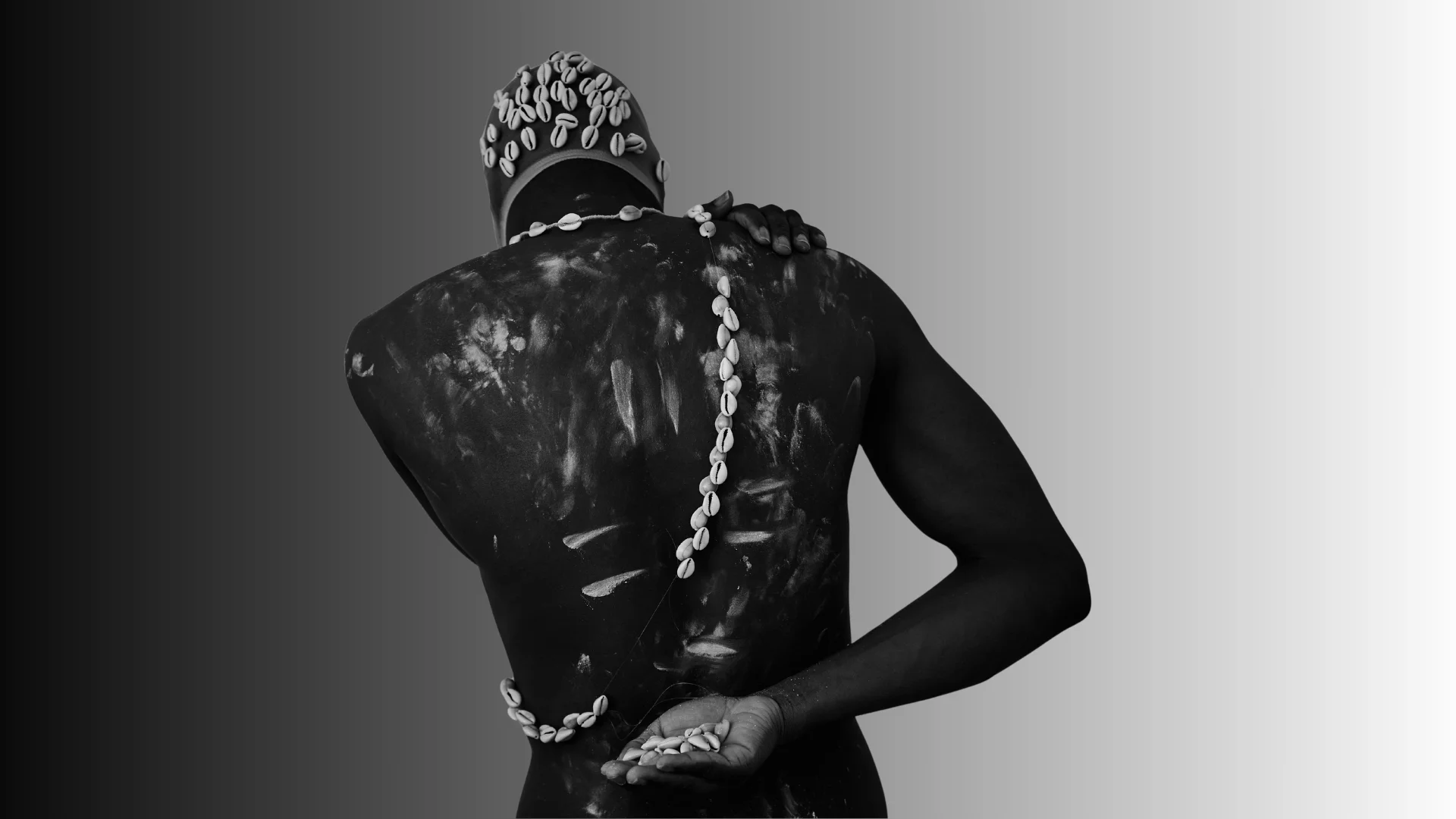
The body reaches its fullest archival significance in Legacy in the Body. Turned away from us, the figure carries a trail of cowries down the back while a hand extends behind, offering still more shells. The artist describes the arrangement as connecting past and present and associates the shells with the transmission of “knowledge, culture, opportunity and value” between generations. The turned back is particularly evocative. We face forward into futurity, but we carry histories we cannot continually see. The body thus becomes an archive upon which inheritance is inscribed.
This is where Ajé Olókun ultimately transcends the economics of wealth. What one inherits is not necessarily what one can count. Language is wealth. Memory is wealth. Knowledge, skill, relationships, ancestry and cultural consciousness constitute forms of capital whose value cannot be exhausted by monetary measurement. In diasporic contexts, this proposition becomes especially poignant. Stuart Hall (1990) reminds us that cultural identity is not simply an archaeological recovery of an unchanged past; it is continuously produced through history, representation and difference. For an artist living between Nigeria and Britain, therefore, inheritance is not simply something left behind. It is something carried across geography, translated and continually renegotiated. The final gesture of the exhibition is consequently not accumulation but transmission. The hand reaching backwards in Legacy in the Body simultaneously receives from the past and offers towards another future. Wealth achieves meaning through circulation. The exhibition’s own concluding statement insists that wealth is not merely what we have, but what we create, nurture and “leave moving through the world after we are gone.”
Ajé Olókun consequently proposes what might be called a moral ecology of wealth. It asks us to move from the question “What do I possess?” towards more difficult questions: What created what I possess? What responsibilities accompany it? What does it prevent me from seeing? What have I inherited? And what, ultimately, will I leave behind? In Akinremi’s photographs, the ancient cowrie returns from the marketplace carrying another kind of currency, not merely the currency of money, but of memory, labour, responsibility and possibility. Wealth becomes less a destination than a passage between hands and generations, between history and futurity, between what is inherited and what is made. For wealth, finally, is not only what accumulates around us. It is what passes through us.
Sources
Akinremi, Segun Emmanuel. 2026. Ajé Olókun: Artist Biography, Artist Statement and Works. Gallery Portfolio Documentation.
Connerton, Paul. 1989. How Societies Remember. Cambridge: Cambridge University Press.
Falola, Toyin, and Olatunde Bayo Lawuyi. 1990. “Not Just a Currency: The Cowrie in Nigerian Culture.”
Hall, Stuart. 1990. “Cultural Identity and Diaspora.” In Identity: Community, Culture, Difference, edited by Jonathan Rutherford, 222–237. London: Lawrence & Wishart.
Hogendorn, Jan, and Marion Johnson. 1986. The Shell Money of the Slave Trade. Cambridge: Cambridge University Press.
Johnson, Marion. 1970. “The Cowrie Currencies of West Africa. Part I.” The Journal of African History 11 (1): 17–49.

