 Follow Us on Google News


 Follow Us on Google Discover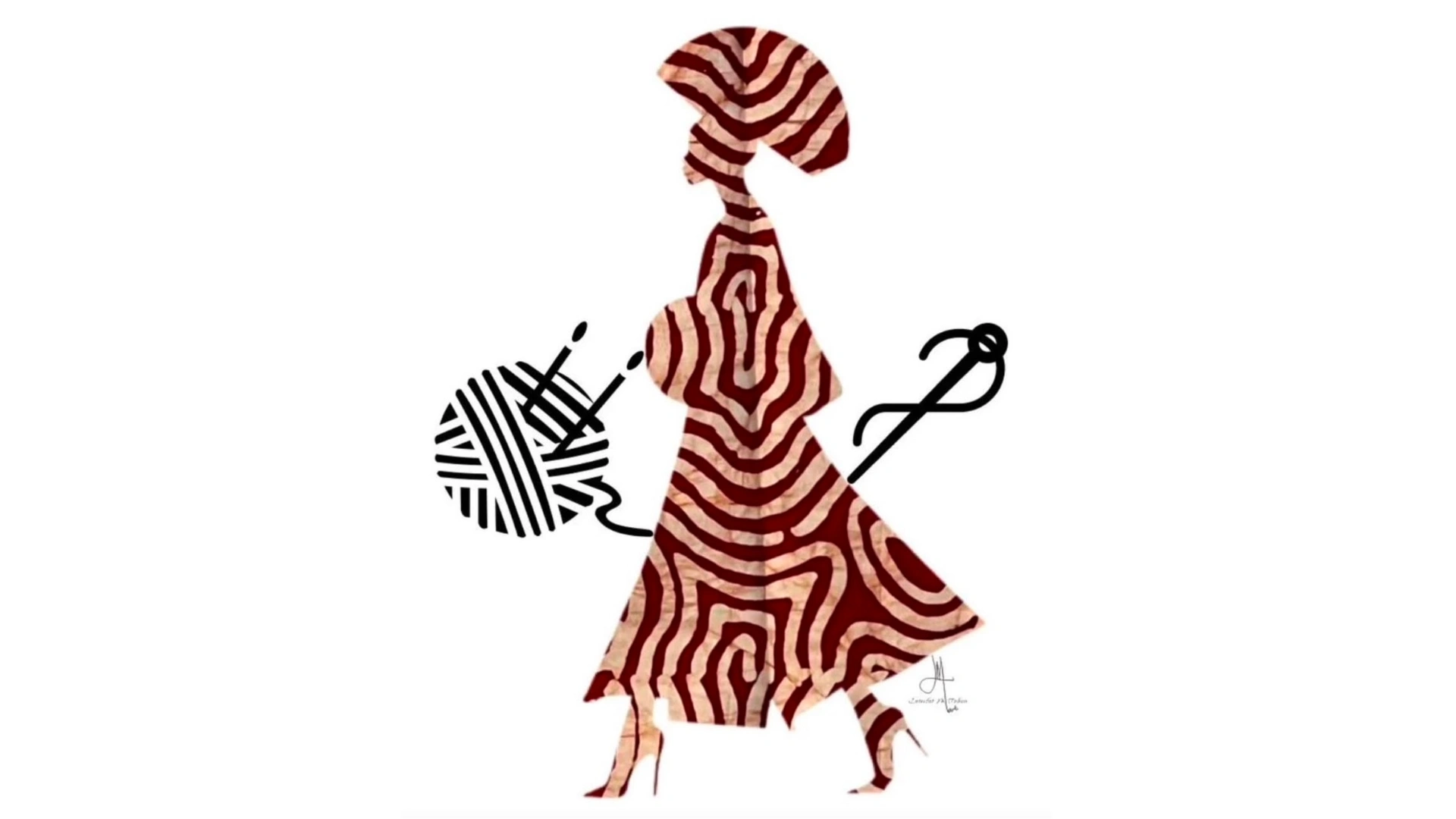
Lateefat Tobun works with remarkably little in Mending the Gaps, and that economy becomes the work’s greatest strength. A solitary figure occupies the centre of the composition, flanked by a ball of yarn and an oversized needle, all suspended within an expanse of white so dominant that it functions less as background than as a fourth element in the piece. Migration, belonging, and repair themes that contemporary figurative art often approaches through accumulation and narrative density are reduced here to a handful of symbols and a large amount of empty space.
The gamble pays off more often than it does not. The figure itself is rendered in an undulating maroon-and-cream pattern that resists settling into any single visual language. It can be read as textile, fingerprint, contour map, wood grain, or even geological strata. Tobun is careful not to privilege one interpretation over another. The pattern wraps the body rather than clothing it, collapsing distinctions between skin, fabric, memory, and landscape. This is perhaps the painting’s strongest formal idea: identity is not presented as something worn over an essential self beneath, but as the surface through which experience becomes visible.
The absence of facial features reinforces this ambiguity. There is no expression to interpret and no interior psychology offered for inspection. Instead, the figure exists as a silhouette: elongated, upright, and mid-stride, balancing precariously in high heels that suggest both vulnerability and determination. The temptation toward universality is obvious, but Tobun avoids the usual pitfalls largely because she refuses to overstate the gesture. The figure feels representative without becoming anonymous.
The ball of yarn and sewing needle introduce the work’s central metaphor of repair, though importantly, they remain physically separate from the body they are intended to mend. Thread has not yet met cloth. The act of stitching exists only as possibility, anticipation, or perhaps obligation. It is an unexpectedly subtle decision. Whether the separation represents the unfinished nature of belonging or simply the impossibility of ever fully repairing what migration asks us to leave behind remains unresolved, and the painting is stronger for resisting the urge to answer its own question.
At its best, Mending the Gaps understands that identity is less often broken than unfinished.
Tobun avoids the familiar binaries that shape much contemporary work about migration: trauma or triumph, rupture or resilience, loss or recovery. Instead, she presents belonging as labour that is repetitive, careful, and ongoing. The title does not promise completion. Gaps are not closed here so much as managed.

The painting is not entirely free from the visual vocabulary it inherits. Sewing, thread, and repair have become increasingly familiar metaphors within contemporary art concerned with memory, displacement, and diasporic experience, and Tobun does not radically reinvent them. What distinguishes the work is discipline rather than novelty. She resists the temptation to overload the composition with explanatory detail or symbolic excess. One figure, one gesture, one unfinished stitch. The restraint gives the imagery room to breathe.
The surrounding white space is crucial to this effect. In lesser hands, it might have read as mere minimalism or aesthetic caution. Here it carries emotional weight. The emptiness around the figure creates a sense of distance without theatricalising isolation and allows the painting’s modest visual vocabulary to feel unexpectedly expansive. Few artists working in this territory trust absence to do so much of the work.
There is also an interesting tension between the elegance of the silhouette and the domesticity of the tools surrounding it. Tobun quietly elevates acts traditionally associated with craft and maintenance into metaphors for cultural continuity and self-construction.
The work proposes that identities are not discovered so much as assembled, maintained, and occasionally repaired. If the painting has a limitation, it is one born of ambition rather than execution. In refusing specificity no face, no named place, no particular history attached to the figure, it risks universality becoming vagueness. The silhouette could belong to almost any migration narrative, which is very much the point, but it is also the cost. Nothing in the canvas insists on a particular life having been lived. That trade is defensible, even well judged, but it is a trade, and the painting is not exempt from naming it.
Mending the Gaps does not attempt to escape the artistic language of migration and belonging that contemporary audiences already recognise. Instead, it speaks that language with unusual precision and restraint. Tobun trusts a small number of carefully chosen images to carry considerable emotional and conceptual weight, and for the most part, they do.
The result is a work less interested in the drama of displacement than in the quieter labour that follows it: the slow work of assembling a self from inherited patterns, remembered places, and unfinished seams. It is a modest painting in scale and gesture, but not in effect. Some works demand attention through complexity. Mending the Gaps earns it through concentration.

