 Follow Us on Google News


 Follow Us on Google Discover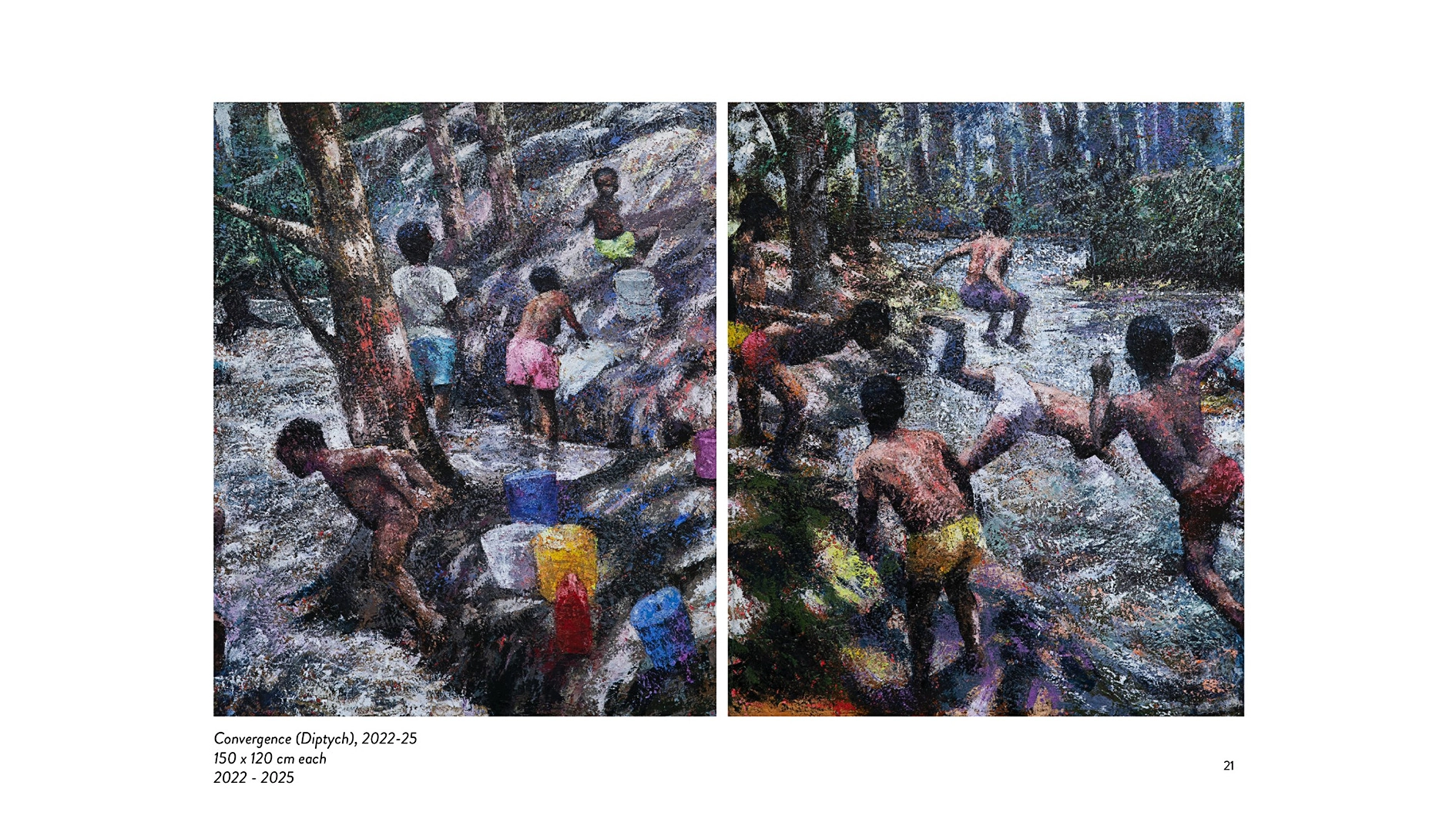
Acclaimed multi-media artist Chika Idu, has once again opened his creative space to the public with a solo show of his latest work, titled, Pure Water at ARAMI, a fine dining restaurant, nestled in the vibrant heart of Lekki Phase 1, Lagos.
The show, which is in partnership with SMO Contemporary Art, presents a compelling exploration of ecology, migration, innocence, and liberty through the evocative visages of women and children, swimming in a pristine underwater world.
Rooted deeply in the lived realities of riverine communities, Idu’s striking compositions navigate the complex interplay between human survival and aquatic ecosystems.
The work draws the viewer into an immersive natural world in which swimmers float and move with an apparent sense of intention, evoking a space of wonder and possibility. The figures drift within a pristine ecosystem removed from the restrictions of the world above.
Pure Water introduces a critical and ironic reference to Idu’s aspiration for a balanced world, while the term also refers to the plastic and sachets drinking “pure water”, used to quench the thirst of millions of Nigerians within heavily populated and polluted city centers. These water sachets clog up the drains and waterways, becoming an environmental hazard which affects people’s quality of life.
Idu’s figures and portraits draw attention to the environmental realities faced by urban and coastal communities, and advocates for “pure waters”. His figures swim towards freedom despite all odds.
Through the fluidity of their light speckled under-water reverie, Idu creates scenes of youthful innocence, where children have capacity for freedom and adventure, despite life’s uncertain currents and societal pressures.
The show is accompanied by a short film, From Shore to Studio, which depicts the artist explorationg and documentation of coastal life, and working in his studio to create his masterpieces. His oil and acrylic paintings on canvas and delicate watercolours on paper are a choreography of life.
His portraits of children and women have a gaze that defies all odds. Beneath the surface, where currents are built from layered palette-knife strokes, the water has a presence and energy of its own.
Idu’s unique style of impasto painting catches and refracts light in motion. His characters, whether on land or in the sea, move with confidence and a sense of adventure.
The artist also considers the monuments and memorials he encountered on the island of Martinique when he visited the Caribbean, and commemorates those who were forcibly carried across the Atlantic Ocean.
His work references the violence of colonial histories and current global migration issues, and asks what liberty might look like and whether that freedom can be recovered.
By confronting historical narratives, environmental vulnerabilities, and cultural stereotypes, the body of work transcends mere portraiture to challenge both local sensitivities and global perceptions, offering an urgent, visually arresting meditation on identity, displacement, and communal resilience.
Idu stated that the overarching motif addresses a critical question: how do we coexist when our lived realities are so vastly divergent?
He said, “The subconscious mind acts as a massive archival storehouse, collecting data, generational memories, and unarticulated fears. Without intentional mindfulness, historical grief and societal conflict bleed seamlessly into our daily creative spaces.
“The antidote is not forced uniformity, but a deliberate cultivation of balance: learning to live peacefully alongside one another without allowing systemic friction to mutate into internal chains.”
Commenting on the exhibition, Prof. Frank A.O Ugiomoh, a distinguished Nigerian art historian, theorist, and retired professor of Art History from the University of Port Harcourt, said, “Different histories are active at the same time in the water metaphor. The bodies of those lost in the slave trade, today’s migrants, and Idu’s women and children are not the same, but each has a place in an ongoing story of movement, displacement, vulnerability, and the search for freedom. Here, memory is not just looking back. It shapes how we see the present and imagine the future.”
For Diana Nwandu, Director of Arami, “from the rooftops of Arami, we have clear views of the Atlantic Ocean as well as the Lagoon and waterways curving their way through the city of Lagos. We are delighted to showcase Chika Idu’s spectacular works within our restaurant. They celebrate nature and align with our values and aspirations for a safe and healthy environment,” she said.
Commenting on the partnership, Founder and Artistic Director of SMO Contemporary Art, Sandra Mbanefo Obiago said, “SMO has its roots in both art and film. This exhibition allows viewers to be immersed in the natural world and see the artist’s creative process. Art must bring hope and inspiration to our lives, while also reminding us of the plight of humanity and the need to advocate for the environment.”


