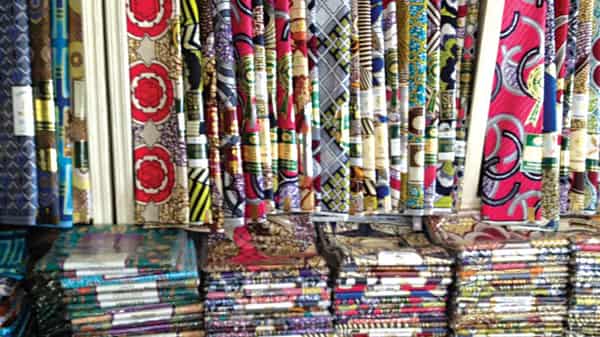
Local manufacturers of clothing in the country have complained about worsening conditions in the sector, saying if the situation does not improve soon, they will be forced to close shops indefinitely.
The latest crisis to hit the sector is the scarcity of dye for polyester fabrics, a situation that has caused production to slow down significantly, especially for producers that rely on local makers.
Pure polyester, a synthetic polymer made from terephthalic acid and ethylene glycol, does not have a specific colour because it is a transparent and colourless material. However, polyester is often used to make fabrics that are then dyed in a wide range of colours, which depends on the specific dyeing and finishing processes used in its production. This fabric is often used to make school uniforms for children as well as other uniforms because the fabric is strong, durable, wrinkle resistant and hydrophobic.
Founder of Kazih Kits Limited, Grace Otakpor-Azih, described the situation as concerning and added that not only are they struggling to produce uniforms, the cost of uniforms is most likely going to shoot up.
Revealing that the problem started a few months ago, she said many manufacturers are being forced to buy imported polyester fabrics to produce, which she said is a more expensive option and not sustainable in the long run.
“We have been going to the only factory in Lagos that produces these fabrics in the state and unfortunately, they have been complaining of a dye shortage. This has never happened in the past. When I went to buy, I was told the waiting time is five weeks and after that time ran out, nothing still. We are just told to keep checking back and ‘we will get it soon’. No specific time is being given and I think they don’t even know when they will resume production either.”
Another manufacturer, who pleaded anonymity, regretted that the textile factory has been left to rot by successive governments to the extent that most materials have to be imported into the country, despite the fact that they could be produced in Nigeria locally.
“The cost of school uniforms and other uniforms in general will significantly increase very soon because the only local production company here in the south-west cannot produce polyester fabrics because there is no dye to work with. It is sadder because if the textile industry is thriving, the dye could be produced locally here and we wouldn’t need to import. Sadly, all the textile companies packed up one after the other and the government did not see it as a big problem.”
She added that production has slowed down until dye comes in and pleaded with the government to resuscitate the textile mills quickly to save the sector from complete annihilation. “It really is a shame that we have to rely on other countries for the most basic things and fabric importation has been prioritised over local production. These are things we can do here easily if given the chance.”
According to her, the sector is practically dead and simply hanging on by a thread, even as pressure from Chinese and Indian suppliers gets more intense. “I have these suppliers reaching out to me all the time, but if we all throw in the towel and decide to import, asides the pressure on FX needed for that, we would completely kill local producers and that would actually be the end for our textile sector,” she said.
Speaking with a source at SunFlag, who pleaded anonymity, the textile mill that produces the materials for most local clothing manufacturers, the source said the dye will likely come in at the end of this month and added that it is imported from India and China.
He blamed amongst other factors, rising FX costs, rising cost of diesel and operation costs, as part of the reasons why they have been unable to meet customer’s demands in recent times. “The FX crisis is affecting us so much and now, the rising cost of diesel has been added to the mix. Electricity is not constant and we have to rely on diesel generators. These problems are nothing new but unfortunately, they seem to be getting worse now,” he said.