
 Get Guardian on Google
When the UBA Foundation established its National Essay Competition in 2011, the initiative was part of its efforts to promote education and create opportunities for young Nigerians. Sixteen editions later, what began as a national competition has expanded to six other African countries, bringing its current reach to seven countries.
Over the years, the competition has offered secondary school students an opportunity to develop their writing skills, engage with national issues and compete for scholarships towards their university education.
The Foundation now hopes to extend the initiative to all 20 African countries where UBA operates.
The 2026 edition attracted nearly 15,000 entries from senior secondary school students across Nigeria. It produced 20 finalists, up from 12 in the previous edition, while the number of scholarship recipients increased from three to five.
The assessment process, however, also drew attention to challenges in students’ writing, including essays with characteristics associated with artificial intelligence-generated content, recycled submissions and limited analysis.
These findings were highlighted in a report by the competition’s judges.
What The Judges Found In The Essays
The judges’ report detailed the strengths and weaknesses identified during the assessment.
The four assessors were Prof. Asabe Kabir Usman of Usmanu Danfodiyo University, Sokoto; Prof. Ini Uko of the University of Uyo; Prof. Samuel Onuigbo of the University of Nigeria, Nsukka; and Prof. Emmanuel Babatunde Omobowale of the University of Ibadan. All four are professors of English.
Entries were assessed over two weeks using a standardised marking guide. Content carried the highest weighting at 30 per cent, followed by expression at 20 per cent.
Organisation and mechanical accuracy, including vocabulary, each accounted for 15 per cent. Depth of analysis and relevance to Nigeria made up 10 per cent, while adherence to guidelines, including the title and word count, accounted for the remaining 10 per cent.
The report said the top 100 essays were outstanding, but many of the remaining entries displayed weaknesses. The judges estimated that between 35 and 40 per cent of the scripts had characteristics they associated with generative artificial intelligence tools, including ChatGPT and Gemini.
They pointed out polished but generic language, repetitive transitions, a lack of personal voice and recommendations that did not appear grounded in local realities.
Some essays, for example, proposed solutions such as vertical farming in urban skyscrapers or blockchain systems for food traceability without explaining how such proposals would work in the Nigerian context.
The report also identified identical introductory paragraphs, definitions reproduced from online sources and conclusions that appeared in multiple submissions. Some entries included titles from earlier editions, while others had no title or used one that did not correspond with the assigned topic.
The judges said about five per cent of the scripts had incorrect titles, including titles linked to previous competition topics.
There were also cases of duplicate submissions. Some essays were entered under names with minor variations or under different school names. In one instance, handwriting checks suggested that the same essay had been submitted more than once under different names from the same school.
Other submissions were far shorter than expected. Some contained only 120 to 180 words.
The judges also encountered entries written in the format of debate speeches, beginning with greetings to a chairman, judges, timekeeper and fellow speakers rather than presenting an essay.
The judges recommended clearer guidelines, school briefings for English teachers, plagiarism screening and measures to prevent multiple entries. They also suggested that the entry portal should reject submissions below the minimum word count.
A Second Stage Built Around Independent Writing
The final stage of the competition was held under supervised conditions at UBA House, Marina, Lagos. The 20 finalists wrote their essays without access to phones, textbooks or the internet.
Before the final assessment, the students attended a one-day writing boot camp with the judges. The sessions covered essay structure, critical argumentation, originality, the use of Nigerian examples, writing ethics and the importance of following instructions.
According to the judges’ report, the final-stage essays were more authentic and showed greater insight. The assessors described some of the submissions as moving and noted that the boot camp had helped students improve their structure, argument and attention to originality.
The Issues Shaping The Essay Topics
Food security remains a major challenge in Nigeria, with millions of households struggling to afford sufficient and nutritious food. Rising food prices, declining purchasing power and disruptions to agricultural activities have made access to food increasingly difficult for many Nigerians. The scale of Nigeria’s food security challenge is reflected in projections by the Food and Agriculture Organisation (FAO), which estimated that 34.7 million Nigerians could face acute food insecurity during the June to August 2026 lean season.
It was against this backdrop that food security became the subject of the first-stage essay in the 16th edition of the UBA Foundation National Essay Competition. Participants were asked to write on the topic: ‘No nation can develop without food security. How can Nigeria deal with this problem?’
The second topic focused on child marriage and the factors contributing to its prevalence in Nigeria, and poverty remains one of the issues associated with the practice.
The 20 finalists were subsequently asked to examine the issue in the final-stage essay, titled: ‘Examine how poverty and other social vices contribute to the prevalence of child marriage in Nigeria.’
UBA Foundation Managing Director and Chief Executive Officer, Bola Atta, said the essay topic changes yearly to encourage students to think critically about important issues and develop their own ideas rather than rely on artificial intelligence.
The Winners And Their Prizes
At the end of the competition, five students emerged as scholarship recipients, sharing educational grants worth a total of N41 million.
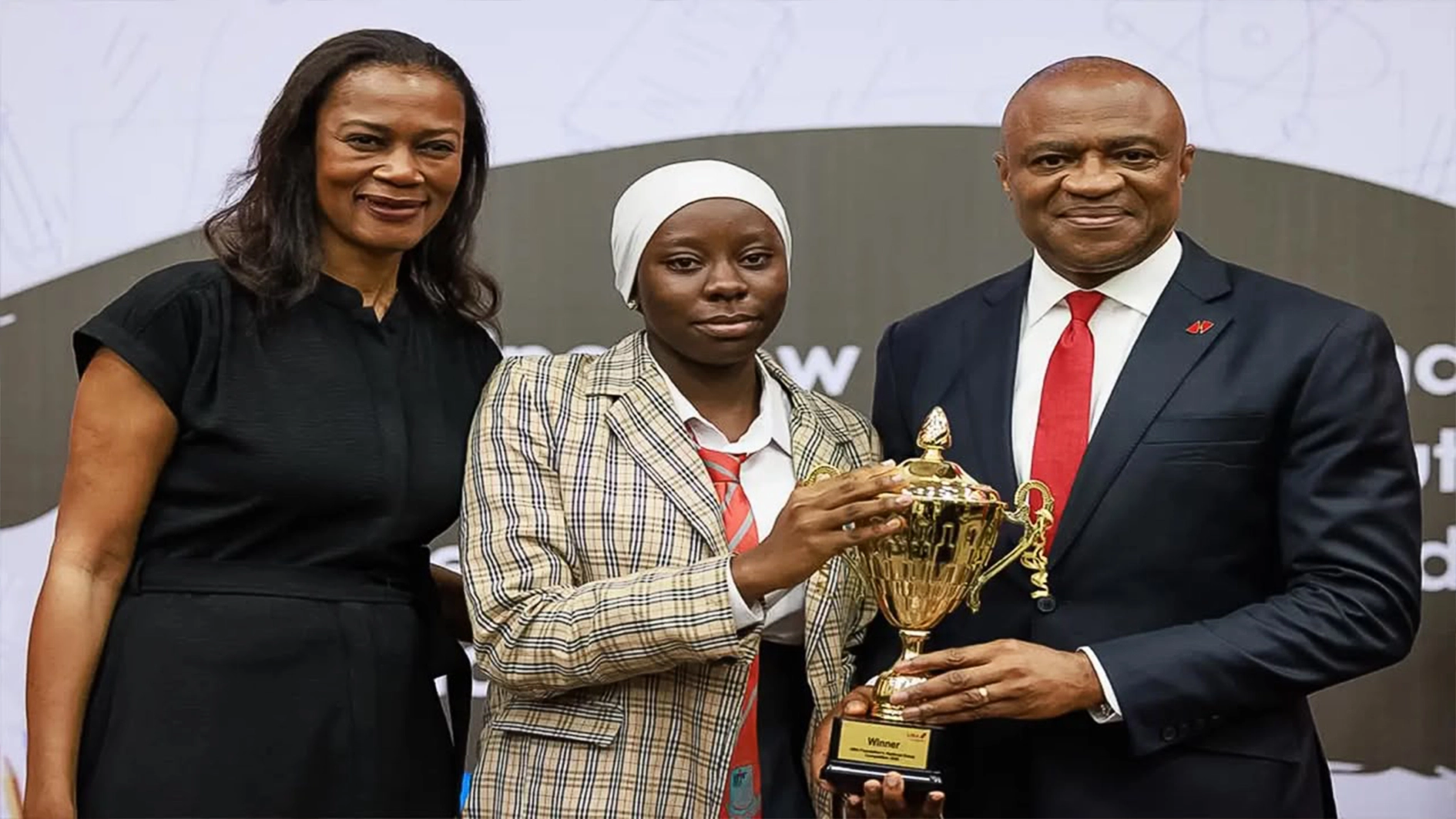
Khaira Ojima Bala of Metro International School, Abuja, took first place and received N15 million.
Unwanabasi Otobon Udom of Topfaith International Secondary School, Mkpatak, came second and received N10 million, while Flourish Chibunumoma Ndamzi of the University of Port Harcourt Women Association International Secondary School placed third and received N7.5 million.
God’sfavour Ezekiel Udo of Federal Government Girls’ College, Ikot Obio Itong, finished fourth and received N5 million, while Uchenna Olivia Anyanwu of Coral Impacts International School, Abuja, came fifth and went home with N3.5 million.
All five scholarship recipients were girls.
Bala, who was 15 at the time of the competition, said the award was important to her and her family.
“I am so happy right now. My parents have sacrificed so much for my education, and this award belongs to them as much as it belongs to me,” she said.
She also thanked the Foundation for providing students with a platform to share their ideas.
The other 15 finalists also received laptops and N20,000 each, credited to their UBA accounts.
Atta also disclosed that the organisation had invested more than N3 billion in the competition over its 16 years.
From A National Initiative To A Continental Ambition
The increase in the number of finalists and scholarship recipients was part of the Foundation’s expansion of the competition. The five scholarship awards ranged from N3.5 million for fifth place to N15 million for the overall winner.
UBA Group Managing Director and Chief Executive Officer, Oliver Alawuba, said the increase in scholarship amounts was in response to rising education costs and inflation.
“As inflation increases and it becomes more difficult to see a child through school, we have raised the amounts to make sure these students get to school. For us, that is important,” he said.
Alawuba also said the Foundation hoped to extend the competition to all 20 African countries in which UBA operates.
Beyond The Prize
According to Atta, the value of the competition extends beyond the scholarships awarded to the five winners.
She said the initiative reflects the Foundation’s belief that education is one of the most effective ways to tackle poverty, with benefits that extend beyond individual students to their families and communities.
She also highlighted the experience of the 20 finalists, who got to interact with students from different cities and built relationships through the competition.
“We believe the competition should offer more than just prizes to the top five winners,” Atta said. “The 20 finalists also benefit from the competitive experience and the friendships they build with other students from different cities. These are relationships that could last for years.”
She said the Foundation would continue to expand and improve the competition to give more students access to the opportunities it offers.
Atta also encouraged students who did not make the final stage to keep trying, noting that some participants who had previously made the top 12 returned in subsequent editions to finish among the top three.
Alawuba said the competition was designed to improve young people’s capacity, build their confidence and strengthen their critical thinking skills.
He said its expansion across Africa would give more young people the opportunity to participate, adding that the Foundation believed in the potential of African youths.
He described the initiative as an investment in young people and said its impact could be seen in the achievements of past beneficiaries, whom he said were contributing across different countries and sectors.v