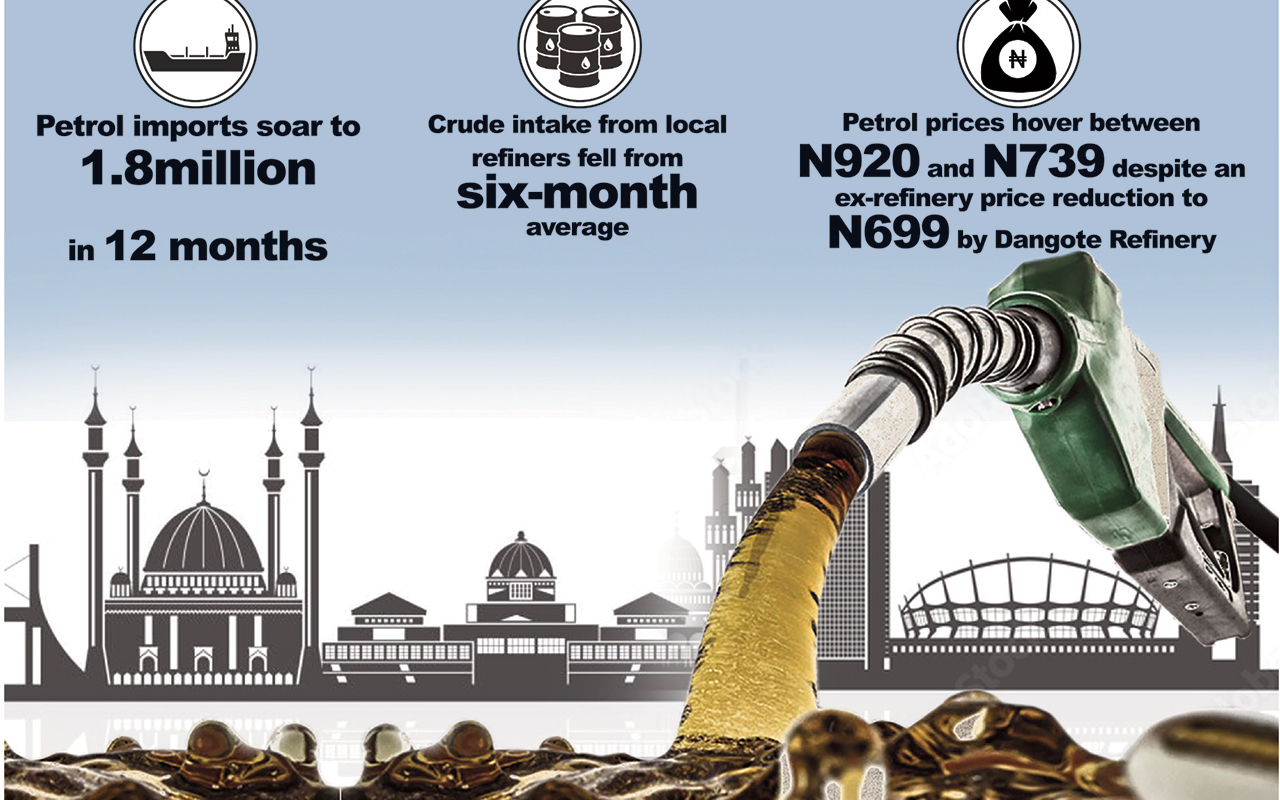
The Crude Oil Refineries Association of Nigeria (CORAN) has raised the alarm over Nigeria’s continued dependence on imported petroleum products, revealing that the country spent approximately N15.4 trillion on petrol imports in 2024, more than double the N7.5 trillion recorded in 2023, even as local refinery companies committed tens of billions of dollars to domestic refining infrastructure.
In a position paper made available to The Guardian yesterday, CORAN emphasised that local refinery operators, including large-scale, mid-scale, and modular facilities, have demonstrated “true faith” in the nation’s downstream sector by building fixed industrial assets in Nigeria, a commitment that cannot be easily relocated or sold without substantial financial loss.
The association said that refining is among the most capital-intensive and risk-exposed segments of the petroleum value chain, requiring investors to manage uncertainties such as crude supply fluctuations, foreign exchange volatility, inconsistent regulatory policies, power and logistics challenges, and daily operational risks.
“A refinery is not a trading strategy; it is an industrial declaration of confidence in Nigeria’s future,” CORAN stated.
It added that by investing in steel, concrete, distillation units, and daily operations, local refinery companies have placed their capital at risk to ensure domestic refining capacity, operational discipline, environmental compliance, and market participation.
By contrast, the association said that importers have relied on short-term trading strategies that generate profit without building national capacity. It noted that during the subsidy era, importers benefited from price arbitrage, foreign exchange advantages, weak consumption verification, and subsidy reimbursement mechanisms, resulting in billions of naira flowing out of the economy while no significant investment in local refining occurred.
CORAN said the historical import-dependent model prioritised access to ports, foreign exchange windows, and permissive import regimes over energy security and industrialisation.
Even after the removal of subsidies, Nigeria remains heavily reliant on imports, CORAN said, citing National Bureau of Statistics data showing over 20 billion litres of Premium Motor Spirit (PMS) imported in 2023, with import costs soaring to N15.4 trillion in 2024. The association said the figure illustrates the scale of foreign exchange outflows that could have been retained within the country to support domestic refining, logistics, storage, petrochemicals, and industrial employment.
CORAN stressed that the magnitude of import spending underscores the urgent need for policies that prioritise local refining investments.
The association also criticised the way capital accumulated by importers was used, noting that profits were often diverted into real estate, financial portfolios, or upstream acquisitions, including marginal oil fields, with crude exported rather than refined domestically.
CORAN said this approach reflects a preference for short-term returns over long-term industrial development and national capacity building.
It called on the federal government to implement measures that guarantee transparent crude allocations for domestic refineries, ensure alignment of foreign exchange and pricing mechanisms, and restrict import licensing to cases where domestic supply cannot meet demand.
The association argued that such measures would ensure that local refiners are not structurally disadvantaged compared to importers, whose operations entail minimal industrial risk.