• Stakeholders Seek Govt’s Support For Its Restoration
The early hours of Wednesday, December 24, 2025, will remain in the memory of traders, residents, and worshippers on Lagos Island. What began as an ordinary day in one of Nigeria’s busiest commercial districts quickly turned into chaos when a fire broke out, engulfing the Great Nigeria Insurance (GNI) building and spreading rapidly to nearby structures.
By the time the flames were brought under control by emergency responders, the main building, the GNI facility has been turned to carcass, which was why the state government has said the structure would be pulled down.
However, while the attentions were principally focused on the GNI building where the fire outbreak started and the lives lost in the accident, about eight, other buildings within the environ damaged by the fire incident were not brought to the fore. And one of such structure is Lagos’ most treasured religious and historical landmarks, the Shitta-Bey Mosque, which has now been reduced to charred remains.
Though the monumental loss from the GNI building fire incident shocked many, the loss of the Shitta-Bey Mosque struck a deeper emotional chord for many Lagos Island residents and the wider Muslim community in Nigeria.
The mosque, also known as Moshalashi Shitta-Bey, among many in Lagos Island, was completed in 1891 and stands as one of the most important Islamic landmarks in Nigeria.
Built entirely by Chief Muhammad Shitta-Bey, the mosque is celebrated for its Brazilian and Portuguese architectural motifs aside it is widely regarded as the first mosque of international standard in modern Nigeria.
For over a century, it served as a Ratibi mosque where thousands of Muslim traders, residents, and visitors performed daily prayers. Its location in the heart of Lagos Island made it both a spiritual centre and a symbol of Islamic heritage in the city.
Shitta-Bey, originally known as William Shitta, was an aristocrat, philanthropist, and influential Muslim leader whose legacy shaped the religious and social development of Lagos. In addition to building the Shitta-Bey Mosque, he played a pivotal role in the reconstruction of the Lagos Central Mosque in 1873. At the time, the mosque was a modest mud structure built in 1864. Shitta-Bey replaced it with a more durable building using blocks, cement, and corrugated iron sheets, bringing it up to the standard of the era.
His philanthropic efforts extended beyond mosque construction. He funded improvements to several mosques across Lagos, replacing thatched roofs with stronger materials and supporting Islamic education and welfare.
In recognition of his contributions, Muslim elders in Lagos bestowed on him the title of Seriki Musulumi of Lagos, the first of its kind. He was later recognised as the second Baba Ajo, equivalent to today’s Baba Adinni.
Internationally, his influence was acknowledged by the Ottoman Empire. Representatives of the Sultan of Turkey attended the opening of the Shitta-Bey Mosque on July 4, 1891, and conferred on him the title of Bey, a high-ranking honour in the Islamic world at the time.
The mosque he built was later designated a national monument by the Nigerian Commission for Museums and Monuments, cementing its status as a heritage site of national importance.
Following the fire incident, the Jumu’atul Muslimeen Council, also known as the Executive Council of the Lagos Central Mosque, alongside the Bashorun Council of the Olowogbowo Division, wrote a formal letter to Governor Babajide Sanwo-Olu appealing for the state leadership to restore the Shitta-Bey Mosque.
The letter described the destruction as a “monumental loss of historical significance” not only to Lagos Island but to Muslims across Nigeria. It emphasised the mosque’s enduring role as a centre of worship and unity, urging swift and coordinated action to rebuild it to greater glory.
A separate letter of consolation was also issued to the Shitta-Bey family, the Olowogbowo leadership, and the Muslim Ummah of Lagos. While mourning the loss, the letter called for collective resolve, urging stakeholders to rise above grief and commit to restoring the mosque.
Citing Quran 3:92 — “True righteousness is not attained, until you spend from what you love” — the letter framed restoration as both a religious duty and a tribute to Chief Shitta-Bey’s lifelong generosity.
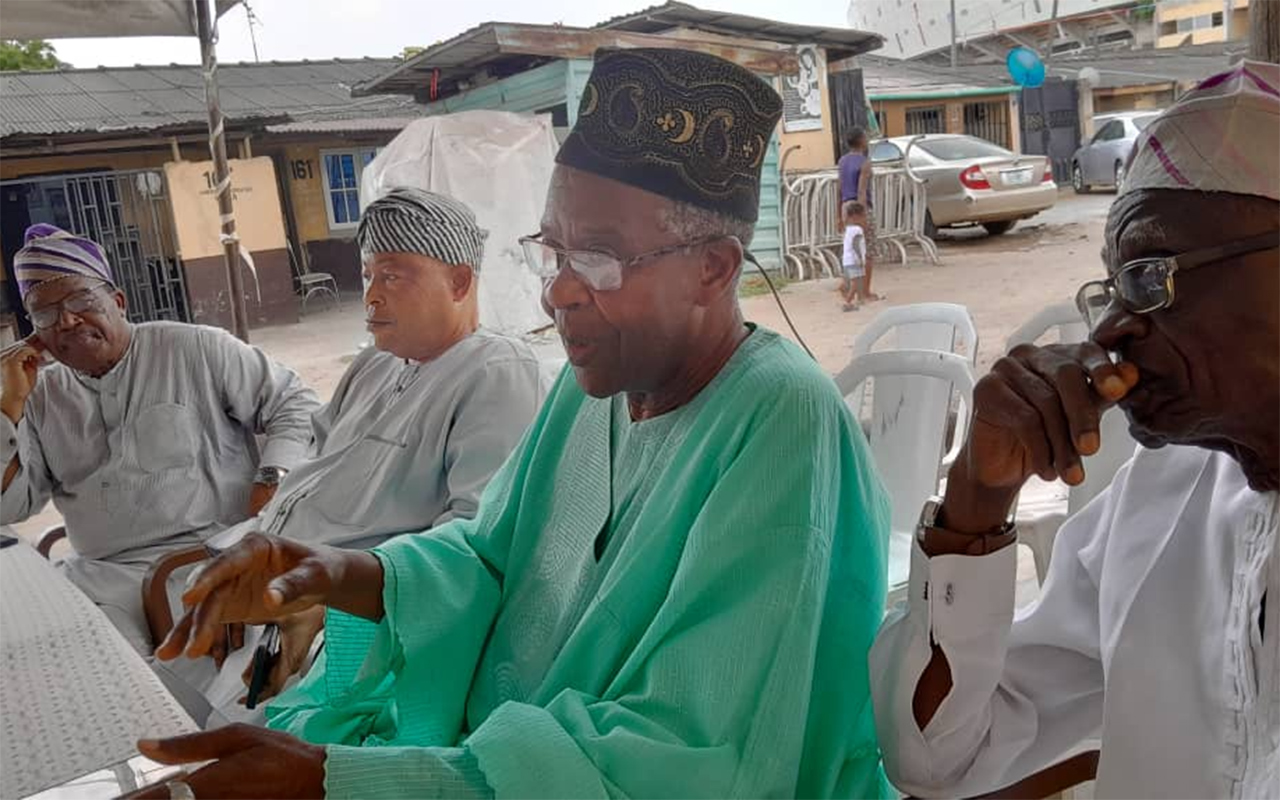
In a show of unity, the Executive Council of the Lagos Central Mosque, led by Alhaji Sikiru Alabi-Macfoy, Chairman and Baba Adinni of Lagos, visited the Shitta-Bey family at Shitta Surulere.
The delegation included Alhaji Oyinlomo Danmola, President of the Nigeria Muslim Council (Lagos Chapter); Alhaji Rafiu Adisa Ebiti, Pro-Chancellor of Summit University; Alhaji Ademola Mustapha, Treasurer of the Lagos Central Mosque; and Alhaji Lookman Seriki, General Secretary of the mosque.
They expressed solidarity with the family, assuring them of the Muslim community’s support, reinforcing the message that the restoration of the mosque would be a collective effort.