 Follow Us on Google News
 Follow Us on Google Discover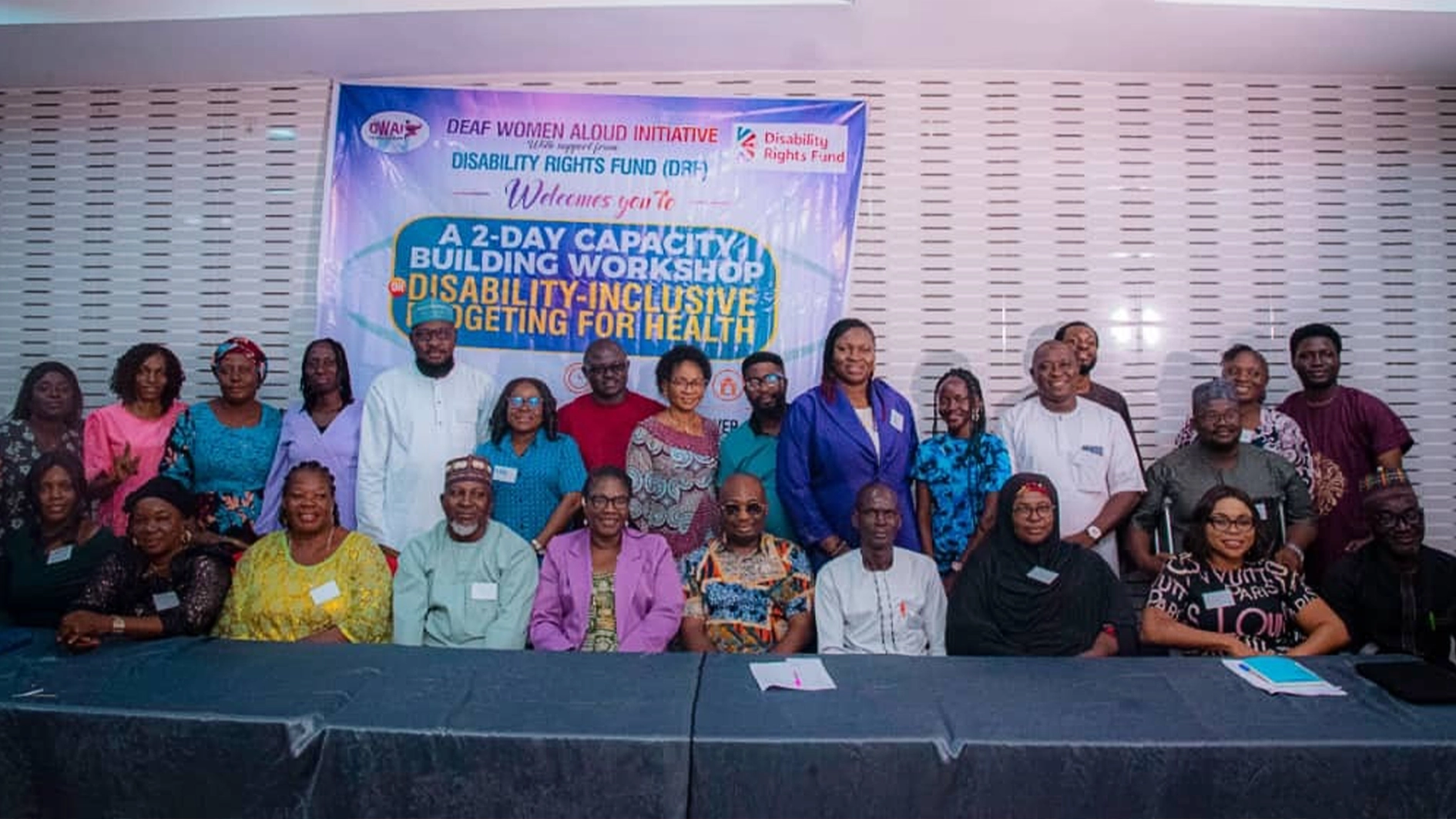
The Federal Capital Territory (FCT) Administration has called for disability inclusion to be mainstreamed into health planning and budgeting, as stakeholders push the six Area Councils to create dedicated budget lines for the healthcare needs of persons with disabilities.
The call was made at a two-day capacity-building workshop on disability-inclusive budgeting for health organised in Abuja by the Deaf Women Aloud Initiative (DWAI), with support from the Disability Rights Fund (DRF).
Representing the FCT Mandate Secretary for Health Services and Environment, Dr. Adedopeyin Olanrewaju, Dr. Aderonke Adedeji said the timing of the workshop was particularly significant as the FCT was developing its 2027 Annual Operational Plan and undertaking reforms aimed at changing the way health interventions are planned and funded.
She said the FCT was working to ensure that gender and disability considerations were mainstreamed across health programmes, noting that primary healthcare facilities were critical because they implement most interventions that directly affect communities.
According to her, the six Area Councils and their primary healthcare authorities have a major role in translating policies into services, but policy formulation and the establishment of disability-inclusive frameworks must also happen at the federal and state levels.
“Area councils are more of implementers. They are the ones that actually implement most of the policies,” she said, stressing the need to take the advocacy “higher, from national to state.”

Adedeji disclosed that the FCT had begun expanding existing gender structures within the health system to accommodate disability inclusion, following encounters with pregnant women and other persons with disabilities who face barriers accessing primary healthcare.
She cited cases of pregnant women unable to access health facilities because of the absence of ramps, while others who manage to reach facilities encounter health workers who are not sufficiently equipped to understand or respond to their specific needs.
“This is about rights, not about charity,” she said.
She explained that the FCT Primary Health Care Board had also begun discussions on training frontline health workers in sign language and disability-sensitive service delivery, arguing that creating a disability inclusion unit or division would make it easier to establish specific budget lines for such interventions.
“If the unit doesn’t exist, there is nothing to press for that you need a budget line,” she said.
No dedicated disability health budget lines
The call followed findings from a baseline assessment conducted by DWAI across the six FCT Area Councils.
In her welcome remarks, the Executive Director of DWAI, Hellen Beyioku-Alase, said persons with disabilities constitute about 15 per cent of the FCT population, yet the organisation’s assessment found that none of the six Area Councils had a dedicated budget line for disability inclusion in health.
She said where persons with disabilities were mentioned in council budgets or interventions, they were often treated as beneficiaries of charity through items such as wheelchairs, food or cash donations rather than as rights holders whose needs should be systematically provided for through public budgets.
“This workshop is not a talk shop. By tomorrow, each council here will have drafted a model disability-inclusive budget line for its 2027 health budget,” she said.
Beyioku-Alase said the initiative was aimed at moving public institutions “from charity to rights, and from handouts to budget lines,” in line with the principle of “nothing about us without us.”
She disclosed that DWAI had visited Gwagwalada, Abaji, Kwali, Kuje and Bwari Area Councils, where officials expressed varying degrees of commitment to disability-inclusive health planning.
According to her, Kuje officials pledged to implement key demands presented by the organisation, while Bwari committed to developing a model accessible health facility. Kwali already had a Disability Desk Officer, while Gwagwalada and Abaji officials pledged to work towards inclusive budgets for the coming fiscal year.
Budgets hidden from public scrutiny
The DWAI Monitoring and Evaluation Officer, Mr Collins Joseph, who presented an overview of the project and its findings, said the baseline assessment involved interviews and document reviews in the offices of Area Council chairmen, health departments and finance departments.
He said the assessment found significant gaps in budget transparency, disability-specific allocations and the availability of disaggregated data.
According to him, 67 per cent of the councils assessed had budgets available only on request, while 60 per cent had no specific budget lines for disability.
He also disclosed that the assessment found zero budgetary provision for sign language interpreters and that 47 per cent of disability-related interventions were largely charity-based.
Joseph criticised the practice of grouping persons with disabilities under broad categories such as “vulnerable groups,” arguing that such classifications often obscure their distinct needs.
“The need of a deaf woman is not the need of a blind man. The need of a woman who uses crutches is not the same need for a woman who is on a wheelchair,” he said.
He called for disability needs to be disaggregated and reflected in specific budget allocations, rather than being lumped together with children, older persons, internally displaced persons and other groups.
He further warned that interventions dependent on the goodwill of individual political office holders were unlikely to survive changes in administration.
“If these things are not institutionalised and put in the budget, the next governor that comes, whether he likes it or not, it becomes a thing of law that he must do it,” he said.
Poor budget implementation compounds problem
While participants demanded dedicated allocations, the FCT health official acknowledged that having a budget line does not necessarily guarantee implementation.
She disclosed that budget implementation across some health programmes remained extremely low, with some programmes unable to implement even five per cent of their approved allocations.
“Some of us couldn’t get up to two per cent implementation,” she said, adding that several health interventions were being sustained through partner funding.
She cautioned against excessive dependence on statutory government budgets, urging stakeholders to use evidence from the baseline assessment to attract grants and other resources to support disability-inclusive health interventions.
However, the DWAI Executive Director insisted that external funding should complement, rather than replace, government responsibility.
She argued that relying on personal donations or short-term project funding to provide essential services such as sign language interpretation was unsustainable.
Beyioku-Alase called for institutionalised funding for sign language interpreters and accessible health services, stressing that interpreters working in healthcare settings require professional training, ethical standards and confidentiality obligations.
She also shared her personal experience of spending several hours at hospitals to access healthcare, describing the frustration faced by deaf patients who may wait for long periods and still struggle to communicate effectively with healthcare providers.
PHC funding offers potential entry point
The FCT health official also pointed to the Basic Health Care Provision Fund (BHCPF) as a potential financing mechanism that disability rights advocates could leverage.
She explained that the funding flows to primary healthcare facilities on a quarterly basis and involves community structures in oversight and accountability.
According to her, some facilities previously received about ₦200,000 per quarter, while allocations have increased in some cases to between ₦800,000 and ₦900,000 per quarter.
She urged disability organisations to advocate for a specific place for persons with disabilities within existing funding mechanisms, rather than waiting solely for new sources of financing.
“There are funding for vulnerable groups, but they always lock them up. At the end of the day, people that are not vulnerable are the ones that benefit from such,” she said.
She added that community development structures, including Ward Development Committees and Community Development Committees, participate in oversight of facility-level funding, providing an opportunity for disability organisations and communities to demand transparency and inclusion.
She also disclosed that the FCT had recently launched an initiative aimed at reducing maternal and neonatal deaths and said disability inclusion was considered in the planning of the programme.
DRF urges stakeholders to turn commitments into action
Speaking on behalf of the Disability Rights Fund, Mr Theophilus Odaudu, Programme Manager, DRF West Africa, commended DWAI for its grassroots-focused advocacy and stressed the importance of translating existing disability laws and policies into actual budgetary commitments.
Odaudu said Nigeria had “beautiful laws and policies” on disability rights, but without adequate budgetary allocations, such provisions would remain largely on paper without improving the lives of persons with disabilities.
He noted that the focus on the Area Councils was particularly important because many persons with disabilities who remain underserved live at the grassroots.
“If we get it right at the area council level, then we will get it right at the marginal level,” he said.
Odaudu urged participants, particularly government officials, to ensure that the discussions and lessons from the workshop translated into changes within their respective offices.
“A lot of the times we gather, we talk and we go, but nothing changes,” he said, challenging stakeholders to ensure that the workshop produces concrete outcomes.
He said the DRF would continue to support locally led initiatives aimed at building a more accessible and inclusive society.
Stakeholders demand sustainable accessibility
Responding to the discussions, the DWAI Executive Director said sustainable funding for sign language interpretation and accessible healthcare must become part of government planning rather than depend on personal donations or short-term projects.
She stressed that sign language interpreters working in healthcare settings require professional training, ethical standards and confidentiality obligations.
She also called for greater investment in accessible health facilities, assistive equipment and disability-sensitive services, arguing that these were essential to reducing barriers to healthcare for persons with disabilities.
The FCT health official, meanwhile, urged disability organisations to take their advocacy to political decision-makers, noting that while health officials may formulate policies, decisions on funding and implementation ultimately involve political authorities.
She said existing financing mechanisms, including the Basic Health Care Provision Fund and health insurance schemes, could provide sustainable entry points for disability-inclusive health interventions if advocates secured specific provisions for persons with disabilities.
For DWAI, the challenge now is to convert the commitments made at the workshop into concrete budget provisions as the FCT and its Area Councils prepare their 2027 plans.
The organisation maintained that disability inclusion cannot be sustained through charity, individual political goodwill or intermittent donor interventions.
Instead, stakeholders said, accessibility, sign language interpretation, assistive equipment, disability-sensitive healthcare training and other reasonable accommodations must be planned, costed, budgeted and implemented as rights-based public services.

