
 Get Guardian on Google
With ambitious projects worth billions of naira launched in the gas pipeline and agriculture sectors, the South East Development Commission (SEDC) appears determined to make a visible impact and rewrite the story of the South-East region. LAWRENCE NJOKU reports.
There are strong indications that if well implemented, the $100 million gas pipeline and 15 agro-mechanisation projects recently launched by the South East Development Commission (SEDC) would not only usher in the needed fibre to actualise the economic potential and growth of the South-East region, but could change the ugly notion held about the Commission since inception.
The Commission, born in July 2024, with its management inaugurated in February last year in response to a long-held desire by the people of the region for a Commission to address the ruins in the region, had not been in the good books of the Senate Committee on South-East Development, chaired by Senator Orji Kalu.
This arose from the feeling that the Commission had not managed its finances effectively, given the quantum of responsibilities it faces.
To buttress its disdain for the Commission, in June this year, the Senate Committee urged its members to account for the N16.6 billion 2025 budget allocation after accusing its members of failure to comprehensively explain N13 billion already spent from the money.
The committee, which also queried the rationale for renting an Abuja liaison office when its headquarters in Enugu was without visible presence, having not functioned or been put to good use, just as it warned against turning the Commission into a conduit for administrative overhead rather than tangible infrastructure. The dust raised by that inquiry was on until recently, when the Commission decided to talk big.
Apparently, in response to the indictment, as well as restoring the region’s confidence n in the Commission, its leadership launched two ambitious projects to boost industrialisation, attract investments and create jobs, among others, in the five states.
The 400-kilometre pipeline, designed to connect gas resources to industrial and commercial centres across Enugu, Anambra, Imo, Abia and Ebonyi states, has about 150 potential customers identified, with projected demand of 254 million standard cubic feet of gas per day.
Construction is scheduled for the first quarter of 2027, with gas delivery targeted for the second quarter of 2028 to supply about 150 manufacturing and industrial customers.
The investment agreement for the project, signed at the South-East Gas Infrastructure Investment and Project Development ceremony in Enugu by the Federal Government, NPC Gas Marketing, and Gas Sync Limited, marked a significant step towards establishing a regional gas distribution network.
Already, the Commission said it had committed $3 million to the gas project and established a framework to mobilise additional investments from state governments, institutions and private investors.
GasSync Limited, which also serves as the project’s promoter, said the pipeline would connect gas resources near the South-East to industrial users across the five states, reducing dependence on the expensive road transport of compressed natural gas (CNG) and liquefied natural gas (LNG).
Its lead promoter, Callistus Mba, explained that the proposed network would originate from the Ohaji area of Imo State, run through Owerri and branch towards Aba in Abia State and Onitsha in Anambra State, with extensions to Enugu and Ebonyi.
He said the company planned to begin construction at two points simultaneously to accelerate delivery, following concerns raised by Enugu State Governor Peter Mbah, that constructing the entire network sequentially from Imo could delay gas supply to other states.
“We are going to start at Ohaji and Onitsha at the same time,” Mbah said, explaining that the approach would allow construction towards Enugu and Ebonyi to progress alongside work on the Imo and Anambra sections.
He said the company had identified about 150 prospective customers across the region, including Geometric Power in Abia State among the companies with which engagement was already underway, adding that the pipeline would support efforts to revive moribund industries in Enugu and develop agro-processing facilities in Ebonyi.
He identified regulatory approvals, right-of-way arrangements, community engagement and coordination among federal and state authorities as critical to meeting the schedule, urging the governors and relevant institutions to facilitate permits and work with host communities along the pipeline route.
Contributing to the project plan, President Bola Tinubu, who was represented by the Deputy Speaker of the House of Representatives, Benjamin Kalu, described the project as a strategic investment that would connect the region’s natural gas resources to industries, strengthen manufacturing and unlock economic opportunities across the five states.
“The South-East’s entrepreneurial spirit is one of Nigeria’s greatest economic assets. I have always believed that the prosperity of the South-East is inseparable from the prosperity of Nigeria,” the president said.
He said the project aligned with his administration’s commitment to building an integrated regional economy, stressing that gas infrastructure should support industrial development across state boundaries rather than serve isolated markets.
The President said the pipeline would benefit manufacturers in Aba, strengthen industrial clusters in Nnewi and Onitsha, attract productive enterprises to Enugu, expand agro-processing and manufacturing in Ebonyi and connect Imo’s gas resources to the wider regional economy.
“Our ambition is not simply to deliver gas to existing factories. It is to make possible factories that do not yet exist, industrial parks yet to be developed, and investments that have remained on the drawing board because reliable energy was unavailable,” Tinubu said.
He also cited his approval of the South-East Investment Company as part of efforts to attract private capital into strategic development projects, noting that governments could not finance every development ambition from public funds.
“This is the model I expect from our development institutions: identify strategic economic opportunities, prepare credible projects, commit public resources responsibly and mobilise private capital at a scale government budget alone cannot achieve,” he said.
He said the project’s initial phase required approximately $100 million and described the partnership between public institutions and private investors as essential to developing sustainable infrastructure.
The governors of the region also committed to the project. Governor Mbah, described the signing of the investment agreement as the commencement of the investment process, adding that the initiative would help realise the region’s aspiration for a common market and coordinated industrial development.
He expressed excitement that the project was advancing less than 13 months after he publicly advocated the idea, and praised the Commission for adopting an innovative financing model that brings governments and private investors together.
The governor assured the SEDC and its partners that South-East governors were committed to the pipeline project, promising to expedite right-of-way arrangements and environmental impact assessment approvals.
“We, the South-East governors, are committed to this. We will ensure that the right-of-way and EIA are given accelerated approval,” he said.
The Imo State Governor, represented by his deputy Chinyere Ekomaru, noted that Imo’s substantial natural gas resources placed the state in a strategic position to benefit, stressing that it was coming at an opportune time, particularly as companies were seeking to become off-takers of gas from the Assa North–Ohaji South.
The Anambra State Deputy Governor, Dr Onyekachukwu Ibezim, who represented Governor Chukwuma Soludo, while commending the commission, stressed that its success would ultimately be determined by its impact on the people and underlined that states across the region had gas resources that could support industrial growth if properly developed.
“We will clap for you when we begin to feel the impact of what you are doing. Our people want to feel this Commission and will seize every moment to ask about what you are doing. The reasons for this are obvious. I want to urge the communities through which the pipelines will pass to have a buy-in. We are strongly behind the commission,” he said, while the Ebonyi State Deputy Governor, Patricia Obila, described energy as fundamental to industrial growth, she lamented that inadequate power supply had contributed to the decline of several enterprises in the region.
“Energy is power. Its importance cannot be overemphasised. With it, factories will produce, the economy will blossom, and employment will be great. We will give you all the support needed to operate in Ebonyi to ensure that our moribund companies return to operations,” she said.
The Managing Director and Chief Executive Officer of SEDC, Mark Okoye, said the commission had conducted technical, financial and legal due diligence before committing funds to the project, which received approval from its governing board.
Okoye said the commission was targeting aggregate regional investment participation of up to $30 million, including its initial $3 million commitment, as part of efforts to mobilise the private capital required to advance the project.
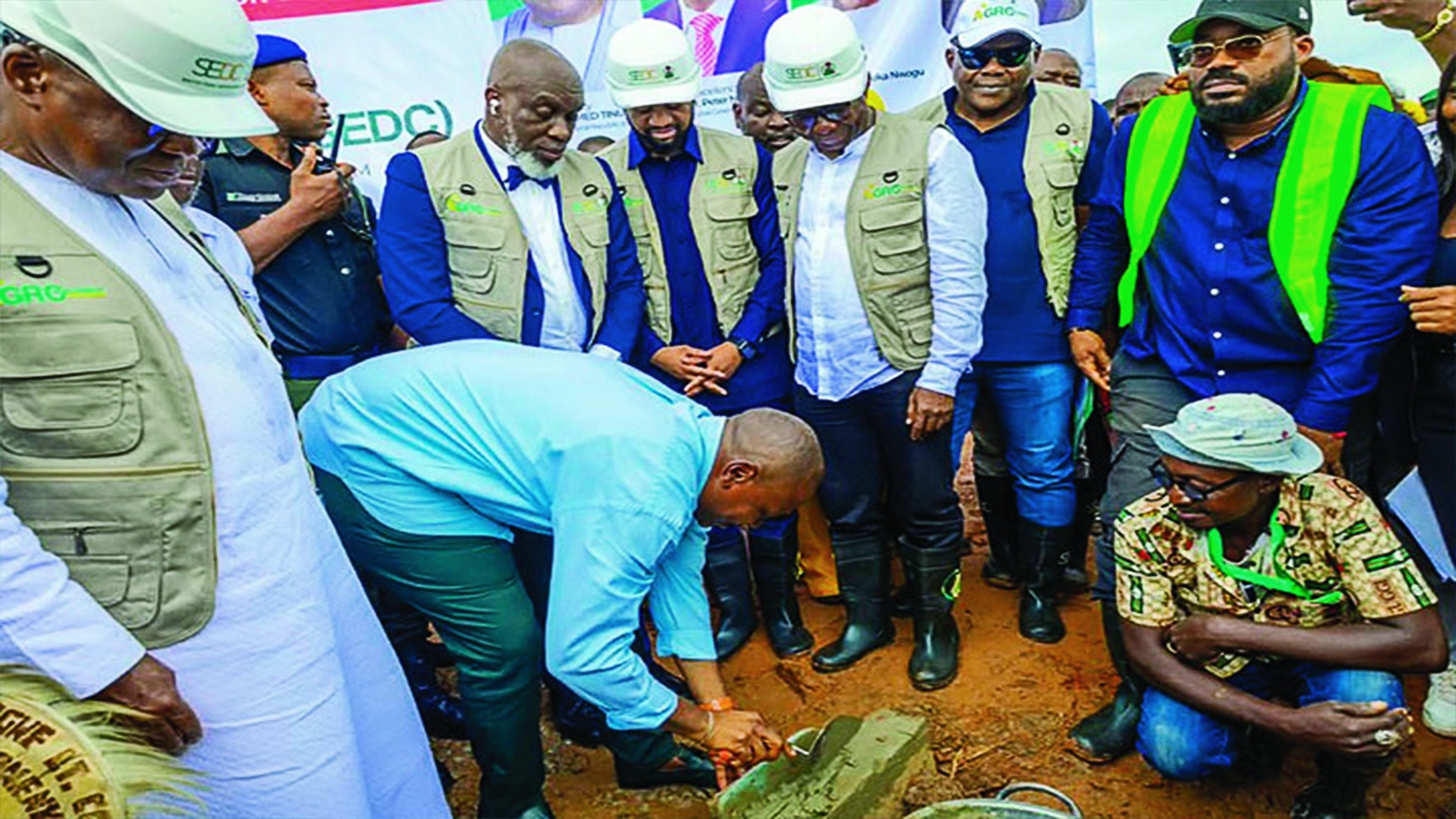
Meanwhile, preceding the gas pipeline launch were the 200-hectare agro-mechanisation projects, one in each of the three senatorial zones of Enugu, Abia, Imo, Anambra, and Ebonyi State, in partnership with the state governments.
The Commission stated that it was an effort to reignite the agro-industrial revolution that made the defunct Eastern Region the fastest-growing economy in the world between 1954 and 1964.
The Commission said during the flag-off at Nomeh, Nkanu East Local Government Council of Enugu State that the project would provide numerous direct and indirect job and business opportunities, making agriculture attractive to the youths again.
“We could all recall that the Eastern Region economy was at one point rated as the fastest growing economy in the world. That means that we were ahead of many leading economies of today in terms of growth. And at the root of it was agriculture, thanks to the visionary leadership of the former Premier of the region, Dr Michael Okpara.
“So, after thorough brainstorming sessions, the SEDC came up with a blueprint to restore the region’s lost glory, starting with agriculture,” its Executive Director, Natural Resources, Agriculture, and Rural Development (NRARD), Dr Clifford Ogbede, said at the event.
For decades, the sprawling farmlands of the southeast, which used to be the engine room for palm, cocoa, and rubber, among others, lay unproductive.
Long before oil wealth introduced an era of economic complacency in Nigeria, the former Eastern region was a global agricultural powerhouse as it did not just feed itself, but built a robust economy on palm plantations, rubber and cocoa.
Okoye, the Managing Director of the Commission, said they deliberately designed the programme as a development intervention rather than simply a farming project.
“The South East Agro Development Programme is about building productive capacity of the region”, he said, stressing that the Nomeh facility would bring together dairy, poultry, fisheries, fodder production, greenhouses, processing, mechanisation, and practical agricultural training.
Okoye noted that should the model be sustained, it could address persistent problems confronting agriculture in the region, including poor access to modern technology, fragmented production, limited processing capacity, inadequate market access, and the difficulty many young people face in seeing agriculture as a viable business.
He explained that it would provide an out-grower arrangement through which farmers in surrounding communities could participate in the value chain, receive technical support and connect their produce to markets, stressing that it was important because a major limitation of many agricultural interventions is their tendency to stop at the project site.
With the launch of these ambitious projects, all eyes are now on the Commission to ensure their realisation in line with the objectives of establishing the regional interventionist body.
For Dr Jonah Onwe, a lecturer in the Department of Accountancy at the University of Nigeria, Nsukka (UNN): “I think the Commission is gradually settling down to duty. What it has embarked upon are projects that directly speak to the needs of the region. It would, however, need to drive them to conclusion for the people to believe in the integrity of the body”.
He tasked members with working towards ensuring the full execution of the projects before embarking on any others.
Also speaking, a property lawyer, Jerry Uwa, stated that funding was key to the projects launched by the Commission, stressing that the members must look beyond yearly budgets to realise the initiatives.
“This is just an aspect of the many challenges in the southeast region. But beginning with these infrastructures, which are revenue-yielding, is in order. It is important that we see them work and not end on paper”, he said