

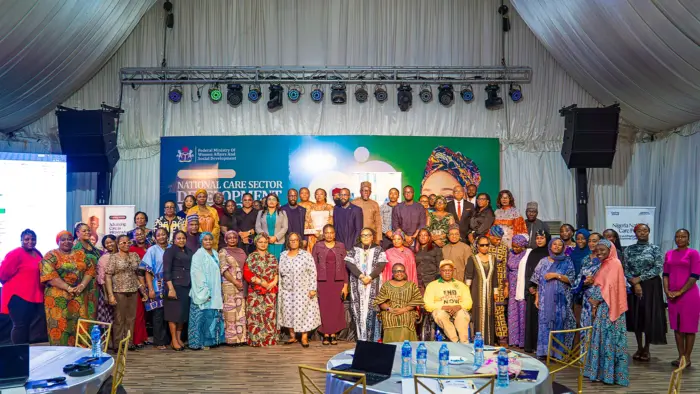
…seeks implementation across 36 states
Caring Africa has welcomed the Federal Government’s approval of Nigeria’s first National Care Policy and Implementation Plan, 2026–2030, describing the development as a significant milestone in recognising unpaid care work, strengthening childcare standards and positioning the care economy as a formal sector capable of creating jobs and expanding women’s economic opportunities.
The policy, approved by the Federal Executive Council (FEC), chaired by President Bola Ahmed Tinubu, seeks to establish a national framework for childcare, elderly care, disability inclusion, caregiver protection and investment in care-related businesses.
Minister of Women Affairs and Social Development, Hajiya Imaan Sulaiman-Ibrahim, announced the approval at a press briefing in Abuja marking the 26th anniversary of United Nations Security Council Resolution 1325 on Women, Peace and Security.
The policy was approved alongside the National Action Plan on Ending Violence Against Children and the National Policy on Menstrual Health and Hygiene Management, 2026–2030.
Caring Africa, which served as technical partner to the Federal Ministry of Women Affairs and Social Development during the policy’s development, said the framework represents an important shift in how Nigeria recognises and values caregiving responsibilities, particularly those disproportionately undertaken by women.
Announcing the approval, Sulaiman-Ibrahim said the policy would recognise unpaid care work and promote safe, regulated childcare and elderly care services, enabling more women to participate in employment, education and leadership.

“It means her work is finally recognised, and that safe, regulated childcare and elderly care will free her time to earn, learn and lead,” the minister said.
The National Care Policy comprises 11 pillars supported by a costed implementation plan identifying responsible ministries, performance indicators and delivery timelines through 2030.
According to Caring Africa, a major component of the policy is the formal recognition of care work as an occupation, with provisions for professional classifications, caregiver certification, a national register and pathways to social protection.
The framework also proposes recognition of experience already acquired by informal caregivers and commits Nigeria to pursuing ratification of International Labour Organisation Convention 189 on decent work for domestic workers.
For childcare providers, the policy introduces a framework for tiered licensing and minimum standards covering physical space, staffing ratios, safeguarding and nutrition.
It also provides a pathway for informal childcare businesses to meet regulatory requirements and proposes subsidies to improve access to quality childcare for low-income households.
Beyond childcare, the policy addresses maternal and newborn care, postpartum support, ageing, disability inclusion, employer-supported care services and sustainable financing, including a proposed dedicated care allocation in the federal budget.
The policy is expected to create opportunities for care enterprises, many of which are operated by women, to access formal recognition, business financing and investment.
The development comes amid concerns about the disproportionate burden of unpaid care work on Nigerian women and its implications for economic participation.
Estimates cited by Caring Africa indicate that Nigerian women spend approximately 4.3 hours daily on unpaid care responsibilities, compared with 1.12 hours for men.
The organisation also noted that only five per cent of children aged zero to two are enrolled in licensed childcare facilities, highlighting the shortage of affordable and regulated services.
Research by Economist Impact suggests that improved access to quality childcare could enable an additional 1.7 million Nigerian mothers to participate in the workforce by 2030.
Stakeholders have also cited estimates indicating that formalising the care economy could create as many as 17 million jobs, although achieving this would depend on investment, regulation and implementation.
Reacting to the approval, Founder and Chief Care Officer of Caring Africa, Blessing Adesiyan, said the policy represents an opportunity to address longstanding structural gaps that have left caregivers and care businesses without adequate recognition or protection.
“Nigeria has never lacked caregivers. What we have lacked is a system,” she said.
“For the first time, Nigerian law will recognise care work as work. For the first time, a parent will be able to check whether a childcare facility meets a standard. And for the first time, a woman running a crèche will be able to borrow against a business her government formally acknowledges exists.”
Adesiyan commended the Federal Ministry of Women Affairs and Social Development and the minister for their commitment to advancing the policy, describing the approval process as an important step towards building a coordinated national care system.
She, however, cautioned that the policy’s success would depend on effective implementation beyond the federal level, particularly because many health, education and social welfare services are delivered by state governments.
“Approval is the beginning rather than the end. Health, education and social welfare are delivered at state level in Nigeria. A federal policy that stays in Abuja will not change anything for a woman looking for childcare in Oshodi or caring for her mother in Sokoto,” she said.
“The work now is domestication across the six geopolitical zones and adoption by the 36 states, and that is what will determine whether this policy becomes real.”
Nigeria’s move follows growing international efforts to recognise care as an essential component of economic and social development.
Countries including Brazil, Chile and Kenya have advanced national care policy frameworks aimed at strengthening care services, supporting caregivers and reducing the unequal distribution of unpaid domestic responsibilities.
For Nigeria, the policy provides an opportunity to address barriers that have historically prevented women from fully participating in the labour market, while creating standards for childcare facilities and improving professional opportunities for paid caregivers.
Adesiyan maintained that the next priority must be translating the framework into practical measures that improve the lives of families, protect vulnerable groups and support women-owned care businesses across the country.
Caring Africa, a care economy policy and technology organisation, said it would continue supporting efforts to strengthen the sector through policy development, innovation and partnerships aimed at expanding access to quality care services.
