

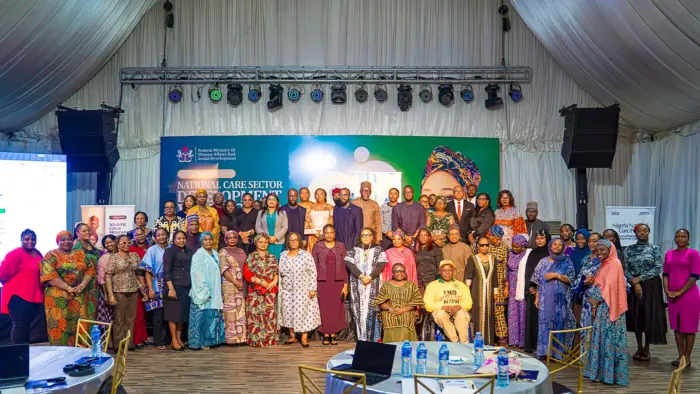
The Federal Government has intensified efforts to establish a national care economy, warning that Nigeria’s failure to recognise, regulate and invest in care work is undermining women’s economic participation, household welfare and national productivity.
The Permanent Secretary, Federal Ministry of Women Affairs and Social Development, Esuabana Nko Asanye, made the submission on Tuesday at the national consultation on the draft National Care Policy held at Wells Carlton Hotel, Asokoro, Abuja.
The consultation, attended by about 100 representatives from government, development partners, the private sector, academia and civil society, is expected to feed into a national framework for organising, financing and regulating care in Nigeria. The draft policy is targeted for submission on October 29, the International Day of Care and Support.
At the centre of the proposed framework is a shift in how Nigeria understands care — from an unpaid, largely invisible household responsibility to an economic sector capable of creating jobs, supporting businesses, strengthening human capital and enabling millions of women to participate more fully in the labour market.
Asanye said the disproportionate responsibility for unpaid care and domestic work continues to fall on women and girls, limiting their access to education, paid employment, entrepreneurship, income and leadership.
“This is not simply a women’s issue. It is an issue of economic efficiency, social justice and national development,” she said.

According to her, millions of women, particularly those in poor and vulnerable households, are forced to choose between earning an income and caring for children, older persons, persons with disabilities and other dependants because affordable care services remain inadequate.
She said Nigeria must therefore begin to treat care as essential economic infrastructure, alongside other systems that enable economic activity.
The proposed care economy encompasses childcare and early childhood development, maternal and newborn care, elderly care, disability support, community and home-based care, as well as the workforce delivering these services.
Beyond addressing household pressures, Asanye said investment in the sector could create employment opportunities for women and young people while opening space for entrepreneurs, cooperatives, social enterprises and private providers.
The economic implications are significant. An estimated 80 per cent of unpaid care work in Nigeria is performed by women and girls, while the country lacks a legal definition of care work, an occupational classification for care workers, a national licensing regime for childcare facilities and a dedicated federal budget line for care.
Nigeria’s National Policy on Women’s Economic Empowerment has also cited an estimate that the country forgoes revenue equivalent to 23 per cent of GDP because women’s care responsibilities keep them out of the labour market.
Childcare access remains particularly limited. Only five per cent of Nigerian children below two years are enrolled in licensed childcare, while enrolment among children aged three to five stands at 15.4 per cent, compared with an OECD average of 87 per cent.
For the Federal Government, closing these gaps will require more than a standalone policy. Asanye called for collaboration across women’s affairs, finance, labour and employment, health, education, social development, housing, infrastructure, agriculture and youth development, alongside private-sector participation.
She also stressed the importance of linking care with social protection, arguing that families should not be pushed into poverty because they have children, older people or relatives requiring intensive care.
Measures such as child benefits, cash transfers, disability support and maternity protection, she said, could reduce the financial pressure associated with care.
The draft National Care Policy contains 11 pillars covering unpaid care and shared household responsibility, maternal and newborn care, childcare and early childhood development, ageing and elder care, disability care, the care workforce, regulation and classification of the care economy, financing, employer-supported care, and trade and industry.
It is supported by a costed action plan identifying responsible ministries, performance indicators and delivery timelines.
Director of Child Development at the ministry, Ali Andrew Madugu, described the care economy as an opportunity to create decent jobs, empower women and strengthen Nigeria’s human capital.
The consultation was structured as a working session rather than a policy launch. Stakeholders reviewed the draft framework and proposed amendments, including the integration of the National Agency for the Prohibition of Trafficking in Persons and the National Orientation Agency.
Participants also debated the proposed certification framework for care workers, particularly the risk of excluding caregivers without formal education. The provision is being revised to allow certification based on demonstrated competence, while formal training would provide a pathway for professional progression.
For Blessing Adesiyan, Founder and Chief Care Officer, Caring Africa, the central issue is whether Nigeria is prepared to invest in the system that makes other economic activity possible.
“We build roads so goods can move and power so factories can run. Care is what allows anybody to leave the house and go to work in the first place. It is the infrastructure underneath all the other infrastructure,” she said.
Stakeholders can submit contributions to the draft policy through nigeriacarepolicy.org.
