

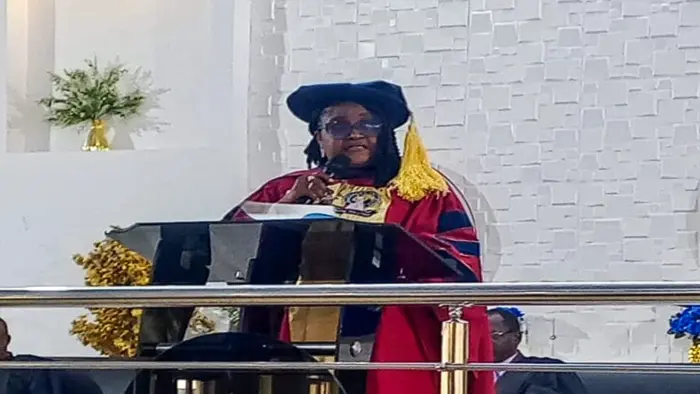
Professor Oluwatoyin Olatundun Ilesanmi, a Professor of Gender and Humanitarianism at Redeemer’s University, Ede, Osun State, has called for a fundamental shift in Nigeria’s approach to humanitarian response, urging government institutions and humanitarian agencies to integrate gender accountability, psychosocial care and human rights into disaster management and national development strategies.
Prof. Ilesanmi made the call yesterday during her 24th Inaugural Lecture at Redeemer’s University, titled, “Vulnerability, Voice, and Valour: Navigating Transformative Frontiers in Gender, Humanitarianism, and Psychosocial Wellbeing.”
The lecture drew on her decades-long scholarly and professional journey spanning psychology, gender studies, humanitarianism and psychosocial wellbeing, with a central focus on protecting the dignity of vulnerable people in situations of conflict, displacement, violence and social exclusion.
According to her, the intersection of gender and humanitarianism is critical because crises do not affect all people equally.
“When gender blindness meets a humanitarian crisis, marginalised groups suffer disproportionately,” she said, explaining that the framework of vulnerability, voice and valour was developed as an analytical continuum that moves from identifying vulnerability, to enabling expression, and ultimately to transformative action.
Prof. Ilesanmi urged humanitarian organisations to move beyond what she described as reactive relief models that focus primarily on the distribution of emergency materials.
She advocated the mandatory integration of psychosocial, clinical and family-sensitive services into emergency response protocols, arguing that humanitarian intervention must address the psychological and social consequences of crises alongside immediate material needs.

She also called on government ministries to recognise that vulnerability is socially distributed and often rooted in structural inequalities that exist long before disasters occur.
According to her, poverty, inadequate housing and age-related inequalities can significantly magnify the impact of disasters, making gender-responsive budgeting and institutional accountability essential components of effective governance.
Prof. Ilesanmi further challenged members of the public to interrogate cultural practices and social attitudes that perpetuate violence and silence survivors, including female genital mutilation and the stigmatisation of survivors of sexual violence.
She said Nigeria’s complex humanitarian landscape, ranging from insurgency, kidnapping and sexual violence to displacement and ecological distress, requires a development model that places human dignity and psychosocial wellbeing at its core.
Drawing from her empirical research, including studies of the Ife-Modakeke crisis, she noted that conventional disaster-response frameworks frequently overlook older people and persons with disabilities.
She therefore advocated structurally inclusive disaster-response systems that guarantee equitable access to recovery opportunities for vulnerable populations.
The professor argued that psychosocial healthcare and gender mainstreaming should not be regarded as peripheral social interventions but as critical components of national economic development.
“A nation cannot build a stable economy when its women and youth are systematically exposed to the psychological shackles of trafficking, modern slavery and severe mental pathologies,” she said.
On nation-building, Ilesanmi urged the Federal and state governments to translate research findings into practical policies and guidelines that can be implemented at the local government level.
She specifically called for the effective implementation and funding of state-level Multi-Sectoral Costed Action Plans under the Violence Against Persons (Prohibition) Act, VAPP, noting that such frameworks must reach communities rather than remain at policy level.
She also advocated reforms within the security sector, particularly training for police and other security personnel in human rights-based and trauma-informed approaches to handling sexual and gender-based violence.
According to her, security institutions must be equipped to respond to survivors safely, confidentially and without reinforcing the trauma they have experienced.
She further proposed what she described as “community-level psycho-architecture”, urging local governments to incorporate safety, accessibility, shelter facilities and other psychosocial considerations into housing and neighbourhood planning.
In her recommendations to key sectors of the Nigerian economy, Ilesanmi called for gender-responsive pedagogy across the education system, stronger anti-sexual harassment mechanisms in educational institutions and independent complaint structures that can protect survivors.
For the health sector, she advocated integrated healthcare models that incorporate mental health and genetic counselling into primary healthcare, while equipping frontline health workers with trauma-informed skills and gender-sensitive protocols for reproductive health and sickle cell disorders.
She also called for every emergency relief operation and internally displaced persons’ camp to have a coordinated multidisciplinary care pathway involving clinical, counselling and family therapy services.
In the justice and rural development sectors, she advocated the removal of structural barriers affecting women’s access to land, markets and development opportunities.
She stressed that women must be included meaningfully, rather than symbolically, in peace processes, conflict negotiations and legislative drafting.
Addressing young people interested in gender, humanitarian and psychological studies, Ilesanmi urged them to approach the fields with intentionality, empathy and a commitment to service.
She described voice as a powerful instrument for transformative change and encouraged young people not to allow personal experiences or the suffering of others to be trivialised or silenced by social stereotypes.
“Voice is the most potent tool for transformative change,” she said, urging young people to become bridge-builders capable of connecting rigorous scholarship with the realities of human suffering.
She also encouraged individuals and civil society organisations to draw on research tools, training manuals and community-based frameworks developed through her work to strengthen advocacy and grassroots mobilisation.
Among these are gender and transformative leadership resources, multi-sectoral action plans and psychosocial support frameworks that can be adapted to community settings.
Prof. Ilesanmi’s work, she noted, also informs postgraduate and professional programmes at the Centre for Gender, Humanitarian and Development Studies at Redeemer’s University, which seek to connect academic training with field-based experience.
Concluding the lecture, she framed her body of work around the relationship between knowledge, care and justice.
“My life’s work has been an attempt to answer one enduring question: How may knowledge serve life? It serves life only when it refuses to let vulnerability remain invisible, insists that care must be highly intelligent, and demands that justice be aggressively embodied in our institutions,” she added.
