 Follow Us on Google News



 Follow Us on Google Discover
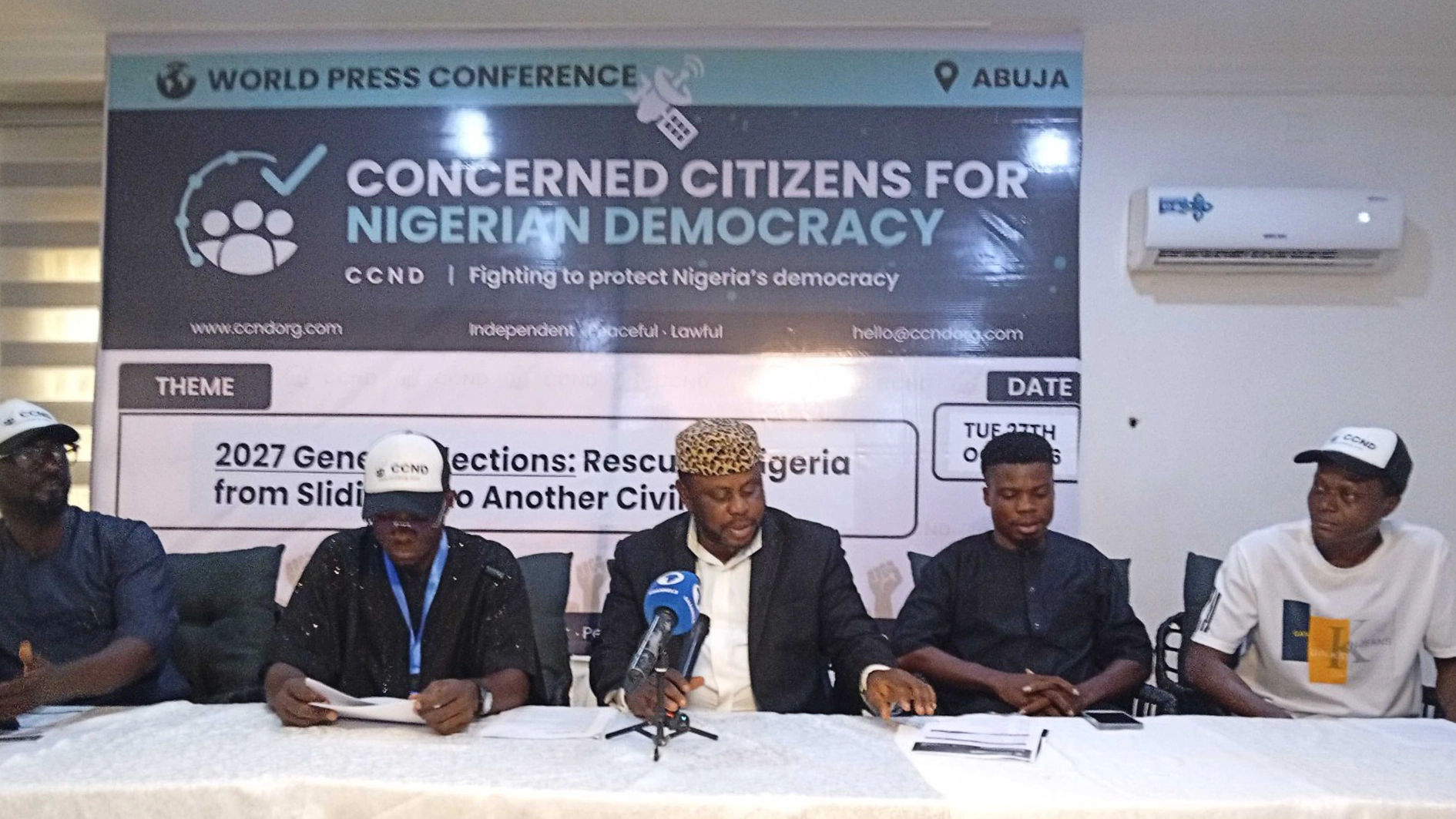
A civil society movement, Concerned Citizens for Nigerian Democracy (CCND), has raised concerns over alleged political partisanship within the electoral system and the conduct of security agencies.
It warned that declining public confidence in the 2027 elections could threaten Nigeria’s stability.
The group called on the Independent National Electoral Commission (INEC) to investigate allegations of political affiliations among some electoral personnel and demanded that security agencies guarantee all candidates equal access to campaign venues.
At a press conference in Abuja on Tuesday, CCND co-convener, Barrister Kingdom Okere, accused the political establishment of failing Nigerians and warned that the country could face another political crisis if the credibility of the electoral process was compromised.
“It is more about survival than anything else. This democracy must not die in our hands,” Okere declared.
He said the All Progressives Congress (APC), which came to power on a promise of change, had left many Nigerians questioning the direction of the country.

“Thirteen years ago, the APC deceived Nigerians with the promise of change. What Nigerians are experiencing today is something difficult to describe,” he said, adding that the situation had become an “abracadabra” for many citizens.
But the group’s central warning was directed at the institutions responsible for delivering and securing the 2027 elections.
Okere alleged that concerns had emerged over the political affiliations of some INEC personnel, particularly those serving in sensitive information technology and election-monitoring departments.
He also questioned whether some recently recruited ad hoc electoral workers had political affiliations that could compromise their neutrality.
The allegations were not independently established at the press conference. CCND urged INEC to investigate them and ensure that electoral appointments and deployments were transparent and based on impartiality.
“INEC must remain independent and conduct free, fair and credible elections in January 2027,” Okere said.
The group also took aim at the police over an alleged attempt to frustrate a political campaign at Unity Fountain in Abuja on Saturday, October 24.
According to Okere, supporters of a prominent presidential candidate had planned to hold a campaign flag-off at the venue when the FCT Commissioner of Police allegedly deployed more than 1,000 officers to the area.
He claimed the deployment was intended to frustrate the gathering, although the supporters later moved to another location and continued their activities.
CCND called for an explanation of the incident and insisted that police protection must not become a means of restricting lawful political activities.
It cited Section 95 of the Electoral Act 2026, as referenced by the speaker, and Sections 39 and 40 of the Constitution, which address freedom of expression and association, in arguing that political parties and candidates should be allowed to campaign without discrimination.
The group also cited reports of a similar incident in Benue State, where a candidate was allegedly asked to obtain the state government’s approval before campaigning.
Okere said such claims required scrutiny, warning that unequal treatment of political parties could undermine confidence in the electoral process.
“Every police commissioner, including the FCT Commissioner of Police, must provide a level playing field for all political parties and candidates,” he said.
‘Nigeria must win before any candidate’
The group’s warning was reinforced by its co-convener, Michael Ademofe, who said public confidence in elections was eroding as the country approached the 2027 polls.
In his opening remarks at the press conference, Ademofe described CCND as a non-partisan citizens’ movement incorporated in the United States, with members across Nigeria’s six geopolitical zones and in the diaspora.
He said the movement was united by the principle that political authority must derive from the people through free, fair and credible elections.
Ademofe warned that growing voter disengagement and the possibility of citizens rejecting results they considered manipulated could create a dangerous atmosphere in a country already facing economic hardship and insecurity.
He cited the violence that followed the 2011 general elections, when more than 800 people were reported killed, as a reminder of the potential consequences of electoral disputes.
The group’s chosen theme for the press conference was “Rescuing Nigeria from Sliding into Another Civil War.”
Ademofe said the warning was intended to prompt action before the elections rather than after a crisis had erupted.
He disclosed that CCND had written to INEC under the Freedom of Information Act, seeking information on matters relating to the electoral process. The details of its requests were not fully available in the supplied remarks.
Economic hardship deepens concern
Beyond electoral integrity, Okere argued that the worsening cost of living had intensified public frustration and made peaceful political competition even more important.
He compared petrol prices of about ₦87 per litre before the APC administration with prices of between ₦170 and ₦190 per litre at the end of former President Muhammadu Buhari’s tenure, saying prices had since risen to between ₦1,400 and ₦1,500 in some locations.
The figures were presented by Okere and were not independently verified at the press conference.
He said the hardship affected Nigerians regardless of ethnicity or religion, arguing that politicians should not exploit social divisions while households struggled with the cost of fuel, food and other essentials.
“Poverty does not recognise tribe or religion,” he said.
Okere also alleged that the 2023 presidential election was compromised and criticised what he described as a pattern of political appointments rewarding individuals perceived to have helped those in power. He did not present evidence at the event to establish those allegations.
The group urged INEC, the police, the Department of State Services, the Nigeria Security and Civil Defence Corps, the military and other relevant institutions to protect the electoral process and avoid actions capable of undermining public confidence.
It said its advocacy would remain peaceful and lawful, stressing that citizens should be able to demand accountability without violence or confrontation.
“Nigeria must win before any candidate wins,” Okere said, urging political leaders and electoral institutions to place national stability above partisan interests.
CCND called on Nigerians to remain engaged in the democratic process and urged public officials, political parties and civil society organisations to work towards credible elections.
The group said its objective was to help preserve democratic institutions and prevent political tensions from escalating into a wider national crisis.

