• NCAA earns N18,000 per domestic ticket
• Six charges built into a single air ticket
• Nigeria’s airfares among the world’s highest
The journey to achieving affordable air travel has been complicated by fiscal hurdles, with over 54 taxes accounting for 35 per cent of the airfare cost in Nigeria.
The tax burden has reduced travelling options for millions of average Nigerians, who also have to contend with insecurity and poor road networks if they choose to travel by road.
The development has already been compounded by looming airfare increases going into the new year, due to the planned implementation of the new tax law.
Stakeholders in separate interviews yesterday told The Guardian that the cost of flights may remain higher in Nigeria compared to Ghana, Kenya, Ethiopia, South Africa, the United Kingdom, the United States, and others.
While only six of these levies are directly visible to passengers, the remaining 48 are silently embedded into air ticket prices, paid by airlines to government agencies, and inevitably passed down to the flying public, multiple sources explained to The Guardian.
The cumulative effect has been devastating for airlines, who said the remaining 65 and 70 per cent of revenue goes into fulfilling other obligations, including the purchase of Jet A1, leaving consumers with exorbitant air prices.
The 54 taxes and fees are spread across four major government agencies, the Nigeria Civil Aviation Authority (NCAA), the Federal Airports Authority of Nigeria (FAAN), the Nigerian Airspace Management Agency (NAMA), and the FIRS and are built into the air tickets payable by travellers through the airlines.
While airlines and passengers in Nigeria are subject to astronomical fees, their counterparts in Europe and Africa pay far less for the same or better services, with taxes ranging from two to three times lower.
The charges, according to a document obtained by The Guardian, are divided into aeronautical and non-aeronautical revenues, as FAAN collects approximately 18 separate payments from airlines.
These range from electricity and counter usage charges — $7 per hour to boarding bridge fees pegged at $250 per use, rent per square meter (office) – Abuja N75,000, Lagos N50,000 and Port Harcourt N55,000 and Service Recovery Charge 20 per cent.
Airlines also pay for Common User Terminal Equipment (CUTE) at $1.40 per passenger, along with Passenger Service Charges (PSC) of N2,000 for domestic and $150 for international passengers, according to the document.
Other payments include the apron pass (Abuja – N250,000), (Lagos – N150,000), and Port Harcourt – N125,000 per vehicle, paid yearly. Companies also pay a yearly registration fee of N500,000 for an on-duty card (ODC) and an additional N25,000 per staff member yearly. There are extension charges (N100,000), air cargo charge (ACC) charge (N5 per kg), cargo registration fee (N250,000), non-refundable processing fees (N50,000), and port charge (N7 per kg).
There are various other charges imposed on aircraft, operators, and personnel, which are eventually passed on to travellers. For NAMA, airlines pay five different charges: en–route charges (between N7,751.80 and N15,150.23), terminal navigation charges (N6,788.23), overflight charges, clearance charges, and extension charges, all of which are paid on a per-flight basis.
Besides, the airlines pay about 30 taxes, fees and charges to the NCAA regularly. The charges are five per cent ticket sales charge (TSC), five per cent cargo sales charge (CSC), five per cent excess baggage charge (EBC), medical certification issue/renewal fee (N5,000 per crew), cabin crew license issue/reissue (N7,500), aircraft type inclusion on license – N5,000 (per type), among others.
Others include cabin instructor authorisation/renewal fees, cabin instructor inclusion on authorisation fees, training facility validation fees, inspection/approval for training facilities in the United Kingdom for pilots, and approval learning centre fees.
The NCAA also charges an airline transport pilot licence (ATPL) fee, a commercial pilot licence (CPL), a renewal instrument rating, an initial validation, a revalidation fee, an air law exam fee, a medical fee, an additional aircraft type charge, and a replacement of licence, while simulator training is free.
Still on the NCAA list of charges are certificate of airworthiness (C of A) renewal charges, aircraft engineer licence validation, aircraft engineer licence validation renewal (foreign engineer), approved maintenance organisation (AMO) charge ($13,440), air operators certificate (AOC) fee, reservation of registration mark charges, import charge and export charge.
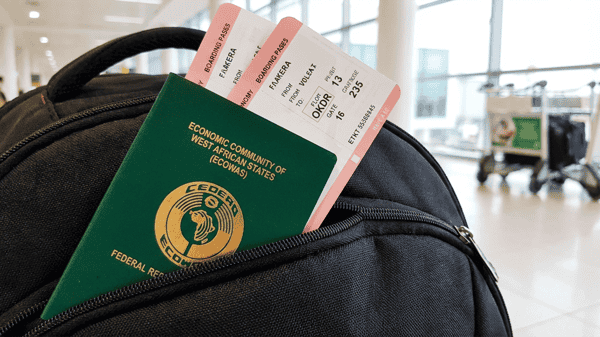
Out of the 54 taxes, fees and charges, six are directly built into every air ticket sold in Nigeria by the airlines.The charges are passenger service charge (PSC), common user terminal equipment (CUTE) fee, passenger terminal facility charge (FAAN), ticket sales charge (TSC), five per cent of excess baggage charge (EBC) and $20 security levy and the newly introduced $11.5 advance passenger information system (APIS) levy, which took effect on December 1.
The NCAA charges alone add between N18,000 and N25,000 to the cost of a domestic ticket per passenger, while for international flights, all the charges run into about $150 to $180 per passenger, making Nigerian tickets among the most expensive in the world.
Additionally, searches conducted by The Guardian reveal that countries such as Ghana, South Africa, Kenya, the United Kingdom, and the United States pay significantly lower levies and charges to their governments and agencies compared to their Nigerian counterparts.
In these countries, taxes, fees and charges are between two and three, but in most African countries, the charges/levies are mostly two. For instance, in Ghana, charges built into air tickets are two – APSC (a statutory passenger tax/charge collected for departures and passenger safety/security charges — set by the Ghana Civil Aviation Authority (GCAA).
For Kenya, travellers pay an air passenger service charge of $50 (international), while for domestic flights, it is $ 4.60. Additionally, airport and security charges are charged per passenger at the East African airports.
Also, for Ethiopia, the typical charges are Airport Departure Tax and airport passenger charges.In South Africa, typical charges are Air Passenger Tax (APT) — a government tax on passengers departing South Africa. The sum is collected and remitted by each air operator.
The APT has fixed amounts of ZAR 100 ($5.78) for some regional destinations and ZAR 190 (about $10.86) for other international destinations.
The other charge is Airport Passenger Service Charges, which is charged by airport operators.
For the United States, the Federal Transportation Excise Tax is 7.5 per cent of the base fare (applies to most taxable passenger transportation); security fee and Passenger Facility Charges (PFCs) at $4.50–$18 each, depending on airport and projects.
In the United Kingdom, the typical charges are Air Passenger Duty (APD) duty charged on passengers departing UK airports. Rates depend on destination band (domestic, band A/B/C) and class of travel (reduced/economy/standard/higher).
Additionally, there are Passenger Service Charges, which are set by airports and included in air tickets. The Director, Operations at Cargolux Airlines, Kingsley Nwokoma, said that the high number of taxes from Nigeria was driving up air ticket prices.
Nwokoma, in an interview with The Guardian, said that these taxes and charges are transferred to passengers who are already overburdened with the high cost of tickets in Nigeria, which is not comparable with other countries.
Nwokoma appealed to the government to review the multiple taxes in the sector to encourage tourism and leisure travellers, adding that the government needed to promote ease of doing business in the industry.
He added, “IATA recently complained that the cost of doing business in Nigeria is high. The taxes would exacerbate the whole situation, given that Nigeria is one of the highest in the region due to multiple overlapping levies.
“We see situations where passengers pay more taxes and fees than the base airfare itself. Times are economical. Government should not continue to add more burden on the flying passengers who are already overburdened under the present circumstances.”
Besides, the Managing Director of Scribe Global Services, Gbemisola Akinboro, said that many passengers had simply dropped out of the flying market due to the high levies and charges.He insisted that some of the intending air travellers are returning to the road despite the glaring insecurity in that mode of transportation.
Akinboro explained that for airlines, the impact was severe, as operators also contend with aviation fuel prices, foreign exchange shortages, and high aircraft leasing costs. He added, “Air travel is gradually becoming unaffordable to many. A family of three may need about N450,000 or more for a one-way ticket. Except for a few who are working for the government, appointees and recognisable businessmen, most are going by roads to their destinations.”
The Managing Director of Aero Contractors, Capt. Ado Sanusi lamented that aviation was one of the most taxed industries in Nigeria. Sanusi explained that the taxes and charges were making the industry unattractive to the flying public, while also slowing down productivity in the sector.
He noted that the industry has a strong multiplier effect, stressing that every flight supports multiple downstream activities — including airports, ground handling, catering, logistics, maintenance, and tourism.
“When costs rise and demand drops, that entire ecosystem feels the contraction,” he said. Also, the Managing Director of TopBrass Aviation Ltd, Capt. Roland Iyayi, in a recent interview with The Guardian, said that government agencies must stop viewing airlines as cash cows.
According to him, FAAN, NCAA, and NAMA all collect charges from the same operators, stressing that each of the agencies wants to generate independent revenue, which he argues defeats the purpose of sectoral development.
“If we must grow aviation, we need an integrated charging system where all levies are transparent and rational,” he said. Besides, aviation analyst, Mr Chris Amokwu, mentioned multiple taxation as the major challenge confronting the operators.
According to him, about 30 to 40 per cent of ticket sales go for taxes and levies, while another 40 per cent is spent on aviation fuel by the operators.
“So, how do you want them to make a profit? You cannot just increase your ticket fares as this will put lots of passengers in trouble. If the multiple taxation, charges and high cost of fuel are not addressed, the nation’s airlines will continue to go under,” he said.