 Get Guardian on Google
Former presidential spokesman, Femi Adesina, has urged Nigerian journalists to avoid giving terrorists and promoters of ethnic and religious hatred undue publicity, warning that irresponsible reporting could threaten national security and fuel conflict.
Adesina said the media must balance its duty to hold government accountable with the responsibility to promote peace, national unity and public confidence.
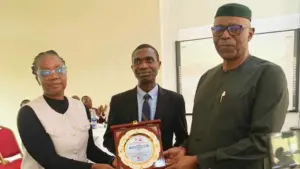
He spoke while delivering a paper titled Media, Conflict and National Security: The Journalist’s Role in a Changing Security Landscape at the second NUJ OGBC Annual Lecture held at Iwe Iroyin Hall, the Nigeria Union of Journalists Press Centre, Abeokuta.
He urged media organisations to give less attention to individuals promoting ethnic and religious hostility and more coverage to voices advocating peace and national cohesion.
“I am not asking anybody to ignore the reality we live in and become propagandists for the government, no. Instead, we must be truthful and realistic,” he said.
Adesina argued that responsible journalism required a balance between reporting the country’s challenges and recognising areas of progress. He warned that persistent negative narratives could discourage national development.
He said Nigeria had considerable economic, political and social potential, adding that the media had a duty to help the country realise its ambitions through accurate reporting and constructive engagement.
To illustrate the dangers of irresponsible broadcasting, Adesina cited the 1994 Rwandan genocide, during which Radio Rwanda and the privately owned Radio Télévision des Mille Collines broadcast messages that fuelled ethnic hatred and violence.
He said the tragedy showed how media platforms could become instruments of destruction when journalists abandoned professional and ethical standards.
He contrasted the Rwandan experience with the role of Radio Kudirat during Nigeria’s pro-democracy struggle, describing it as an example of how broadcasting could support democratic development.
“Same platform, very different outcomes,” he said, urging journalists to remain conscious of the power of their profession.
Adesina also recalled a 1985 speech by former British Prime Minister Margaret Thatcher to the American Bar Association, in which she warned against giving terrorists what she called the “oxygen of publicity”.
He said the warning remained relevant, particularly as traditional media organisations competed with social media platforms for audience attention.
“There is no justification for media houses and professionals of mass communication acting as spokespersons and loudspeakers for terrorists,” he said.
He also urged journalists to recognise the sacrifices of the Nigerian Armed Forces and other security agencies when reporting security operations.
Adesina questioned why attacks by Boko Haram and other security threats often received extensive coverage while the successes and sacrifices of security personnel attracted less attention.
He warned against allowing sensationalism to determine news priorities, stressing that media coverage should also examine the causes of insecurity and highlight efforts to achieve peace.
The former presidential spokesman further cautioned against clickbait headlines, presenting opinions as facts and spreading misleading information to attract online engagement.
He urged journalists to uphold the basic principles of professional journalism, particularly the distinction between facts and opinions.
“Opinions are free but facts must always remain sacred,” he said.
Adesina noted that the internet and social media had transformed communication into an interactive process, allowing audiences to respond to and influence information.
He said the development had increased the responsibility of journalists, who must now contend with misinformation, instant reactions and the rapid spread of unverified reports.
He urged media practitioners to adapt to the changing environment without abandoning professional ethics.
Reflecting on the Nigerian media’s contribution to national development, Adesina recalled its role in documenting military coups, the struggle against military rule and the country’s return to democracy in 1999.
He also described Nollywood as one of Nigeria’s major instruments of cultural influence and soft power across Africa.
Adesina cited former journalists who ventured into politics and governance, including Lateef Jakande, Bisi Onabanjo and Olusegun Osoba, as examples of the profession’s contribution to public life.
He stressed that holding government accountable should ultimately help improve public institutions and strengthen the country.
According to him, constructive criticism and responsible reporting can go together, as journalists can expose wrongdoing while acknowledging genuine achievements.