 Follow Us on Google News


 Follow Us on Google Discover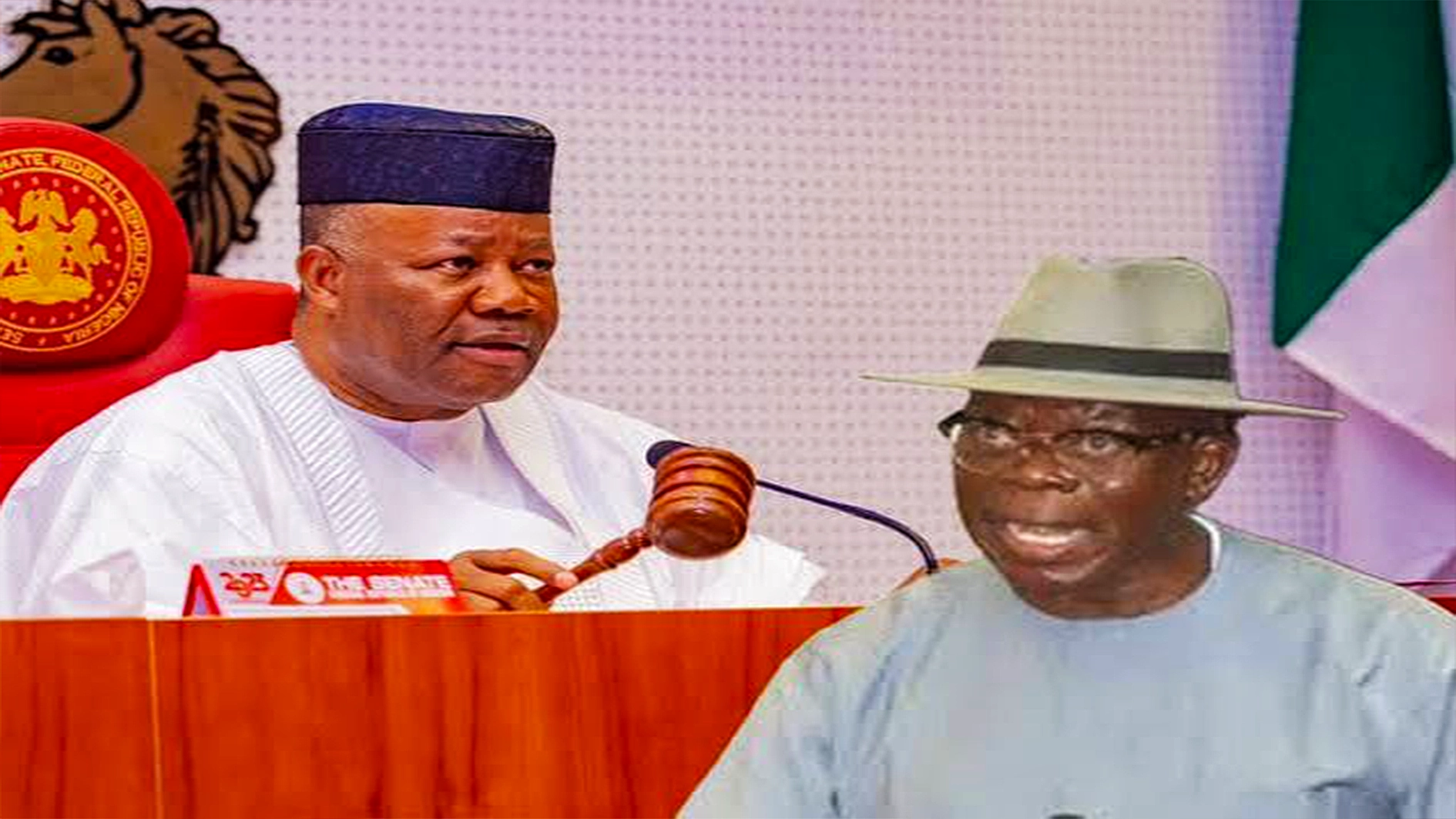
What began as a light-hearted exchange between Senate President Godswill Akpabio and Senator Adams Oshiomhole (APC, Edo North) on Thursday evolved into a broader debate over the Senate’s oversight powers, consistency in enforcing legislative authority and the relationship between the leadership and rank-and-file lawmakers.
The atmosphere of reconciliation between Akpabio and Oshiomhole was punctuated by renewed questions over the Senate’s earlier decision to overturn a purported warrant of arrest issued against former Nigerian National Petroleum Company Limited (NNPCL) Group Chief Executive Officer, Mele Kyari, with Senator Mohammed Ogoshi Onawo (PDP, Nasarawa South) accusing the leadership of sending mixed signals to government agencies that routinely ignore legislative summons.
The issues arose during consideration of a substantive motion sponsored by Senator Sani Musa (APC, Niger East), who called on the Senate to invoke its constitutional powers against Ministries, Departments and Agencies (MDAs) that have consistently failed to submit audited financial statements, render accounts or honour invitations from the National Assembly.
While supporting the motion, Onawo argued that the Senate could not effectively demand accountability from defaulting agencies while appearing reluctant to fully back its own committees in enforcing legislative summons.
He specifically referred to the controversy surrounding the Senate Public Accounts Committee’s attempt to compel the appearance of former NNPCL Group Chief Executive Officer, Mele Kyari, noting that the subsequent reversal of the committee’s arrest warrant had weakened the authority of the legislature.
According to him, the action of the leadership had inadvertently aided and abetted the culture of impunity among MDAs, many of which now appeared emboldened to ignore invitations from the National Assembly.

His intervention reopened one of the Senate’s most contentious recent disputes.
The controversy began during the Public Accounts Committee’s investigation into over ₦210 trillion in disputed audit entries contained in NNPCL’s audited financial statements covering the period between 2017 and 2023.
Frustrated by Kyari’s repeated failure to appear before the committee despite several invitations, Oshiomhole demanded stronger action, declaring that lawmakers should “bring Mele Kyari here, dead or alive.”
He also described some NNPCL officials as “a bunch of criminals and thieves,” after reacting angrily to comments by the company’s Chief Financial Officer, Dapo Segun Ajiya, who had suggested that lawmakers frequently sought employment opportunities for their children within the national oil company.
The remarks immediately generated national controversy.
The Senate subsequently distanced itself from both the purported arrest warrant and Oshiomhole’s comments.
Leading the motion, Senate Leader Opeyemi Bamidele argued that under the Legislative Houses (Powers and Privileges) Act, only the Senate President has the authority to issue a warrant of arrest on behalf of the Senate.
He also warned that comments appearing to pronounce individuals guilty before the conclusion of investigations could undermine the credibility of the National Assembly and create the impression that lawmakers had already prejudged issues before them.
It was against that backdrop that Akpabio and Oshiomhole publicly signalled a thaw in their relationship during Thursday’s plenary.
The reconciliation unfolded after Oshiomhole rose on a point of order and jokingly complained that the Senate President had already breached a private peace agreement by repeatedly refusing to recognise him whenever he raised his hand to contribute.
The former Edo State governor also humorously accused Akpabio of failing to adequately protect senators who were “vertically challenged,” drawing laughter across the chamber.
Responding, Akpabio denied deliberately ignoring Oshiomhole, explaining that another senator had earlier caught his attention.
He then publicly reaffirmed his respect for the former Edo governor. “I will never refer to the un-senatorial comments of ‘bringing the man dead or alive,’ but I want to assure you that this chair will protect everyone, every single senator,” Akpabio declared.
Describing Oshiomhole as “my brother, my friend and my colleague when we were governors,” Akpabio said he held him “in very high esteem.”
He added jokingly that their reconciliation would endure. “Agreement is agreement. I will not behave like America and Iran, where they will have an agreement today and two days later they will bomb each other.”
The exchange represented a remarkable turnaround after weeks of visible disagreements between both APC leaders.
Only days earlier, they had clashed during Senate consideration of President Bola Tinubu’s nomination of former Federal University Oye-Ekiti Vice-Chancellor, Prof. Abayomi Fasina, as a non-career ambassador.
Oshiomhole had argued that the Senate should suspend Fasina’s confirmation pending the determination of sexual harassment allegations against him.
Akpabio rejected the proposal and, in a moment of levity, revived the controversy surrounding a viral video allegedly showing Oshiomhole massaging the feet of South African influencer Leshaan Dagama aboard a private jet.
The joke drew laughter but fuelled speculation that relations between both lawmakers had deteriorated significantly.
Thursday’s proceedings, however, suggested that while the personal differences between Akpabio and Oshiomhole may have been resolved, the wider institutional debate over how aggressively the Senate should enforce its oversight powers against non-compliant government agencies remains far from settled.
Indeed, Onawo’s intervention underscored growing concerns among lawmakers that unless the Senate consistently backs its committees and firmly enforces its constitutional powers, repeated resolutions directing MDAs to appear before the legislature may continue to be ignored, thereby weakening parliamentary oversight and accountability.

