• Party leadership seeks Tinubu’s intervention over state’s crisis
• Wike lacks authority in party affairs, APC leaders insist
• APC scribe asks FCT minister to resign, rejects corruption allegations
• Rivers deputy governor, SSG formally join APC
• Analysis: Fubara’s APC defection and shrinking space for Wike in Rivers politics
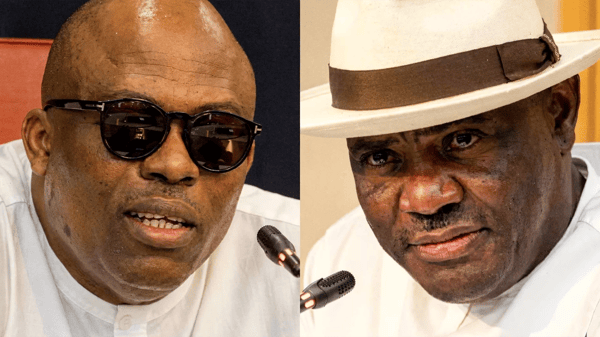
The All Progressives Congress has moved to curb FCT minister Nyesom Wike, warning that his actions in Rivers State threaten party unity, undermine Governor Siminalayi Fubara and could force President Bola Tinubu to choose between his government and the party.
“We may ask the President to choose between us and his FCT minister if Wike continues to behave as if only he can serve the political interests of the President in Rivers State or any other state for that matter. He is not a member of this party,” a member of the APC National Working Committee (NWC) stated.
A fresh political rift recently broke out between the incumbent Governor, Siminalayi Fubara, and his predecessor, the minister, following Wike’s disapproval of the APC convention that saddles state chief executives with the responsibility of leading the party in their domains.
Speaking during a “Thank You” visit to Oyigbo Local Council of Rivers State, the former Rivers State governor warned political opponents, particularly APC leaders, to stay away from Rivers politics.
He described any interference in the state as risky, claiming that previous attempts to challenge political forces in Rivers had ended badly. He also praised the unusual cooperation between the APC and the Peoples Democratic Party (PDP) in the state, presenting it as a political model he said he had successfully implemented.
“Let anyone who has the capacity to unite two major political parties in a state come out and show that it can successfully merge the APC and PDP to work together. If it is easy, try it and see what it takes. This is the only state where you see the two major political parties working together,” Wike boasted.
However, apparently piqued by what he viewed as a degradation of his status as a mere appointee of the APC-led Federal Government, which he believes robs him of the authority to dictate political direction in the state, Wike declared that all occupants of political offices, including the governor and chairmen of political parties, should be subject to him.
In response, APC leaders, including the Vice President, Kashim Shettima, said that since the FCT minister is not an APC member, he should restrict himself to his official duties and to the troubled PDP, where he claims membership.
In a statement, the APC National Secretary, Ajibola Basiru, asked the minister to resign his appointment, stressing that his position on the leadership structure of the APC in Rivers State was being deliberately misrepresented by Wike to achieve mischievous ends.
The APC scribe maintained that the convention, which recognises sitting governors as leaders of their parties in their respective states, is long-standing and does not amount to meddling in Rivers’ politics. He described Wike’s actions as excessive and unbecoming of a serving minister.
“It is shocking that such an innocuous statement can elicit such uncouth responses from no less than a member of the Federal Executive Council,” Basiru said, adding that Wike’s remarks amounted to clear interference in Rivers APC affairs, which he insisted was inappropriate given that the minister is not a member of the party.
The scribe stated, “Our records clearly show that Minister Nyesom Wike is not a member of the APC. As National Secretary, I am mandated to protect the interests of the party and its structures across the federation. My comments on Rivers APC cannot be construed as interference in Rivers State affairs.”
Basiru also rejected allegations by the FCT minister that he and other APC leaders were scrambling for a purported N600 billion in Rivers State, describing the claim as cheap blackmail that should be substantiated.
“My background and track record are of unquestionable integrity. He should prove his allegation or meet me in court,” Basiru said.
Responding to what he described as veiled threats from Wike, the APC scribe said he would not be intimidated and reminded the former Rivers governor that political power is transient.
While noting that Wike’s support for President Bola Tinubu does not automatically confer APC membership on him, Basiru remarked that millions of Nigerians who are not APC members also supported the President.
“His alleged attempts to destabilise the APC in Rivers State will not be tolerated. The honourable thing for him to do is to resign his appointment as minister and pursue his political interests outside the APC,” Basiru added.
His comments came days after Tony Giadom, during Wike’s thank-you visit to the people of Gokana Local Government Area last Tuesday, openly asserted that Governor Siminalayi Fubara would need to go through the Minister of the Federal Capital Territory (FCT), Nyesom Wike, to achieve any political success in the state.
Giadom described the FCT minister as a “dependable leader” and declared that Gokana LGA was firmly under Wike’s influence.
“I guarantee, on behalf of my brothers, that the Gokana people are for Wike and Tinubu, and nobody will challenge Wike’s influence in Gokana. Gokana is a ‘no-go area’ for anybody, even Governor Fubara. For him to win anything in Gokana, he must pass through Wike,” Giadom said.
The Ambassador of the Renewed Hope Family in Rivers State, Desmond Akawor, who also spoke during the minister’s tour, alleged that Oyigbo had witnessed no meaningful development since Wike left office. Speaking in the Oyigbo native language, Akawor told Governor Fubara to prepare to vacate Government House next year, claiming that the people would not vote for him again.
He commended Wike for what he described as the liberation of the area, noting that Oyigbo might have suffered regular shutdowns similar to those experienced in parts of the South-East if not for Wike’s intervention.
Chairman of Oyigbo Local Government Area, Okechukwu Akara Nworgu, described Wike’s political decision as timely and beneficial, assuring him of the people’s continued loyalty.
“For all you have done for us, we will do exactly what you ask us to do,” he said.
Meanwhile, the incumbent Deputy Governor, Dr Ngozi Odu, and the Secretary to the State Government (SSG), Dr Benibo Anabraba, officially joined the APC yesterday.
While Dr Odu completed her registration at Ward 8, Unit 11, Akabuka town, in Ogba/Egbema/Ndoni Local Government Area, Dr Anabraba registered at Ward 1, Unit 1, Bob-Manuel’s Compound, Abonnema, in Akuku Toru Local Government Area.
Speaking after his registration, the SSG said the exercise formally affirmed his membership of the APC and would enable him to participate fully in the party’s activities. He noted that the move would also strengthen his support for Governor Fubara’s “Rivers First” agenda and for President Bola Tinubu’s Renewed Hope Agenda.
He expressed optimism that enhanced synergy between the Rivers State Government and the Federal Government would yield greater dividends for the people of the state.
Fubara’s APC defection and shrinking space for Wike in Rivers politics
The political elopement of the Minister of the Federal Capital Territory (FCT), Nyesom Wike, from the Peoples Democratic Party (PDP) to the All Progressives Congress (APC) upset the power dynamics in Rivers State. It also weakened the PDP nationally.
For nearly two years after the 2023 elections, Wike appeared firmly in control of Rivers politics from Abuja, leveraging his closeness to President Bola Tinubu and his cabinet position to undermine his successor, Governor Siminalayi Fubara, while keeping the PDP structurally fragile in the state.
However, the recent defection of Governor Fubara to the APC, alongside key PDP stalwarts, has fundamentally altered that balance. The move threatens Wike’s long-standing dominance in Rivers and raises serious questions about his future relevance, both within the state and in the broader national political equation.
From PDP strongman to internal disruptor
Wike’s ascent within the PDP was built on raw power and centralised control. As governor of Rivers State between 2015 and 2023, he dictated party structures, enforced discipline, and turned the state into one of the PDP’s most dependable strongholds. His influence peaked ahead of the party’s 2022 presidential primaries.
That dominance collapsed when he lost the PDP presidential ticket to former Vice President Atiku Abubakar and was sidelined from the vice-presidential slot. Rather than retreat, Wike launched an open revolt. As leader of the G-5 governors, he worked against the PDP in the 2023 elections, fracturing its southern base and accelerating its internal crisis.
In Rivers, the PDP emerged from the elections weakened, divided and stripped of cohesion. Ironically, Wike’s actions hollowed out the same political structure that had once sustained his authority, creating a vacuum that would later undermine his own leverage.
Alliance with APC and federal backing
Wike’s informal alignment with the APC was formalised with his appointment as FCT minister in President Tinubu’s administration.
For the APC, he was a strategic asset—an opposition heavyweight capable of weakening the PDP and opening political pathways into the South-South. For Wike, the alliance offered protection, relevance and continued influence after leaving office.
From Abuja, he remained deeply involved in Rivers politics, particularly in his bitter struggle with Governor Fubara. Legislative defections, impeachment threats and institutional pressure initially reinforced the perception that Wike still controlled the state’s political machinery. Yet, beneath the surface, that control rested on fragile foundations.
Fubara’s defection: The turning point
Governor Fubara’s defection to the APC marks a decisive shift. For the ruling party, it delivers what Wike could not fully provide: direct control of Rivers through a sitting governor with constitutional authority, grassroots legitimacy and access to state structures.
With Fubara now in the APC, Wike’s strategic value diminishes sharply. He is no longer the bridge between the party and Rivers State; the governor is. In Nigerian politics, power gravitates towards incumbency, especially when it offers electoral advantage and stability.
The defection of PDP stalwarts alongside Fubara further weakens Wike’s local base. Rivers politicians, long accustomed to aligning with power, are recalibrating their loyalties as the centre of gravity shifts.
Wike’s influence has always been rooted in control of party machinery, political structures and loyalists. That control is increasingly difficult to sustain from Abuja, particularly when the governor has embraced the ruling party and secured federal backing. Ironically, the same federal leverage that once empowered Wike now works against him, as institutions are more likely to align with an APC governor than an APC-aligned minister.
As Fubara consolidates his position within the party, Wike risks being reduced to a peripheral actor—visible in national power circles but steadily losing relevance at home.
PDP collapse and Wike’s isolation
Fubara’s defection deepens the PDP’s collapse in Rivers and across the South-South, where all governors are now in the APC. Once the party’s strongest outpost, Rivers PDP is fragmented, leaderless and politically drained.
Yet this collapse offers Wike little consolation. Having presided over the party’s destruction, he is now without a viable political fallback. He remains too estranged from the PDP to return to it and insufficiently rooted in the APC to command it organically. This leaves him politically exposed, caught between two parties without full ownership of either.
The alliance between Wike and the APC has always been transactional, driven by utility rather than ideology or trust. As that utility declines, questions about his long-term place within the APC become unavoidable. Options ahead include a formal defection and struggle for relevance within the party, a realignment with a weakened opposition or third-force coalition, or a gradual retreat into national relevance without local dominance.
Party insiders warn that if Wike continues to insist that Fubara will not secure a second term in 2027, he risks a confrontation with President Tinubu, who needs Rivers State for his re-election. The APC, controlling the federal machinery, is unlikely to allow a minister to jeopardise its hold on one of the most strategic states in the South-South.
Describing Wike as probably the most unfortunate politician in the history of Nigeria’s Fourth Republic, erstwhile PDP national vice chairman, South-West, Eddy Olafeso, said the governor of Rivers played politics faster than the minister by joining the APC, leaving his former boss in the cold.
Olafeso also said APC stalwarts have shown Wike the way out by making it clear that Fubara would be recognised as the leader of their party in Rivers, before Wike resolved to defect to the APC.
“Some of them are even calling for his removal as minister.”
Olafeso said Wike cannot return to the PDP since he has been expelled.