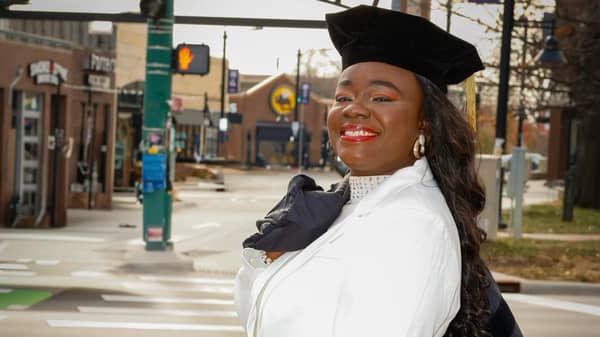
Dr. Chibuzor Mirian Azubuike is a Nigerian-born scholar, educator, and community leader with a Ph.D. in Leadership Communication from Kansas State University. She is the Founder and Executive Director of Light Impact Global Institute and Haske WaterAid and Empowerment Foundation, advancing women’s leadership, resilience, and community empowerment. A prolific writer and speaker, her work bridges scholarship and service, focusing on leadership, gender, migration, and social impact across global contexts.
Childhood Influence
Being the first child and eldest daughter shaped my sense of responsibility from a very young age. Leadership became instinctive. Much of what I do today centers on ensuring that others are supported and protected. The challenge with that role is learning not to disappear in the process. I am now more intentional about balancing care for others with care for myself. That awareness continues to shape my leadership journey.
Bridging Scholarship and Service
My PhD in Leadership Communication was a deliberate choice rooted in practice, not abstraction. Before starting the program, I already had over ten years of experience in community development, particularly in water provision, youth engagement, and women’s empowerment. I took on the PhD because I wanted to build capacity at a deeper level. I needed to be grounded in leadership theory and leadership as practice, not just action. The program strengthened my understanding of leadership as something that is relational, contextual, and co-created. One of the most important ways the PhD shaped my work is through community-engaged research methods. I no longer see development as something that is imposed. I design initiatives by working with people, not for them. Across cultures, this approach allows communities to participate in meaning-making, which leads to solutions that are sustainable because they are rooted in lived experience rather than external prescriptions.
Insights from Resilience Research
One of the core insights from my research is that resilience is not simply resistance or endurance. It is thriving in the face of adversity. Resilience goes beyond tolerance. It is about becoming the best version of yourself, not the version shaped to fit systems that were never designed with you in mind. This insight fundamentally changed how I see leadership and empowerment. My work is not about teaching women to be people’s favorites or to assimilate quietly. It is about building capacity so women can claim their voice, agency, and purpose on their own terms. That understanding continues to guide my teaching, research, and community work. I now focus on helping women recognize resilience as a leadership practice that allows them to grow, create, and thrive, even in constrained or hostile environments.
Founding Light Impact Global Institute
Light Impact Global Institute was born from a gap I kept encountering in practice. I saw well-intentioned programs designed for women, particularly African and migrant women, that lacked grounding in lived experience. There was often a disconnect between theory and reality. I wanted to build an institute that combined rigorous research with hands-on knowledge of community development. One of the gaps I am especially committed to addressing is the support of African migrant women. While encouraging girls to pursue education is essential, it is equally important to equip them with leadership, confidence, and protection from exploitation once they access those opportunities. Education without empowerment leaves women vulnerable. LIGI exists to bridge that gap through research-informed leadership training, fellowships such as the African Graduate Women’s Fellowship, and international outreach programs, including work connected to community wellbeing.
Scaling Grassroots Impact
One of the most challenging lessons has been patience. In many communities in Nigeria, trust has been eroded by years of broken promises and failed systems. People often do not distinguish between government actors and nonprofits. To them, institutions are institutions. I learned that maintaining trust requires humility and consistency. Communities must be seen as the heroes of the story, not the organization or its founder. Real impact happens when people feel respected, listened to, and included. Scaling is not about speed. It is about relationships. That lesson has shaped how I approach every project and partnership.
Storytelling as Leadership
Storytelling is powerful because it shapes meaning. It can be used to harm, to erase, or to misrepresent. But it can also be used to heal, to build, and to restore dignity. Stories emerge from lived experience, and no two stories are ever the same. For marginalized communities, storytelling creates space for visibility and agency. It allows people to name their realities in their own words. Stories also carry lessons. When we listen carefully, stories can help prevent future harm by illuminating patterns, injustices, and possibilities for change. This is why storytelling remains central to my leadership and research work.
Navigating Identity in Global Spaces
I navigate these spaces by embracing my unique positionality rather than trying to minimize it. I am a Nigerian-born scholar, a woman of color, a mother, and someone with hands-on experience in community development. I do not see these identities as weaknesses. I see them as sources of insight and strength. My lived experiences shape how I ask questions, how I interpret data, and how I engage communities. I believe representation is not just about presence, but about whose knowledge is valued and whose voices are taken seriously. Carrying that responsibility is part of my ethical commitment to the work I do.
From Inclusion to Equity
Performative inclusion focuses on appearance. Structural equity focuses on power. Having one “different” face at the table is not enough. Institutions must ask harder questions: Whose voices are being heard? Whose ideas are shaping decisions? How safe do people feel to speak honestly without fear of penalty? Structural equity requires creating systems where diverse perspectives are not only welcomed, but respected, resourced, and integrated into decision-making. It also means recognizing and rewarding innovation that comes from the margins, not just the center.
Balancing Ambition and Service
The first act of service is self-care. Ambition and service cannot be sustained without self-love. Women are often taught to give endlessly, even at the expense of their own wellbeing. That is not sustainable leadership. My advice is simple: treat yourself with the same compassion you offer others. Fulfillment and service flow from wholeness, not exhaustion. Do not put the cart before the horse. When you care for yourself, you are better positioned to serve with integrity and longevity.
Being a Woman of Rubies
I consider myself a Woman of Rubies because of resilience shaped through deeply personal loss. One defining moment in my life was losing my mother. It is a loss I am still navigating. As the first child and first daughter, with no female sibling, my mother hoped to give me a sister because she believed in the beauty of sisterhood. She lived a short but impactful life, prioritizing education and foresight. Losing her while I was still finding my way shaped many of my later choices. I often wish she were here to guide me. That loss tested my courage and character, and it continues to inform the empathy and depth I bring to my work.
Women Who Inspire
Many women have inspired me, but three public figures stand out. Chimamanda Ngozi Adichie has shown the power of voice and narrative. Ngozi Okonjo-Iweala exemplifies integrity, competence, and global leadership. The late Dora Akunyili represents courage and principled service in the face of resistance. What connects them for me is not just their achievements, but how they navigated leadership alongside womanhood and motherhood. I have also been deeply inspired by women mentors in my personal and professional life—scholars, writers, practitioners—who have supported me and modeled resilience. Their lives remind me that strength is often collective and intergenerational.