 Follow Us on Google News


 Follow Us on Google Discover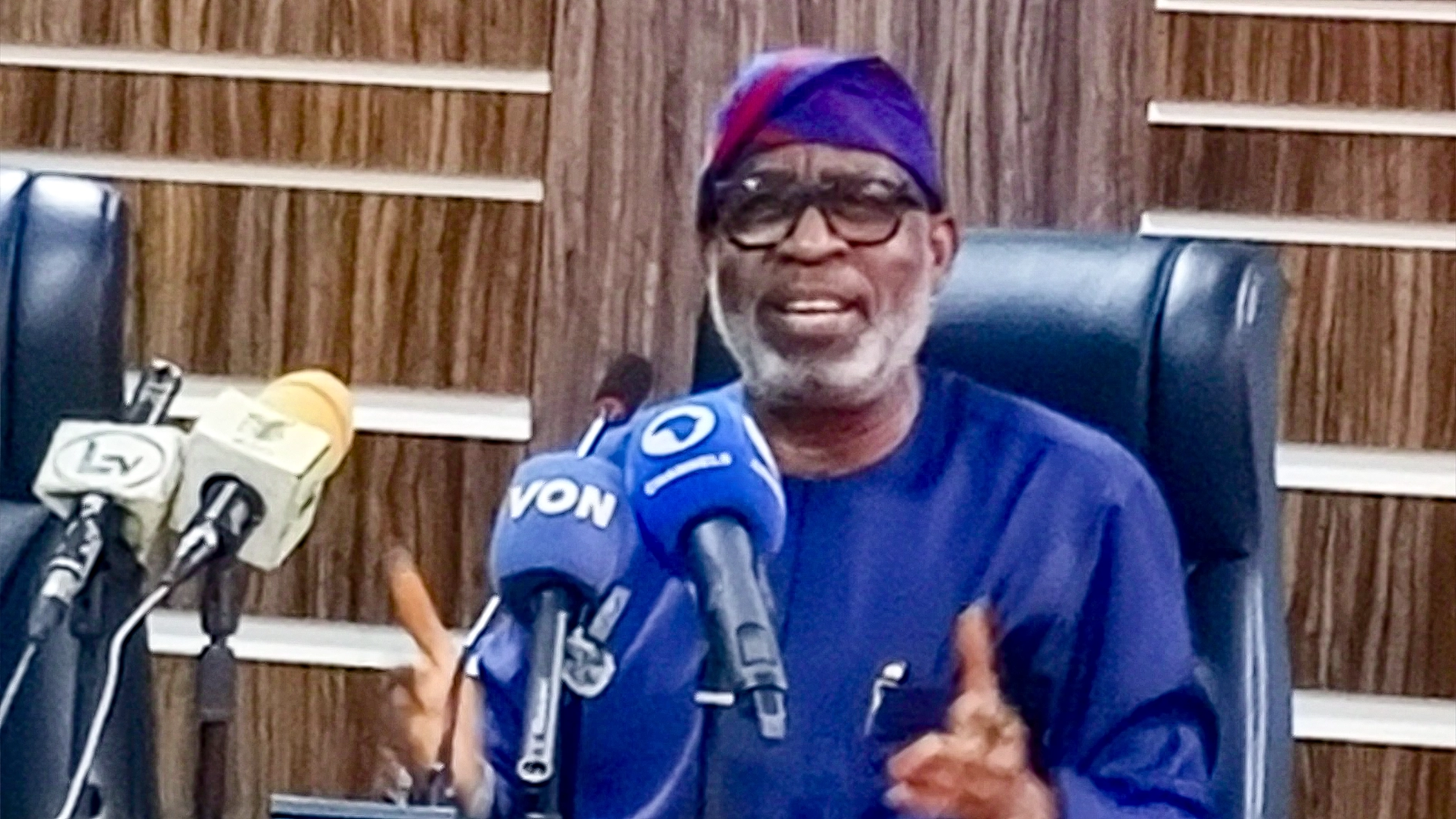
…Insists subsidy removal was necessary to avert deeper economic crisis
Nigeria could have descended into a severe economic crisis requiring citizens to use wheelbarrows to carry money to buy basic commodities like bread if President Bola Ahmed Tinubu had delayed the implementation of his economic reforms, Minister of Solid Minerals Development, Dele Alake, has said.
Alake made the assertion on Wednesday in Abuja during an interactive session with journalists, while defending the Tinubu administration’s decision to remove petrol subsidy and introduce other far-reaching economic reforms.
The minister said the reforms were painful but necessary to correct structural distortions inherited from previous administrations, insisting that there was no shortcut to rebuilding an economy that had been weakened by years of policy inconsistencies and delayed decisions.
According to him, successive governments were aware of the need to reform the subsidy regime and address other economic distortions but repeatedly postponed difficult decisions because of political considerations, particularly fears that unpopular policies could affect their electoral fortunes.
Alake said Tinubu, however, chose to “take the bullet” by implementing the reforms despite the political consequences, arguing that the country could not continue digging itself deeper into an economic hole.

“There will never be the right time, except you have the vision and the knowledge and the courage to take that decision at the psychological moment,” he said.
“If we hadn’t taken that decision, if President Bola Ahmed Tinubu hadn’t done it the day he did it, three, four months thereafter, you would be using a wheelbarrow to carry currencies to buy one loaf of bread.”
He cited the experience of Germany before Adolf Hitler’s rise to power as an example of how severe economic distortions and hyperinflation could destabilise a society, warning that Nigeria must avoid allowing economic hardship to create conditions for authoritarianism.
The minister maintained that the petrol subsidy regime was unsustainable and disputed the widely held perception that ordinary Nigerians were its major beneficiaries.
According to him, wealthy Nigerians with several vehicles benefited more from subsidised petrol than poorer citizens, while organised cartels exploited the price differential by moving petroleum products across borders for huge profits.
“The beneficiaries of the fuel subsidy were the cartels, the oil cartels,” Alake said.
He argued that the subsidy also deprived governments of resources that could have been deployed to infrastructure, social services and other productive sectors of the economy.
Recalling that during the subsidy era, several state governments struggled to pay salaries, while the Federal Government also borrowed to meet its wage obligations, he said the situation represented a major drain on public finances and made reform unavoidable.
The minister likened the process of economic restructuring to childbirth, saying the pain associated with reform was temporary while the eventual benefits could be long-lasting.
“When a woman is in the labour world, she goes through excruciating pain. We call it labour pains. It is natural,” he said, adding that the arrival of a baby eventually overshadows the pain. That is the process of restructuring an economy. You must go through the pain, and then the gains will start to manifest.”
Alake also rejected criticism that the Tinubu administration’s reforms were taking too long to produce results, saying major economic policies required a gestation period before their effects could be felt across society.
He explained that reforms involved policy formulation, mobilisation of financial and human resources, implementation, monitoring and adjustments to emerging challenges.
“You can’t announce a policy today, conceptualise a policy today, and expect the results to manifest tomorrow,” he said.
The minister claimed that the administration had already achieved macroeconomic stability, while some of the benefits were gradually reaching households and individuals.
He cited the Nigeria Education Loan Fund, NELFUND, as one example, arguing that families with children in tertiary institutions were already experiencing relief through access to student loans and allowances.
According to him, the impact of such interventions might not be immediately obvious to Nigerians without children in tertiary institutions but was significant to families bearing the cost of higher education.
Alake also drew a parallel between Tinubu’s federal reforms and the policies implemented during his tenure as governor of Lagos State. He recalled that when Tinubu assumed office in 1999, Lagos generated about N600 million monthly in internally generated revenue while the wage bill for the state civil service was more than N1 billion.
He said the administration responded by identifying leakages, blocking loopholes and introducing reforms, including computerisation and biometric verification of the payroll.
According to Alake, the biometric exercise saved about N350 million in its first month by identifying ghost workers and fictitious institutions on the payroll.
He said the experience demonstrated that genuine reforms often provoke resistance from individuals and groups that benefit from inefficient systems.
“The same principle has been applied to the economy of Nigeria. The same principle, it’s just on a larger canvas,” he said.
Alake therefore urged Nigerians to remain patient and consistent with the current reforms, warning against calls for another economic “reset”.
“We don’t need a reset now. Because the reforms have come. They are in place. And they are moving ahead,” he said.
He also challenged the media to undertake deeper analysis of government policies and political claims, urging journalists to conduct proper background checks before publishing information.
According to him, the media should criticise government where necessary but should also provide context and balance rather than inadvertently amplifying the interests of groups opposed to reforms.
The minister further dismissed concerns over the composition of the APC presidential campaign council, describing it as an internal mechanism of the ruling party rather than an issue that should dominate national discourse.
He said Nigerians should instead focus on the party’s campaign message, manifesto, policies and plans for the country ahead of the 2027 elections.
He urged journalists and voters to scrutinise the records of politicians seeking public office and demand evidence of tangible achievements from their previous positions.
Alake maintained that effective leadership requires vision, knowledge and courage, arguing that statesmen must be prepared to take difficult decisions whose immediate consequences may be unpopular but whose long-term benefits could serve the greater number of citizens.
His defence of the Tinubu reforms comes amid continuing debate over the impact of fuel subsidy removal, inflation, living costs and the pace at which the administration’s economic policies are translating into improved living standards for Nigerians.
Recent assessments have offered mixed perspectives, with government officials and some business leaders pointing to improved macroeconomic stability and investor confidence, while business groups have continued to highlight pressures facing households and domestic enterprises.

